How long you can leave chickens, and the number that actually decides it
Everyone worries about the feed. The published figures say feed is the easy half: a bird can go weeks without it and only days without water, and water is also the thing that runs out, freezes and gets fouled while you are away.
Two to three days is comfortable with ordinary equipment. A week needs planning. Beyond that you need a person, not more gear. The limit is water, not feed — Mississippi State Extension publishes that “A bird can survive for weeks without feed but only for a few days if water is not available.” And birds drink roughly twice the weight of feed they eat, rising to three or four times that in extreme heat, so water is the thing that runs out first.
The three published figures this all rests on
All three come from the same Mississippi State Extension publication on water quality and quantity, and together they turn “will they be all right?” into arithmetic.
Published figures. Mississippi State Extension on water; the feed intake range is MSU's figure as used across this site.
Figure
What it says
Why it matters when you are away
Survival
"A bird can survive for weeks without feed but only for a few days if water is not available"
Water is the constraint. Plan the water first and the feed second
Water to feed ratio
"Water intake in your birds is roughly twice the weight of feed intake"
Lets you compute water demand from a feed figure you already know
Heat
"during periods of extreme heat stress, water intake may triple or even quadruple"
A reservoir sized for mild weather can empty in two days in a heatwave
Feed intake
1/4 to 1/3 lb per hen per day
The input for both calculations
Water: capacity, and the three ways it fails
Volume is only the first requirement. A full container that fouls, freezes or tips over on day two has not solved anything, and all three failures happen specifically because nobody is there.
Fouling. An open fount collects bedding, droppings and feather down within a day. This is the argument the waterer page makes for closed nipple systems generally, and it gets much stronger when nobody is going to look at it for a week.
Freezing. No amount of capacity helps below freezing. A thermostatic heated waterer is the answer, and winter absence is a different problem from summer absence — it is about a heater and a power supply, not about gallons.
A single point of failure. One container that leaks, tips or blocks is the whole supply gone. Two independent waterers in different places is the cheapest insurance on this page, and it also removes the queueing problem when the whole flock drinks at the same times of day.
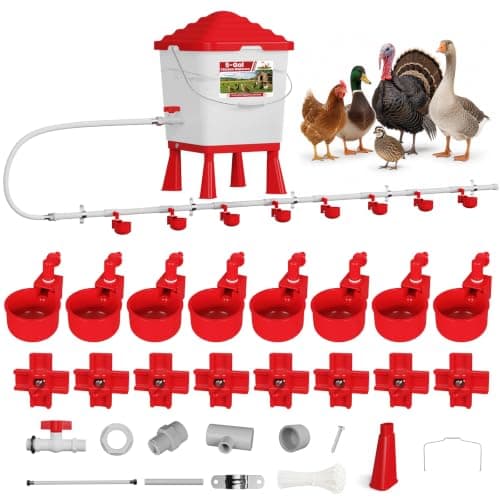
A large reservoir behind closed drinking points answers the first and third of those together, which is why the pipeline system is the first pick rather than a bigger fount.
Feed: easier, with one caveat
Feed capacity is genuinely straightforward — at a third of a pound per hen per day, a 40 lb hopper covers six hens for nearly three weeks. The caveat is not capacity, it is who else is eating.
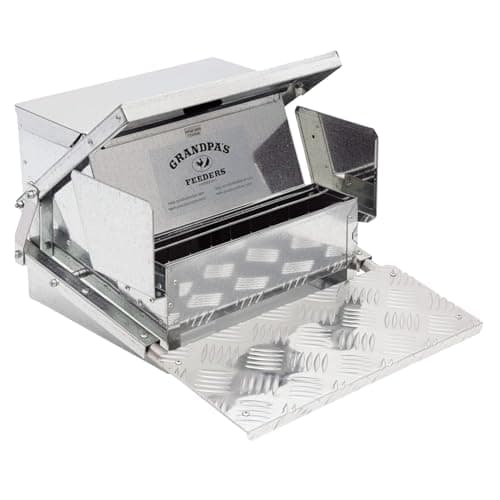
An open feeder left full for a week is a standing invitation. The rats page makes the point that a rodent problem is a feed problem, and an unattended week is exactly how a feed problem becomes a rodent population. A treadle feeder closes between visits, which is its real argument here — the treadle feeder roundup covers the mechanism and the training period, and the Grandpa’s review checks one maker’s capacity claim against the published intake figures.
The door, which is the part gear is genuinely for
Feed and water scale with capacity: buy a bigger container and you have bought more days. Dawn and dusk do not scale. They happen on a schedule, and a coop that stays shut at dawn is a coop full of birds with no access to the run, while a coop that stays open at dusk is an open invitation all night.
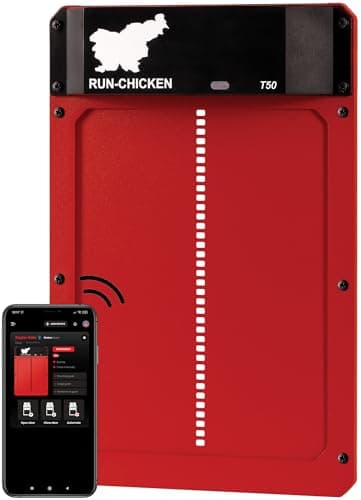
This is the one task where an automatic door is doing something no amount of capacity can do, and it is the reason it sits on this page alongside two containers. The door roundup ranks them on published specifications, and the head-to-head covers the differences that matter.
What each trip length actually needs
Planning by duration. Assumes mild weather; heat moves everything one row down.
Away for
What it needs
What to check before you go
1 to 2 nights
Nothing special. Fill everything, shut the coop securely
That the fill is genuinely full, and that the run is secure without you walking it
3 to 4 days
Two waterers in different places, a feeder with real capacity, an automatic door
Nest boxes - eggs will accumulate, and accumulated eggs get broken and then eaten
A week
All of the above, sized by the arithmetic above, plus somebody checking once mid-week
The weather forecast, specifically the high. Heat changes the water figure by 3 to 4 times
More than a week
A person, visiting. This is not a gear problem any more
That they know what normal looks like, so they can tell you when it is not
The egg point in the middle row is worth drawing out because it is the one people do not anticipate. Eggs left in the nest for days get stepped on, and a broken egg in a nest is the published starting point for egg eating — which is very hard to stop once it starts. If you are away more than about three days in lay, somebody collecting is doing more than a favor. Roll-out nest boxes are the hardware answer, since the egg leaves the nest the moment it is laid.
What to tell whoever comes
A neighbor who has never kept chickens can do this competently with a short list, and most of the risk is in what they do not know to look at.
Water first, every visit. Not topped up — looked at. Is it clean, is it flowing, is the reservoir going down?
Count the birds. Every visit, out loud. It is the only check that catches a problem on the day it happens.
Collect the eggs. Even if they keep them. The egg handling page covers storage, and the short version is to leave them unwashed.
Confirm the door did what it should. Shut at dusk, open at dawn. A door that failed is the single highest-consequence thing that can go wrong.
One sentence on what “wrong” looks like. A bird sitting apart, fluffed up and not moving with the others. That is the observation that actually needs a person.
Heads up: some links on this page are affiliate links. If you buy through one we may earn a commission at no extra cost to you. It never changes a ranking, and we take no payment for placement. The full version.
The picks
The three-day kit, and the week kit
Water capacity first because it is the binding constraint, then feed capacity, then the door - which is the one job nobody can do remotely and the one a person has to come for otherwise.
Five gallons behind sixteen closed drinking points, which is the only shape of waterer that answers the question this page is about — capacity the birds cannot foul and you do not have to be present to refill.
Double the capacity of the standard feeder for the same mechanism and the same 24-month guarantee — the version to buy if you ever want to leave the flock for a week.
An aluminum, powder-coated door that runs a published year on two AA cells and reverses itself when it meets resistance — the whole unit, not an opener bolted to a door you supply.
Four nipples and a bucket you already own, which is the cheapest way to end the open-water problem for good and is rated by the maker at three chickens per nipple.
#ad We have no verified Amazon listing for this one, so no number is shown. How this is funded.
FAQ
Questions people actually ask
+How long can chickens be left alone?
Two to three days is comfortable with ordinary equipment, a week is possible with planning and a mid-week check, and beyond that you need somebody visiting. The binding constraint is water rather than feed: Mississippi State Extension publishes that a bird can survive for weeks without feed but only a few days if water is not available.
+How long can chickens go without water?
Mississippi State Extension publishes that a bird can survive only a few days if water is not available, against weeks without feed. That is a survival figure rather than a target - condition and laying suffer long before it, and a hen that cannot drink for a day typically stops laying. Treat it as the outer wall of a margin, not a budget.
+How long can chickens go without food?
Weeks, on the published figure, and that is not the number to plan around. Mississippi State Extension's point in publishing it is the contrast with water, which runs out in days. In practice feed capacity is the easy half of leaving a flock: at a third of a pound per hen per day, a 40 lb feeder covers six hens for nearly three weeks.
+How much water do chickens need per day?
Roughly twice the weight of what they eat, which is the ratio Mississippi State Extension publishes. At a feed intake of a quarter to a third of a pound per hen per day, that is about half to two-thirds of a pound of water per hen daily, or about 3.4 gallons for six hens over a week. In extreme heat the same source says intake may triple or even quadruple.
+Can I leave my chickens alone for a week?
Yes, with the water sized properly and somebody looking in once mid-week. Six hens need about 14 lb of feed and 4.5 gal of water for seven mild days, with more capacity than that for margin. Two waterers in separate places rather than one large one, a feeder that closes, an automatic coop door, and a check on the forecast - heat multiplies the water requirement by three or four.
+What is the best automatic waterer for leaving chickens?
One with real reservoir capacity behind closed drinking points, rather than a bigger open fount. An open container fouls with bedding and droppings within a day, which is the problem nobody is there to fix. A five-gallon system feeding cups or nipples covers six hens for well over a week in mild weather and cannot be fouled from above.
+What happens to the eggs if I am away?
They accumulate, get stepped on, and that is a problem. A broken egg in a nest is the published starting point for egg eating, which is difficult to stop once a hen has learned it. Past about three days in lay, somebody collecting is doing more than a favor - or fit roll-out nest boxes, which take the egg out of the nest the moment it is laid.
+Do I need an automatic coop door if I go away?
It is the one job that cannot be solved with capacity. Feed and water scale - buy a bigger container and you have bought more days. Dawn and dusk happen on a schedule regardless, and a coop left open overnight is the highest-consequence failure on the list. If a trip means somebody driving over twice a day purely to open and close a door, the door pays for itself quickly.
Where the numbers came from
Sources
Every figure cited on this page came from one of these documents. If one of them has changed since we read it, the number here is out of date and we would like to know.
Grandpa's treadle feeder reviewed on published figures: the 6-hens-for-10-days claim checked against extension feed intake, and the 500 g vs 900 g treadle weight that decides the size.
The published order is shade, water, ventilation. What to buy for each, the signs of heat stress in severity order, and the CFM arithmetic that rules a fan out of most coops.