Rats come for the feed. Remove access to it — a treadle feeder that closes when no bird is standing on it, feed stored in a sealed container rather than its sack, and nothing left out overnight — and the population loses its reason to be there. Killing rats while the food source remains is an ongoing job with no end.
This is one of the few measured keywords in this whole category, which tells you people search for it, and most of what they find is about killing rats. That is the second thing to do and it does not work well while the first thing is undone.
Why they came
A rat needs food, water and somewhere to nest. A backyard chicken setup supplies all three: an open feeder or spilled grain, a waterer, and a raised coop with a dry space underneath. It is close to ideal habitat, and rats find it quickly.
They are not there for the chickens. Adult chickens are not prey for a rat, and a healthy flock will kill and eat a young one given the chance. Rats will take eggs and will very occasionally take a chick, but that is opportunism rather than the reason they came.
Which is genuinely good news, because it means the problem has a solution that does not involve an arms race.
The three changes
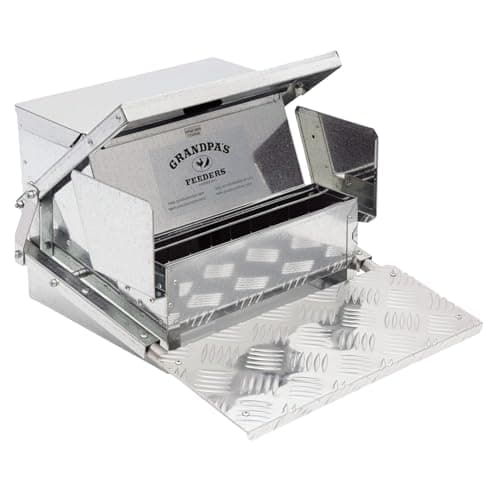
A feeder that is closed at night. This is the largest single change. A treadle feeder holds the lid shut unless a bird of sufficient weight is standing on the plate, so at 2 a.m. it is a closed metal box. Grandpa’s publishes that its cantilevered lid prevents access by sparrows, rats and mice — on the mechanism that they are too light to open it, which is why the published treadle weight matters as much as the lid. Note the published two-week training period — the treadle page covers it — during which feed is still accessible, so plan the switch for a time you can also lock feed away overnight.
Feed in a sealed container, not its sack. Rodents follow smell before they look for a way in. A threaded, gasketed container removes the invitation. See feed storage. If you already have an established population, use a galvanized metal can with a locking lid rather than plastic.
Nothing left out overnight. Not treats, not scratch, not spilled feed. Sweep up. This is the free one and it is the one people skip.
Making the structure less attractive
Close in the space under a raised coop, or raise it high enough that nothing wants to nest under it. Half-inch hardware cloth does this and doubles as predator-proofing.
Half-inch hardware cloth on every opening. A young rat gets through a surprisingly small gap; a mouse gets through a much smaller one.
Clear cover near the coop. Woodpiles, long grass and stacked pallets are cover for the route in. Rats dislike crossing open ground.
Do not store feed in the coop. It draws them into the structure you least want them in.
Why it matters beyond the nuisance
Rats eat a meaningful quantity of feed, which you are paying for. They gnaw structures and wiring. They will take eggs. And they carry disease that can affect both birds and people, which is the reason this sits on the health hub rather than the feeding one.
A small population becomes a large one quickly. That is the argument for acting on the first droppings rather than waiting to see whether it is a problem.
On poison, and traps
We are going to be careful here because this is where advice gets people into trouble.
Rodenticides in a chicken run are a genuinely bad idea. Chickens will eat bait. Secondary poisoning affects the owls, hawks and cats that would otherwise be helping you. And a poisoned rat dying inside a coop wall is its own problem. If you use bait at all it belongs in tamper-resistant stations well away from the birds, and many people conclude it is not worth it.
Snap traps work, in enclosed boxes the birds cannot reach, sited along walls where rats travel. They are labor rather than a solution, and they only keep up if the food source has already been removed.
The order matters and it is the whole point of this page: remove the food first. Trapping into an unlimited food supply is a permanent part-time job.
Heads up: some links on this page are affiliate links. If you buy through one we may earn a commission at no extra cost to you. It never changes a ranking, and we take no payment for placement. The full version.
The picks
The three things that remove the food source
A feeder that closes overnight, a container that does not smell, and the mesh that keeps them out of the structure.
Grandpa's Feeders
Standard Automatic Chicken Feeder, 20 lb
20 lb, 6 birds for 10 days
Best for: Six birds and a rodent problem
A galvanized treadle feeder that publishes exactly what it does — 20 pounds, six chickens, ten days, three to four birds eating at once — and a two-week training schedule that tells you it will not work on day one.
A food-grade HDPE drum with a threaded double-gasket lid that swallows a whole 40 lb sack — the container that ends the rodent argument by removing the smell rather than the rodents.
#ad We have no verified Amazon listing for this one, so no number is shown. How this is funded.
Score8.1no photo yet
Galvanized hardware cloth
1/2 in mesh, 19 gauge
1/2 in mesh, 19 ga
Best for: The only mesh that actually excludes predators
Half-inch welded mesh in 19 gauge steel — not chicken wire, which keeps chickens in and keeps nothing out, and is the single most expensive mistake a first-time keeper makes.
#ad We have no verified Amazon listing for this one, so no number is shown. How this is funded.
FAQ
Questions people actually ask
+Do backyard chickens attract rats?
Chicken feed attracts rats. The birds themselves are not prey for a rat, and a healthy flock will kill and eat a young one given the chance. Rats come for accessible feed, spilled grain and water, and a dry nesting space under a raised coop — which is why removing the food source is what actually works.
+How do I get rid of rats around my chicken coop?
Remove the food first: a treadle feeder that closes when no bird is on the plate, feed stored in a sealed container rather than its sack, and nothing left out overnight. Then close in the space under a raised coop, cover openings with half-inch hardware cloth and clear cover nearby. Trapping only keeps up once the food is gone.
+Can I use rat poison near chickens?
It is a poor idea. Chickens will eat bait, secondary poisoning affects the owls, hawks and cats that would otherwise help, and a rat that dies inside a coop wall becomes its own problem. If bait is used at all it belongs in tamper-resistant stations well away from the birds.
+Will rats hurt my chickens?
Adult chickens are not at risk from rats, but rats will take eggs and can occasionally take a very young chick. The larger concerns are the feed they consume, the structures and wiring they gnaw, and the disease they can carry — which is why it is worth acting on the first droppings rather than waiting.
Where the numbers came from
Sources
Every figure cited on this page came from one of these documents. If one of them has changed since we read it, the number here is out of date and we would like to know.
Grandpa's treadle feeder reviewed on published figures: the 6-hens-for-10-days claim checked against extension feed intake, and the 500 g vs 900 g treadle weight that decides the size.