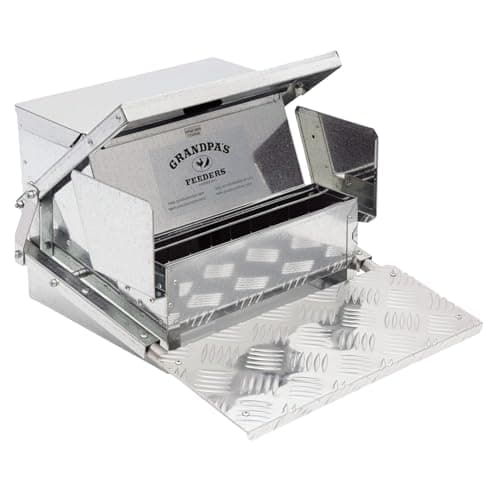
Grandpa's Feeder review: the capacity claim, checked
A galvanized treadle feeder that shuts when no bird is standing on it. Its maker publishes more numbers than anyone else in the category — including the one that decides whether your birds can open it at all, which is buried in the FAQ and converted wrong.
The Grandpa’s feeder is a galvanized treadle feeder whose lid stays shut unless a bird of sufficient weight is standing on the plate. Its maker publishes more checkable figures than anyone else in this category, and this review checks them: the “6 hens for 10 days” claim survives extension feed-intake arithmetic, and the figure that actually decides your purchase — 500 g of bird for the standard feeder, 900 g for the large — is published only in the FAQ, with an imperial conversion that does not match its own metric.
We have not used one. This review reads what Grandpa’s publishes on its standard and large product pages and in its FAQ, and tests the claims that can be tested with arithmetic. The mechanism itself, the training period and the general bantam problem are covered on our treadle feeder roundup; this page is about whether the specific product delivers what its own numbers promise.
What Grandpa's publishes, both sizes
Grandpa's Feeders product pages and FAQ, read 2026-09-19.
Standard
Large
Feed capacity
9 kg / 20 lb
18 kg / 40 lb
Published duty
6 hens for 10 days
12 hens for 10 days
Eating at once
3 to 4 chickens
4 to 5 chickens
Dimensions
43 x 51 x 29 cm (17 x 20 x 11.5 in)
55 x 63 x 40 cm (22 x 25 x 16 in)
Empty weight
6.7 kg (15 lb)
10.5 kg (23 lb)
Minimum bird weight
500 g
900 g / 2 lb
Materials
Galvanized finish, aluminum tread plate
Galvanized finish, aluminum tread plate
Training
2 bolts, 2 settings, one week each
2 bolts, 2 settings, one week each
Warranty
24-month 100% money-back guarantee
24-month 100% money-back guarantee
The capacity claim, checked
This site exists largely because manufacturers’ capacity claims usually do not survive arithmetic. Coop makers are the worst offenders — the space-per-bird page is a catalog of “fits six hens” boxes that fit three. So it is worth saying plainly when a claim does survive, and this one does.
Mississippi State Extension publishes the input: “An average laying hen will consume about 1/4 to 1/3 pound of feed per day depending on weather conditions, size of the bird, and level of productivity.” Run Grandpa’s duty figures against both ends of that range.
Two honest caveats. The arithmetic assumes laying hens; growing birds and a cold snap both push intake up, and the extension figure names weather as a variable. And a hopper that is technically large enough is not the same as one you should run to empty — if you are away for the full ten days, you are betting on the top of the range being right.
The number that actually decides your purchase
Everything above is about feed. The figure that decides whether the feeder works at all is bird weight, and it is the one Grandpa’s buries. It is not on either product page. It is in the FAQ: “A standard chicken feeder requires 500grams/14oz and a large chicken feeder requires 900grams/2lb.”
Read that twice, because the two halves of the standard figure do not agree. 500 g is 17.6 oz, not 14 oz — the published imperial conversion is about a quarter light. Elsewhere in the same FAQ the threshold appears again as “500gms/1lb”, and 500 g is 1.1 lb, so that one is close. If you are weighing a bird to decide, use the gram figure: it is the one that is internally consistent across both models, and the large model’s “900grams/2lb” converts correctly.
That workaround deserves a note of its own, because it is not free. The treadle threshold is the entire pest-exclusion mechanism: Grandpa’s sells it on the basis that rats, mice and wild birds “are too light to open the feeder.” Weighting the plate lowers the force a bird needs, and it lowers the force anything else needs at the same time. It is a legitimate fix for a flock that cannot quite work the lid. It is also a partial surrender of the reason you bought a treadle feeder.
What it does about rats, and what it does not
The pest claim is the reason most people buy this feeder, and it is worth being precise about its scope. Grandpa’s publishes that the “cantilevered lid prevents access by sparrows, rats, mice, and other pests”, on the mechanism that they are too light to open it. A closed lid overnight removes the single largest food source in most runs, which is why our rats and rodents page puts a treadle feeder first among the fixes.
What it does not do is deal with feed that is already on the ground. Chickens feed by scratching and some spillage is inherent; a rat population living on spilled grain around the feeder is not evicted by a lid. Nor does it touch the other two attractions that page names — standing water and a dry space under a raised coop. The feeder closes one door, and it is the biggest one. It is not the whole job.
There is also a gap during training. The published procedure is two weeks, and for those two weeks the lid is propped open by design. If the old open feeder stays in the run alongside it, the rodent problem continues for a fortnight after you have paid to solve it.
Which size, on the numbers
The obvious reading is birds: six or fewer, standard; more than that, large. Two published considerations complicate it.
Feed sitting in the hopper. Our feed storage page puts feed’s shelf life at weeks to a couple of months. A small flock under a large hopper is the case to watch: three hens at the low end of the extension range eat 0.75 lb a day, so 40 lb is more than fifty days of feed standing in an outdoor container. Buying the larger model “to refill less often” with a small flock trades freshness for convenience.
It is not a thing you move. The standard is 15 lb empty and 35 lb full. The large is 23 lb empty and over 60 lb full — this is a fixed installation you site once, and Grandpa’s revised the large model’s published dimensions and weight upward from what we previously recorded, so measure the spot before ordering: 22 by 25 inches of footprint is a lot of run floor.
What Grandpa's does not publish
The documentation is unusually good for this category, which makes the remaining gaps worth naming rather than glossing.
Steel gauge. A galvanized finish described as “high quality”, over “sturdy metal construction”, is a description rather than a thickness. Nothing on either page lets you compare it with a competitor on material.
Where it is made now. The FAQ says the feeder was “designed and created in New Zealand in 1994”. Current country of manufacture is not stated.
What the guarantee covers in practice. The term is a 24-month “100% money-back guarantee against defects in the equipment”, which is longer than most of this category offers. Who pays return shipping is not published.
Weatherproofing, stated two ways. The FAQ says the feeder is “weather proof” and, separately, “waterproof”. We would still site it under cover, because the issue is not whether the housing survives rain but whether the feed in the trough stays dry.
Heads up: some links on this page are affiliate links. If you buy through one we may earn a commission at no extra cost to you. It never changes a ranking, and we take no payment for placement. The full version.
The picks
The two sizes, and which one your flock can actually open
Same mechanism, same guarantee, and two published figures that decide between them: how much feed sits in the hopper, and how heavy a bird has to be to work the treadle.
Grandpa's Feeders
Standard Automatic Chicken Feeder, 20 lb
20 lb, 6 birds for 10 days
A galvanized treadle feeder that publishes exactly what it does — 20 pounds, six chickens, ten days, three to four birds eating at once — and a two-week training schedule that tells you it will not work on day one.
Double the capacity of the standard feeder for the same mechanism and the same 24-month guarantee — the version to buy if you ever want to leave the flock for a week.
On published figures it is the best-documented treadle feeder in the category, and its capacity claim holds up: six hens for ten days needs 15 to 19.8 lb of feed at Mississippi State Extension's published intake of 1/4 to 1/3 lb per hen per day, against a 20 lb hopper. We have not used one. The things to check first are bird weight and siting, not the hopper.
+How heavy does a chicken need to be to open a Grandpa's Feeder?
Grandpa's FAQ publishes 500 g for the standard feeder and 900 g for the large. Note the imperial conversion in the FAQ is inconsistent: it prints 500 g as 14 oz, but 500 g is 17.6 oz. Standard laying breeds clear both thresholds easily; bantams and very light birds are the edge case, and the large model needs nearly twice the weight of the standard.
+Will a Grandpa's Feeder work with bantams?
The standard model is the one to consider, because its 500 g threshold is much lower than the large model's 900 g. Grandpa's lists bantams among the birds it suits and offers a fix for birds that are too light: put a small weight on the tread plate. That works, but it also lowers the weight needed by anything else, which is the mechanism that excludes rats and wild birds.
+Does a treadle feeder actually stop rats?
It removes the food source they come for, which is the largest single change you can make, and Grandpa's publishes that rats, mice and sparrows are too light to open the lid. It does nothing about feed already spilled on the ground, standing water, or a dry harborage under a raised coop. Treat it as the first fix rather than the only one.
+How long does it take to train chickens to use it?
Grandpa's publishes two weeks: two training bolts giving two settings, one week on each. The first setting props the lid open so birds learn to stand on the plate; the second lets it move under them. Then the bolts come out. Plan for the old feeder to be removed at the end of that fortnight, not before.
+Grandpa's Feeder 20 lb or 40 lb?
Six or fewer standard-breed birds, the 20 lb. More than that, the 40 lb. Two caveats: the large needs 900 g of bird against the standard's 500 g, so light flocks should stay with the standard; and a small flock under a 40 lb hopper can leave feed standing for over fifty days, against a shelf life measured in weeks. The large is also 23 lb empty with a 22 by 25 inch footprint.
+Does the Grandpa's Feeder have a warranty?
Yes, a 24-month 100% money-back guarantee against defects in the equipment, which is longer than most of this category publishes. Who pays return shipping is not stated.
Where the numbers came from
Sources
Every figure cited on this page came from one of these documents. If one of them has changed since we read it, the number here is out of date and we would like to know.