How to stop chickens eating eggs, using the published figures
It is a learned habit, it starts with breakage, and an extension service publishes a number for every one of the five things that prevent it. Including the one nobody wants to read.
Stop the breakage and you stop the habit. Penn State Extension publishes that “egg breakage is a major reason why hens start eating eggs,” and the five fixes all have figures attached: 2 inches of nesting material at all times, one 12 by 12 inch nest per 4 to 5 hens, nests at least 2 feet off the ground and 4 feet from the roosts, no bright lights near the nesting area, and collection early because “most hens will lay before 10:00 a.m.”
Egg eating is not a vice a hen is born with. It is something she learns, in one moment, when an egg breaks in the nest and she discovers what is inside. That is why the published advice is overwhelmingly about prevention rather than cure — and why the cure, when you get to it, is bleak.
Penn State Extension puts the difficulty plainly: once the habit is established it is “extremely difficult, if not impossible, to break.” So the useful version of this page is the five things that stop the first egg breaking, each of which has a published number rather than a folk rule.
The five published fixes
Each published fix and the figure attached to it. Source: Penn State Extension, Prevention of Egg Eating in Chickens (Phillip Clauer).
Fix
Published figure
What it prevents
Nesting material
2 in of clean, dry material at all times
The egg breaking on a hard floor
Nest count and size
One 12 x 12 in nest per 4 to 5 hens
Crowding, and laying on top of another egg
Nest height
At least 2 ft off the ground
Eggs rolled out and dropped
Nest position
At least 4 ft away from the roosts
Roosting in the nest, and fouled bedding
Collection timing
Early; most hens lay before 10 a.m.
An egg sitting under a bored flock all day
1. Padding, because breakage is the trigger
This is the fix that does the most work and gets the least attention. Penn State is specific about the mechanism: “Many eggs are cracked due to a lack of protective padding in nesting boxes,” and the instruction is to keep 2 inches of clean, dry nesting material in the nests at all times.
The words “at all times” are the hard part. Loose shavings get scratched into a corner within a day and the hen is then laying onto bare plastic or wood. That is precisely the condition the figure is meant to prevent, and it is why a fitted nest pad outperforms loose bedding here — not because it is more comfortable but because it is still there tomorrow.
2. Take the egg out of sight
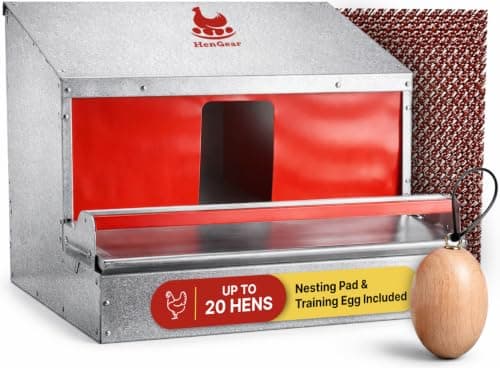
If the egg is not in the nest, it cannot be pecked, broken or eaten. A sloped-floor roll-away box moves the egg into a covered collection tray within seconds of being laid. It is the only fix on this page that works even after the habit has started, because it removes the opportunity rather than the motivation.
The honest downside: roll-away boxes must be mounted genuinely level or the eggs do not roll, and they are considerably more expensive than a wooden box with a pad in it. They also need the collection tray checked — an egg that rolls away is out of sight from you as well as from the hen. The roll-out comparison covers the mounting requirement in detail.
3. Fix the shell, not just the nest
A thin shell breaks in a nest that would not have broken a good one. Penn State’s instruction is specific and is the opposite of what people usually do: provide “free-choice oyster shells or limestone as a calcium supplement” and “do not mix extra calcium directly into the feed.”
Free-choice means a separate dish the hens go to when they need it. Mixing calcium into the feed forces it on every bird including pullets and any rooster, which is a burden on birds that are not forming shells. Grit and oyster shell explains why the two get confused and why only one of them is calcium.
4. Darken the nest
Penn State: “Don’t use bright lights in your coops, especially near the nesting area. Bright light increases nervousness and picking habits.” This costs nothing. Move the boxes to the darkest wall, or hang a curtain across the front — the commercial roll-away boxes ship with vinyl curtains for exactly this reason.
5. Collect early, not just often
The published detail is more useful than “collect often”: “Collect eggs often and early in the day. Most hens will lay before 10:00 a.m. each morning.” A single mid-morning collection therefore removes most of the day’s eggs before the flock has had all afternoon to investigate them. If you work away from home, that one check before you leave is worth more than three in the evening.
Where the published guidance disagrees with itself
This site uses University of Maryland Extension’s nest box figures throughout, and on two points Penn State says something different. Both are extension services, both publish, and we are not going to pretend the difference is not there.
Two extension services, two figures, same question.
Question
Univ. of Maryland Extension
Penn State Extension
How many nests
One per 4 to 5 birds
One per 4 to 5 hens, but never fewer than 4 boxes
How high
18 to 20 in off the floor
At least 2 ft (24 in) off the ground
Distance from roosts
Not specified
At least 4 ft away
The nest-count difference matters most. For a flock of six, UMD’s ratio gives two boxes; Penn State’s floor gives four. Our reading is that the Penn State minimum is written for flocks where egg eating is already a concern and redundancy is cheap insurance, while the UMD ratio describes normal use — and our own observation, stated on the nest box page, is that hens converge on one favorite box regardless of how many you provide. If you have an egg-eating problem specifically, follow Penn State and add boxes. Otherwise the ratio is enough.
The uncomfortable part: a hen who already does it
Penn State does not hedge: “If you do catch an egg eater, cull her from the flock at once. Egg eating is a bad habit that will multiply the longer you let it continue.”
That is a hard sentence for somebody keeping six birds with names, and we are not going to soften it into something it does not say. What is worth adding is the reason: the behavior spreads by observation. One hen eating eggs in front of the flock teaches the flock.
Before acting on it, be sure you have the right bird and that it is actually happening — a broken egg in a nest is evidence of breakage, not of eating. The roll-away box is the diagnostic as well as the fix: if eggs stop disappearing once they roll out of reach, the problem was a bird. If they were never being eaten, you have simply solved the breakage.
Heads up: some links on this page are affiliate links. If you buy through one we may earn a commission at no extra cost to you. It never changes a ranking, and we take no payment for placement. The full version.
The picks
One product per published cause
Padding so the egg does not break, a box that takes the egg out of sight if it does, and free-choice calcium so the shell was strong enough in the first place.
Precision Pet
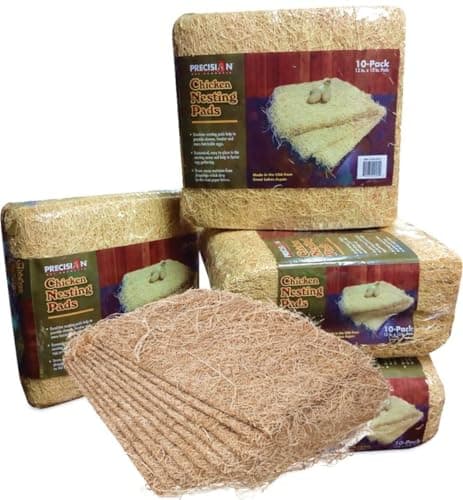
Chicken Nesting Pads (Excelsior)
13 x 13 in
Aspen excelsior fibers on a kraft-paper backing at a standard 13 by 13 inches, which is the size nearly every nest box is built around and the reason these are the default.
Thirty-three to thirty-eight percent calcium in a crushed form, offered free-choice — the supplement that fixes thin shells and the one most first-time keepers confuse with grit.
#ad We have no verified Amazon listing for this one, so no number is shown. How this is funded.
FAQ
Questions people actually ask
+Why are my chickens eating their eggs?
Almost always because one broke. Penn State Extension publishes that egg breakage is a major reason hens start eating eggs — a hen finds a cracked egg, discovers what is inside, and repeats it. Thin shells from insufficient calcium and nests without enough bedding are the two conditions that make that first breakage likely.
+How do I stop chickens eating eggs?
Remove the trigger and the opportunity. Keep 2 inches of clean, dry nesting material in the nests at all times, provide free-choice oyster shell rather than mixing calcium into the feed, keep nests dark and at least 2 feet off the ground, collect early because most hens lay before 10 a.m., and fit roll-away boxes so a laid egg moves out of reach within seconds.
+Do roll-away nest boxes stop egg eating?
They are the only fix that works after the habit is established, because they remove the opportunity rather than the motivation — the egg rolls into a covered tray seconds after being laid. They have to be mounted genuinely level or the eggs do not roll, and they cost considerably more than a wooden box with a pad in it.
+Will more calcium stop my hens eating eggs?
It addresses one of the two causes, by making shells strong enough not to break. Penn State Extension is specific about how: provide free-choice oyster shells or limestone as a separate supplement, and do not mix extra calcium directly into the feed, because that forces it on pullets and roosters that are not forming shells.
+Do I have to cull a chicken that eats eggs?
Penn State Extension says to cull a confirmed egg eater at once, on the grounds that the habit spreads through the flock by observation and becomes extremely difficult to break. That is the published guidance and we are not going to soften it. Before acting, confirm you have the right bird — a broken egg is evidence of breakage, not necessarily of eating.
+How many nest boxes prevent egg eating?
The two extension services disagree. University of Maryland Extension publishes one nest per four to five birds, which gives two boxes for a flock of six. Penn State publishes the same ratio but adds a floor of never fewer than four boxes. If egg eating is already a problem, follow the higher figure; otherwise the ratio is enough, because hens converge on one preferred box regardless.
Where the numbers came from
Sources
Every figure cited on this page came from one of these documents. If one of them has changed since we read it, the number here is out of date and we would like to know.