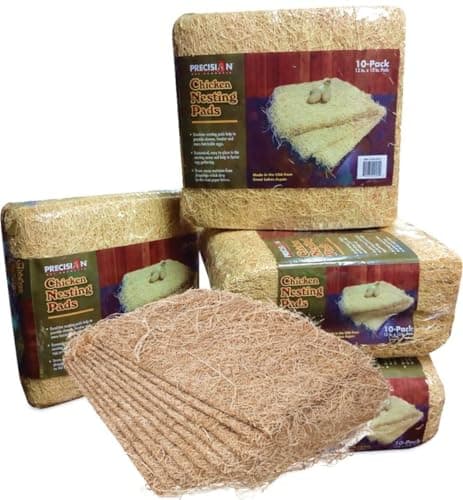
Excelsior nest pads at the standard 13 by 13 inch size are aspen wood fibers bonded to a kraft-paper backing. The backing is the point: it holds the pad together so a hen cannot scratch it into a corner, which is what happens to loose shavings within a day.
Why loose bedding fails in a nest specifically
Nest-building is instinctive. A hen entering a box turns around, scratches material toward herself, and shapes a hollow. Repeated by several hens several times a day, loose shavings end up piled at the back or pushed out the front, and the middle of the box — where the egg lands — is bare.
The consequences are exactly the ones people complain about. Eggs land on wood and crack. Eggs sit in the accumulated dust rather than on clean material and come in dirty. And a cracked egg is how egg eating starts.
Coop floor bedding does not have this problem, because the birds are not deliberately rearranging it into a shape. It is a nest-specific failure and it wants a nest-specific answer.
What a pad is
Aspen excelsior — long, curled wood shavings — bonded to a kraft-paper backing. Around three quarters of an inch thick, and made to a de facto standard 13 by 13 inches, which is why almost every nest box on the market takes one without trimming.
The backing is what makes it work. A hen can shape the surface fibers into a hollow, which is what she wants, without dismantling the pad and exposing the floor. It stays a pad.
They are consumable: you lift the dirty one out and drop a fresh one in, which takes seconds and is the reason nests actually get cleaned rather than intended to be. That is also the drawback — it is a recurring cost that a bag of shavings is not.
The alternatives
Nest box bedding options.
Option
Stays put?
Best for
Drawback
Excelsior pads, 13 x 13 in
Yes, held by the backing
The default; fits nearly every box
Consumable, recurring cost
Pine shavings, deep
No, but a deep layer takes longer to fail
Cheap and available; top up frequently
Scratched flat within a day or two
Straw
Partly — it interlocks better than shavings
Warmth in winter; cheap
Poor absorbency; hollow stems can harbor mites
Hay-and-straw blend with zeolite
Partly
Ammonia control in a small coop
Costs more; holds moisture differently
Artificial nest liners
Yes
Reusable, washable
Have to actually be washed, which people do not
How often to change them
Whenever they are visibly soiled, and always after a broken egg. A broken egg in a nest is not just mess: it is the thing that teaches a hen what is inside an egg, and leaving the residue there is an invitation to find out again. Change the pad, do not just scrape it.
Beyond that, a monthly change in normal use is a reasonable rhythm, more often in wet weather when birds bring mud in.
What nobody publishes
Not one maker in this category publishes a durability figure, an absorbency figure or a dust rating for nest pads. Dimensions and material are the extent of it. That is why these score moderately on documentation in our rubric despite being a genuinely good product — there is very little to check.
Heads up: some links on this page are affiliate links. If you buy through one we may earn a commission at no extra cost to you. It never changes a ranking, and we take no payment for placement. The full version.
The short answer
The short list
Ranked on the published rubric. Every row jumps to that product's full write-up below; the button goes straight to Amazon.
#
Pick
Best for
Key spec
Score
Price
1
Our pick
Precision Pet
Chicken Nesting Pads (Excelsior)
Aspen excelsior fibers on a kraft-paper backing at a standard 13 by 13 inches, which is the size nearly every nest box is built around and the reason these are the default.
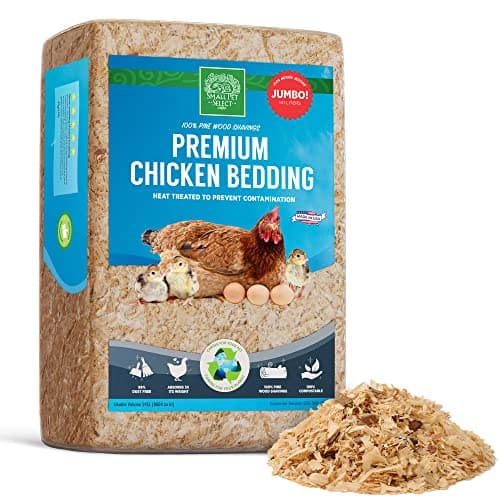
Ordinary pine shavings with an unusual claim attached: triple-screened to 99 percent dust-free, which is the one bedding spec that matters in an enclosed brooder.
Chopped hay and straw with zeolite already blended in, and the only bedding here that publishes its coverage — 63 square feet at two inches, which is a number you can divide by your coop.
#adPrices as of October 18, 2026. Scores are our own published rubric, not customer ratings.
#1 · A nest that stays put
Precision Pet Chicken Nesting Pads (Excelsior)
Aspen excelsior fibers on a kraft-paper backing at a standard 13 by 13 inches, which is the size nearly every nest box is built around and the reason these are the default.
Who it is for. Anybody collecting dirty or cracked eggs, and anybody who finds the nest bedding kicked into a corner every morning.
Published specifications
Dimensions
13 in x 13 in
Material
Aspen excelsior wood fibers adhered to a kraft paper backing
Thickness
Approximately 3/4 in (varies by brand and reporting)
Fit
Designed to fit most nesting boxes
Source: Precision Pet / Petmate and Pecking Order excelsior nesting pad product listings, retrieved 2026-09-01
Rubric — 7.1 / 10
Capacity honesty8/10 · weight 26%
Documentation5/10 · weight 24%
Build and weather7/10 · weight 20%
Running cost6/10 · weight 15%
Daily use10/10 · weight 15%
What it gets right
13 by 13 inches is the de facto standard nest-box footprint, so a pad drops in without cutting
The kraft backing means the pad stays as a pad instead of being scratched into a corner within a day, which is what loose shavings do
Aspen excelsior is springy enough to cushion an egg falling six inches, which is the difference between a cracked egg and a whole one
Lifting one pad out and dropping a new one in takes seconds, so nests actually get cleaned
What it costs you
Consumable — you replace them rather than clean them, so this is a recurring cost that loose bedding is not
Nobody in this category publishes a durability figure, so how long a pad lasts is anybody's guess
A 13 inch pad in a larger community nest box leaves gaps at the edges
Skip it if. Your hens lay reliably on clean shavings and nothing is getting broken or dirty. Pads solve a problem you may not have.
Ordinary pine shavings with an unusual claim attached: triple-screened to 99 percent dust-free, which is the one bedding spec that matters in an enclosed brooder.
Who it is for. Brooders, nest boxes and any coop where a bird has shown respiratory trouble.
Published specifications
Composition
100% natural pine shavings; no dyes, additives or irritants
Dust
Triple-screened to be 99% dust-free
Bag volume
141 liter expanded capacity
Origin
Made in the USA from sustainably sourced material
Source: Small Pet Select, Pine Shavings Chicken Bedding product listing, retrieved 2026-09-01
Rubric — 7.4 / 10
Capacity honesty8/10 · weight 26%
Documentation7/10 · weight 24%
Build and weather7/10 · weight 20%
Running cost6/10 · weight 15%
Daily use9/10 · weight 15%
What it gets right
A published dust figure, which almost no bedding brand states at all — and dust is the specific hazard in a small enclosed brooder
Volume published in liters expanded, so you can compare bags rather than guess from a picture
Pine shavings are the default bedding for good reasons: absorbent, cheap to replace, and they compost
No dyes or additives, which is what you want against a bird's respiratory tract
What it costs you
The 99 percent figure is the maker's own and comes with no published test method
Costs meaningfully more than a farm-store bale of shavings, for a difference you cannot see
No zeolite or odor control, so ammonia management is entirely down to your cleaning schedule
Skip it if. You are bedding a large, well-ventilated walk-in coop. Buy the cheap compressed bales and spend the difference on ventilation.
Chopped hay and straw with zeolite already blended in, and the only bedding here that publishes its coverage — 63 square feet at two inches, which is a number you can divide by your coop.
Who it is for. A small suburban coop where the ammonia smell is a social problem as well as a bird-health one.
Published specifications
Composition
Chopped hays and straw combined with Sweet PDZ odor-neutralizing zeolite
Coverage
Covers 63 square feet at a depth of 2 in
Odor control
Odor-neutralizing natural zeolite
Disposal
Composts; stated as a good addition to a garden or compost bin
Excelsior nest pads at the standard 13 by 13 inch size. Aspen fibers bonded to a kraft-paper backing stay as a pad while still letting a hen shape a hollow, which loose shavings do not — those get scratched into a corner within a day, leaving eggs landing on bare wood.
+How often should I change nesting box pads?
Whenever they are visibly soiled, monthly in normal use, more often in wet weather, and always immediately after a broken egg. Egg residue left in a nest is what teaches a hen what is inside an egg, and that habit is close to incurable once it starts.
+What size are chicken nesting pads?
13 by 13 inches is the de facto standard across brands, roughly three quarters of an inch thick, which is why almost every commercial nest box takes one without trimming. That standard also tells you the working range for a DIY box: 12 to 14 inches square.
+Do herbal nesting pads work?
We have not found published evidence for the parasite-deterrence or calming claims made for herb-infused pads, so we are not going to repeat them. The pads underneath are the same excelsior pads. If you like the smell, that is a perfectly good reason to buy them.
Where the numbers came from
Sources
Every figure cited on this page came from one of these documents. If one of them has changed since we read it, the number here is out of date and we would like to know.