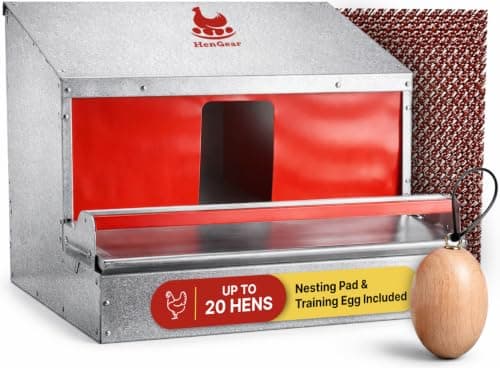
A roll-out box has a sloped floor: the egg is laid, rolls away from the hen and lands in a covered tray she cannot reach. It keeps eggs clean and unbroken, and it removes the opportunity for egg eating — a habit that is close to incurable once a hen has learned it.
The argument that actually matters
Clean eggs are nice. The real reason to consider a roll-out box is egg eating, and it is worth understanding why it is such a serious problem.
A hen cracks an egg by accident — steps on it, or it breaks under another bird — and discovers what is inside. Eggs are highly nutritious and hens are opportunists. Having learned it once, she starts breaking them deliberately. And because chickens learn by watching each other, the rest of the flock picks it up.
There is no reliable cure. The standard advice — collect more often, add more bedding, use fake eggs, isolate the culprit — helps at the margins and frequently does not work. The reliable prevention is removing the opportunity, which is exactly what a sloped floor does: the egg is gone before the hen has finished standing up.
Some of that standard advice does have published figures behind it, and some of it does not. How to stop chickens eating eggs separates the two, using the numbers Penn State Extension attaches to each fix.
How they work
Best Nest Box publishes the mechanism in useful detail: a “precisely sloped floor which allows eggs to roll out or roll away from hens to a separate convenient and protected collection area,” with an “angled metal egg guard to discourage hens from reaching the eggs in collection area.” The nesting area itself uses poultry nest pads, and the entrance has V-shaped vinyl curtains for privacy.
The collection area is reversible — configurable as front or rear roll-out at any time. That is a genuinely practical feature, because it decides whether you collect from inside the coop or from outside it, and that depends on your coop layout rather than the manufacturer’s guess.
The two sizes
Published specifications.
Small 24 in
Medium Extended 36 in
Length
24 in
35-7/8 in
Depth
19.5 in
21 in
Height
20 in
19-3/4 in at highest point
Weight
Not published
34 lb
Stated capacity
Up to 20 hens
Up to 32 hens
Roll-out direction
Reversible, front or rear
Reversible, front or rear
Warranty
Not published
Not published
Both capacity figures are commercial ratings and neither is useful to a backyard flock. The number that matters is the length against your coop wall: 24 inches fits most backyard coops and 36 inches does not.
The requirement people miss
A roll-out box has to be genuinely level side to side, and the slope is built into the floor rather than achieved by tilting the box. Mount it out of level and eggs collect at one end of the tray, roll into each other, and crack — which defeats the entire purpose and is a frustrating way to discover the requirement.
Check it with a spirit level, not by eye, and check it again after the first heavy frost heaves the ground under a coop that sits on soil.
The trade-offs, honestly
They are communal, not individual. Both models here are open nesting areas rather than divided compartments. Some hens prefer an enclosed private nest, and a broody hen in a communal box is disruptive to everybody.
You cannot let a hen brood in one. The eggs roll away. If you ever want a hen to hatch her own, you need a conventional box as well. Read the other way round, that is the feature: a clutch is what triggers setting in the first place, so a box the eggs leave immediately is the one thing that prevents a broody hen rather than treating one.
They are large and heavy for a small flock. Thirty-four pounds and three feet of wall, for six hens, is a lot of nest box.
Neither maker publishes a warranty. On a metal-and-plastic product at this price, that is a real gap.
Heads up: some links on this page are affiliate links. If you buy through one we may earn a commission at no extra cost to you. It never changes a ranking, and we take no payment for placement. The full version.
The short answer
The short list
Ranked on the published rubric. Every row jumps to that product's full write-up below; the button goes straight to Amazon.
#
Pick
Best for
Key spec
Score
Price
1
Our pick
Best Nest Box
Small 24" Reversible Roll-Out Nest Box
The same roll-out mechanism in a two-foot box, which is the version that actually fits a backyard coop rather than a commercial layer house.
A sloped-floor box that rolls the egg away from the hen into a protected tray, which stops the two problems that ruin eggs in a nest box: dirt and the hen that learns to eat them.
Best Nest Box Medium Extended 36" Reversible Roll-Out Nest Box
A sloped-floor box that rolls the egg away from the hen into a protected tray, which stops the two problems that ruin eggs in a nest box: dirt and the hen that learns to eat them.
Who it is for. A flock of eight or more, or anybody who has already lost eggs to a hen that learned what is inside them.
Published specifications
Dimensions
35-7/8 in length, 19-3/4 in tall at the highest point, 21 in depth
Weight
34 pounds
Stated capacity
Accommodates up to 32 hens
Roll-out mechanism
Precisely sloped floor allows eggs to roll away from hens to a separate protected collection area
Egg guard
Angled metal egg guard discourages hens from reaching the collection area
Reversibility
Can be configured at any time as front or rear roll-out
Source: Best Nest Box, Medium Extended 36" Reversible Roll Out Nest Box product page (bestnestbox.com), retrieved 2026-09-01
Rubric — 8.2 / 10
Capacity honesty7/10 · weight 26%
Documentation8/10 · weight 24%
Build and weather9/10 · weight 20%
Running cost8/10 · weight 15%
Daily use10/10 · weight 15%
What it gets right
The roll-out design removes egg-eating as a possibility rather than trying to break the habit later, and egg-eating is close to incurable once it starts
Eggs land on wire in a covered tray rather than in bedding a hen has stood in, so they need washing far less often
Reversible collection means you can mount it against a wall either way round, which is the difference between fitting and not fitting your coop
Published dimensions to an eighth of an inch, so you can check it fits before it arrives
What it costs you
The 32-hen figure is a commercial rating; for a backyard flock the relevant guidance is University of Maryland Extension's one nest per four to five birds, and this is a communal box rather than four nests
Thirty-four pounds and nearly three feet wide is a lot of box for six hens
No published warranty
Roll-out boxes need to be genuinely level, or eggs collect at one end and crack against each other
Skip it if. You have three or four hens in a small coop. This is more nest box than your flock will ever use, and it will not fit.
#ad We have no verified Amazon listing for this one, so no number is shown. How this is funded.
FAQ
Questions people actually ask
+Are roll out nesting boxes worth it?
If egg eating is a risk or already a problem, yes — it is the only reliable answer, because it removes the opportunity rather than trying to break the habit. If your eggs are clean and unbroken and nothing is eating them, it is a preventive purchase for a problem you may never have.
+How do roll out nesting boxes work?
The floor is sloped so a laid egg rolls away from the hen into a separate covered collection tray, protected by an angled metal guard that stops her reaching back in. Best Nest Box's models are reversible, so the collection area can be configured to face front or rear depending on your coop layout.
+Do roll out nest boxes need to be level?
Side to side, yes, and it is the requirement people miss. The slope that moves the egg is built into the floor, so mounting the box out of level makes eggs collect at one end of the tray and crack against each other. Check with a spirit level, and check again after ground frost.
+Can a hen go broody in a roll out nest box?
No, and that is the design working as intended — the eggs roll away before she can accumulate a clutch. If you ever want a hen to hatch her own chicks you need a conventional nest box as well, which is a real consideration for anybody keeping a mixed or heritage flock.
Where the numbers came from
Sources
Every figure cited on this page came from one of these documents. If one of them has changed since we read it, the number here is out of date and we would like to know.