Twelve to fourteen inches square is the working range for standard breeds, which is why nest pads are made to a 13-inch standard. University of Maryland Extension publishes one nest per four to five birds, mounted 18 to 20 inches off the floor and placed on the ground at first until pullets get used to them.
The three numbers
Nest box dimensions and placement.
Measure
Figure
Source
Box footprint, standard breeds
12 to 14 in square
The de facto standard the 13 in nest pad market is built around
Boxes per flock
One nest per 4 to 5 birds
University of Maryland Extension
Mounting height
18 to 20 in off the floor
University of Maryland Extension
Initial placement
On the ground until pullets get accustomed, then secured firmly
University of Maryland Extension
Relative to roost
Always below roost height
Behavioral — hens sleep on the highest surface
We are labeling the box footprint honestly. We could not find a square-inch figure published by an extension service, and rather than repeat one of the several circulating unsourced numbers we are pointing at the thing that is genuinely evidential: the entire nest pad market is standardized at 13 by 13 inches, which tells you what commercial box makers actually build to.
By flock size
Nest boxes needed, at one per four to five birds.
Birds
Boxes at 1 per 4
Boxes at 1 per 5
3
1
1
4
1
1
6
2
2
8
2
2
10
3
2
12
3
3
15
4
3
Depth, lip and the details
Depth. A hen should be able to get fully inside, so the box is at least as deep as she is long. A hen with her tail sticking out of a shallow box tends to push the egg out with it.
Front lip. A raised lip of three or four inches keeps bedding — and eggs — in. Without one, both end up on the coop floor.
Height inside. Enough that a hen can stand and turn. Roughly the same as the footprint dimension works.
Sloped roof. If the box has a flat top at a height birds can reach, they will roost on it and foul the nest below. A sloped top solves this and is worth adding to a DIY box.
Bantams and large breeds
The 12 to 14 inch range is for standard breeds. Bantams are comfortable in a smaller box, around 10 inches, though they will happily use a standard one. Very large breeds — Jersey Giants, Brahmas — genuinely want more, closer to 14 or 15 inches square, and a standard box for a large bird means a cramped hen and dirtier eggs.
If your flock is mixed, build to the largest bird. A small hen in a large box is fine; a large hen in a small box is not.
Why height matters more than it looks
The published 18 to 20 inches is not arbitrary. Too low and the box is at the level of scratched-up litter and gets fouled. Too high and it competes with the roost — and this is the one to watch, because chickens instinctively sleep on the highest available surface. A nest box mounted above the roost bar becomes where they sleep, and a nest box that is slept in is full of droppings by morning.
The rule is simple: nest boxes below the roost, always. If you have a coop where the boxes are high, raise the roost rather than lowering the boxes.
Heads up: some links on this page are affiliate links. If you buy through one we may earn a commission at no extra cost to you. It never changes a ranking, and we take no payment for placement. The full version.
The picks
Boxes that match these numbers
A backyard-sized box, the pads it takes, and the larger version for a bigger flock.
Best Nest Box
Small 24" Reversible Roll-Out Nest Box
24 x 19.5 x 20 in
Best for: A backyard flock that still wants roll-out
The same roll-out mechanism in a two-foot box, which is the version that actually fits a backyard coop rather than a commercial layer house.
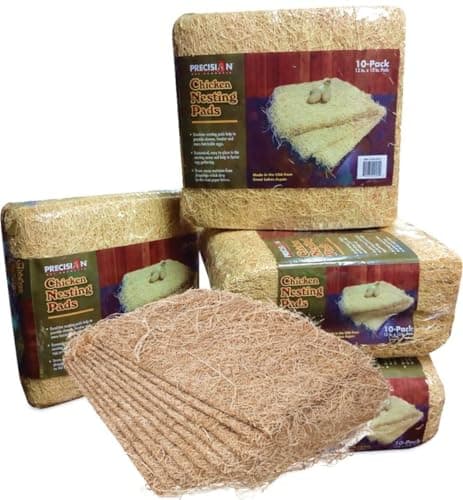
Aspen excelsior fibers on a kraft-paper backing at a standard 13 by 13 inches, which is the size nearly every nest box is built around and the reason these are the default.
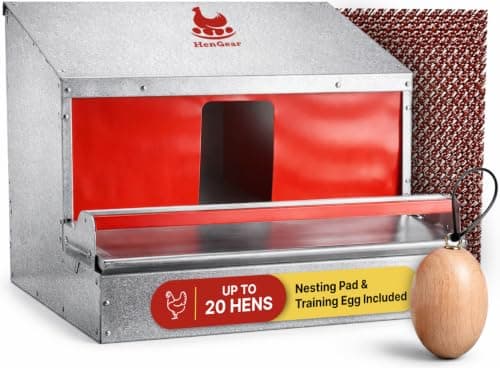
A sloped-floor box that rolls the egg away from the hen into a protected tray, which stops the two problems that ruin eggs in a nest box: dirt and the hen that learns to eat them.
#ad We have no verified Amazon listing for this one, so no number is shown. How this is funded.
FAQ
Questions people actually ask
+What size should a chicken nesting box be?
12 to 14 inches square is the working range for standard breeds. The clearest evidence for it is that the nest pad market is standardized at 13 by 13 inches, which is what commercial box makers build to. Bantams are comfortable smaller; very large breeds want closer to 14 or 15 inches.
+How high off the ground should nesting boxes be?
18 to 20 inches, published by University of Maryland Extension, and always below the roost. Chickens sleep on the highest available surface, so a nest box mounted above the roost bar becomes a bedroom and is full of droppings by morning.
+How many nesting boxes for 6 chickens?
Two, at the published ratio of one nest per four to five birds. Providing more rarely changes anything, because hens tend to decide collectively that one particular box is correct and queue for it while the others sit unused.
+Do nesting boxes need a lip?
Yes, three or four inches at the front. Without one, bedding gets scratched out onto the coop floor and eggs can roll out after them. A sloped rather than flat top is also worth having, because a flat top at a reachable height becomes a roost and the birds foul the nest below it.
Where the numbers came from
Sources
Every figure cited on this page came from one of these documents. If one of them has changed since we read it, the number here is out of date and we would like to know.