The broody hen, and the published method for breaking one
Mississippi State publishes the fix in two sentences: a wire-floored cage, three to four days, ample feed and water. The more useful page is the one next to it, which explains how to make a hen broody on purpose - because read backwards, that is the list of things you are doing by accident.
A broody hen is not sick. She has switched from laying eggs to incubating them, and University of Georgia Extension publishes what that costs you: “A broody hen will stop laying eggs, may become aggressive and will sit on a nest to prevent other hens from laying there.” The fix is published in two sentences by Mississippi State Extension: “The problem can be solved by removing the hen from the flock and placing her in a wire-floored cage for 3 to 4 days. Ample feed and water should be supplied to the affected hen.”
First, confirm she is broody and not ill
The two look similar from a distance and the treatments have nothing in common, so this is worth thirty seconds. University of Maryland Extension publishes three signs, written for people trying to find a hen who will hatch eggs, which makes them a clean checklist for identifying one you would rather stop. A broody hen will:
Be “always on the nest and refuse to get off eggs”, including overnight, when the rest of the flock has gone up to roost
“Fluff their feathers up and peck at you when you try and collect their eggs” — a bird who is normally easy to handle
Have “a bald patch on their chest which occurs naturally and allows the body heat from the hen to pass to the eggs more easily”
That third one is the decisive sign, because it cannot be faked by a hen who simply likes a particular box. Lift her and look: a brood patch is bare skin, warm and often slightly pink, in the middle of her breast. She plucked it herself.
Why she went broody, read off the instructions for causing it deliberately
The most useful document here is not about stopping broodiness at all. Mississippi State publishes a separate page on stimulating the setting instinct — how to persuade a hen to go broody on purpose, for people who want her to hatch a clutch. Read it backwards and it is a list of the things you are doing by accident.
Mississippi State Extension publishes each of these as a way to INDUCE setting. Inverted, they are the three levers you actually control.
What the extension page says induces it
What that means you should do instead
“After the hen accumulates a nest full of eggs (a clutch) she instinctively starts setting and incubating them.”
Collect every egg, every day. A clutch cannot accumulate if there is never more than one egg in the box.
“Provide the hen with dark, secluded areas in which to make her nest.”
Stop supplying dark, secluded corners. Close off the space behind the feed bin and under the coop that nobody meant to be a nest.
“The most critical factor for inducing females of any bird species to set on eggs is the amount of daylight each bird is exposed to every day” — about 17 hours.
This is the lever you least control, and the one worth knowing about: long days are pro-setting. A hen going broody in June is behaving exactly as published.
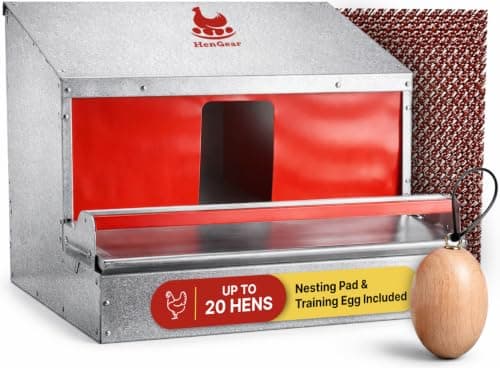
The first row is the actionable one and it is the reason this page ends with a nest box rather than only a cage. Broodiness is triggered by a clutch. A box that keeps the clutch from ever existing removes the trigger rather than treating the result — and it is the same argument this site makes on egg eating, for the same reason.
Before you break it: should you let her sit?
A broody hen is a working incubator that costs nothing to run, and if you want chicks she is genuinely the easiest route to them. Three published facts decide whether that is open to you.
You need fertile eggs. University of Maryland is blunt: “Eggs for hatching need to be fertile and come from flocks with rooster housed with hens.” No rooster means no chicks, and a hen will sit on infertile eggs for weeks without any outcome at all. That is the single most common version of this story, and it is the worst one — all of the cost, none of the chicks.
She can cover more than you would guess. “The number of eggs a hen can hatch will depend on her size, with larger hens capable of handling up to 20 eggs.”
It is 21 days, and then it is longer. Incubation runs 21 days, and she then mothers the chicks for weeks after that. Add the time she was broody before you noticed and a hen who hatches a clutch is out of lay for a good deal longer than the three or four days breaking her would have cost.
This site’s standing position, set out across the hatching hub, is that a first-time keeper is better served buying day-old sexed pullets than hatching — because half of what hatches is cockerels, and that is a problem you have to have a plan for before the eggs go under her, not after. If you do want to hatch, a broody hen beats an incubator on running cost and loses on control; the incubator running-cost page puts numbers on the comparison.
The published method
Mississippi State’s instruction is short enough to quote whole, and it is worth noticing what it does not contain: no ice, no water bath, no darkness, no starving her out.
The wire floor is the whole mechanism. Broodiness needs a nest: something she can settle into, that holds still and holds heat. A wire floor supplies none of those — there is nothing to arrange, nothing to sit down into, and air moves underneath her, so her underside never reaches the temperature the behavior depends on. University of Georgia describes the same principle with a different material, noting that some producers “build a ‘broody pen’ that has pebbles on the floor instead of litter.” Wire or pebbles, the requirement is identical: a floor she cannot make a nest out of.
Two things people get wrong. The first is leaving out the feed and water — the published instruction says ample, and a hen coming off a fortnight of broodiness has already been eating far less than usual. The second is giving up after one round. The published guidance explicitly allows repeating it; a second three-day stint is a normal outcome.
What the cage has to be, before looking at any product
Mississippi State says “wire-floored cage” and stops. It publishes no size, no mesh spacing and no material. Those gaps are where the buying decision actually lives, so here is what we graded against and where each figure comes from.
1. The floor has to actually be wire
This sounds too obvious to state until you start shopping, at which point it becomes the single most common disqualifier. Plenty of cages that look right have a deep plastic pan for a floor, which is a better nest than the nest box she came out of.
2. It has to be big enough, by the yardstick this site already uses
Since the extension method gives no dimension, we used the one this site applies everywhere else: poultry.extension.org publishes 3 to 4 square feet per hen for indoor space. Three or four days is short, and we are not going to pretend a short confinement needs the same allowance as a permanent coop — but it is the only published figure available, it is the figure the rest of this site is held to, and applying it produces a clear answer rather than a vibe.
3. The mesh has to be fine enough for feet
A half-inch aperture is the number this site already recommends for hardware cloth, and it is fine enough that a standard hen’s toes do not drop through. Vinyl or plastic coating over the wire is better than bare galvanized for a bird standing on it for days.
4. You have to be able to get feed and water in and muck out
A top-opening door and a pan that slides out without opening the cage are worth more here than anywhere else, because the occupant has spent a fortnight learning to peck hands.
The cages, measured against that
Floor area below is ours, computed from each maker’s published dimensions with the arithmetic shown. The last row is the one to look at hardest.
Floor area computed from published dimensions. Allowance: 3 to 4 sq ft per hen indoors (poultry.extension.org).
Product
Floor
Grid
Area
vs 3-4 sq ft
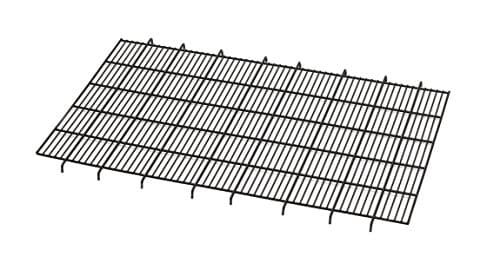
MidWest Floor Grid FG36B
35 x 24 in
1/2 in, vinyl coated
5.83 sq ft
Clears it
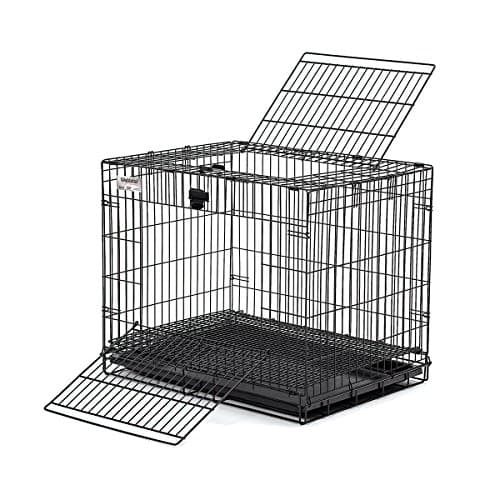
MidWest Small Wabbitat
25 x 19 in
1/2 in grid mesh
3.30 sq ft
In range
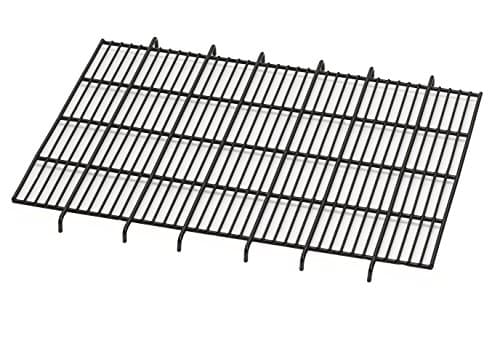
MidWest Floor Grid FG24B
23 x 18 in
1/2 in, vinyl coated
2.88 sq ft
Below the floor
MidWest 158 Wabbitat Deluxe
5.5 in deep plastic base
1 in mesh — on the TOP
6.51 sq ft
Disqualified
The last row is why this section exists. The Deluxe Wabbitat is the biggest of these, the most expensive, and the one that looks like the obvious upgrade — and it is the wrong product entirely. MidWest publishes it with “an easy-to-clean 5.5″ deep plastic base”; the one-inch mesh in its specification is the top of the cage, not the floor. Bed that base with anything and you have built her a superior nest. Its 6.51 sq ft of floor is the largest number in the table and it is irrelevant, which is a good reminder that the headline figure is only worth reading after the product qualifies at all.
Which breeds go broody, on registry wording
The internet is confident about this and the breed registry is not. Below is what The Livestock Conservancy actually publishes for the eight breeds this site recommends to beginners, quoted rather than summarized — including the three where it says nothing at all.
The Livestock Conservancy breed profiles, retrieved 2026-09-14. Quoted verbatim; blank means the profile does not address it.
Breed
What the registry says
Plymouth Rock
“Hens are usually good sitters and mothers.”
Australorp
“They are generally considered good sitters and mothers.”
Sussex
“They can be broody and are good mothers.”
Rhode Island Red
Most hens “can become broody except within the strains that have been heavily selected for egg production”
Leghorn
“They are not broody and aren’t the best mothers.”
Wyandotte
“Hens are good mothers” — broodiness itself is not addressed
Orpington
Not addressed
Araucana
Not addressed
Two things fall out of that table. The first is the Orpington, which has the loudest broody reputation of any backyard breed and about which the registry profile says nothing on the subject. We are not going to invent the sentence.
The second is more useful than any per-breed answer. The Rhode Island Red wording puts the variation inside the breed rather than between breeds, and the Australorp profile explains why: the breed was developed between 1900 and 1922 by breeders working to eliminate broodiness, because a hen who sets is a hen who is not laying. Mississippi State says the same thing in one line — the readiness to set “varies within and among breeds, strains, and families of chickens.” Strain beats breed. Two Plymouth Rocks from different hatcheries can behave differently, and the breed name on the label will not tell you which you bought.
What it costs to leave her to it
Nothing published puts a figure on how long an unbroken broody spell lasts, and we are not going to produce one. What is published is the direction: she stops laying, she may lose condition, and she occupies a nest box that the rest of the flock then queues for. On a flock of six that is a sixth of your production plus a share of everybody else’s disruption, for as long as it runs.
Set against that, the published treatment is three or four days and a cage you keep. That is the whole argument for acting rather than waiting, and it is why the method is worth knowing before you need it rather than after — a hen who has been sitting for two weeks before anyone noticed is thinner and more stubborn than one caught in the first few days.
Heads up: some links on this page are affiliate links. If you buy through one we may earn a commission at no extra cost to you. It never changes a ranking, and we take no payment for placement. The full version.
The picks
A wire floor, and the box that prevents the next one
Three ways to get the wire-floored cage the published method calls for, ranked on floor area against the extension allowance - plus the nest box that stops a clutch accumulating in the first place.
MidWest Homes for Pets
Small Wabbitat Rabbit Cage
3.30 sq ft of wire floor
A half-inch grid mesh floor over a slide-out pan, which is the only thing Mississippi State's method actually requires — and the only complete cage here that arrives ready to use rather than needing a crate you already own.
The cheapest way to the most floor, if and only if you already own one of the 36-inch MidWest crates it is cut to fit — it turns a crate you own into the wire-floored cage the published method describes.
The same half-inch vinyl-coated grid in the 24-inch size, and the only pick here whose floor area lands below the published indoor allowance for a single hen — which is a real mark against it rather than a rounding error.
A hen who has switched from laying eggs to trying to incubate them. University of Georgia Extension publishes that a broody hen will stop laying eggs, may become aggressive, and will sit on a nest to prevent other hens laying there. She sits flat, fluffs up and pecks when you reach under her, and develops a bald patch on her breast that lets her body heat reach the eggs.
+How do I break a broody hen?
Mississippi State Extension publishes the method: remove her from the flock and place her in a wire-floored cage for 3 to 4 days, with ample feed and water supplied. She can then usually be returned to the flock with no further problem, and the treatment can be repeated if she continues to be broody. The wire floor is the active part - she cannot build a nest on it and air moves underneath her.
+How long does it take to break a broody hen?
Three to four days in the wire-floored cage, on the published method. If she goes straight back to the nest box afterwards, Mississippi State is explicit that the treatment can be repeated - a second round is a normal outcome rather than a sign you did it wrong.
+Will a broody hen lay eggs?
No. That is the whole reason the extension literature treats broodiness as a management problem: University of Georgia publishes plainly that a broody hen will stop laying eggs. She also occupies a nest box the rest of the flock then has to queue for, so the cost is not limited to her own production.
+Why did my chicken go broody?
Three published conditions, all on Mississippi State's page about inducing setting deliberately. A clutch of eggs accumulated in the nest, which is what triggers the instinct; she had a dark, secluded place to nest; and day length was long, which the same page calls the most critical factor for inducing birds to set. You control the first two directly.
+Should I let my broody hen hatch eggs?
Only if you have fertile eggs and a plan for cockerels. University of Maryland Extension publishes that eggs for hatching must be fertile and come from a flock with a rooster housed with the hens - without one she will sit for weeks and nothing will hatch. Incubation is 21 days and she then mothers the chicks for weeks, so she is out of lay far longer than the three or four days breaking her would cost.
+Do I need a special broody breaker cage?
You need a cage with a genuine wire floor, which is all the published method specifies. Nothing sold as a purpose-built broody breaker publishes more than that, and several cages that look suitable have a deep plastic pan for a floor - which is a better nest than the one she came out of. A wire floor grid dropped into a dog crate you already own satisfies the method as well as anything.
+Which chicken breeds go broody most?
The breed registry is less definite than the forums. The Livestock Conservancy calls Plymouth Rocks and Australorps good sitters, says Sussex can be broody, and rules out only the Leghorn - which it describes as not broody. It says nothing about broodiness for the Orpington, despite that breed's reputation. Its Rhode Island Red profile puts the variation inside the breed, noting most hens can become broody except in strains heavily selected for egg production.
Where the numbers came from
Sources
Every figure cited on this page came from one of these documents. If one of them has changed since we read it, the number here is out of date and we would like to know.
Incubators compared on published watts and egg capacity, the running cost of a 21-day hatch, and the extension figures for temperature, humidity and turning.
Eight beginner breeds compared on published egg figures, standard weights and the registry's own temperament wording — including where no figure is published at all.