Chicken molting, and the feed change the published numbers actually support
Mississippi State Extension publishes how long a molt runs and why. Read the guaranteed analyses next to it and the bag with the word feather on the front turns out to publish less of the nutrient that builds a feather than the bags that say nothing about molt at all.
Molt is annual and it stops the eggs. Mississippi State Extension publishes the timeline: a late molter lays for 12 to 14 months first and then sheds and regrows in 2 to 3 months, while an early molter may start “after only a few months in production” and “may take as long as 4 to 6 months to complete the molt.” What the published feed figures support during that window is more protein and less calcium — which describes a grower ration, not a layer ration, and not necessarily the bag with the word feather on the front.
What a molt is, on the published timeline
Mississippi State states it plainly: “Each year chickens molt, or lose the older feathers, and grow new ones.” It is not a disease, it is not a deficiency, and it is not something you caused. It has an order, too, and the order is worth knowing because it tells you whether what you are looking at is a molt at all: “The feathers are lost from the head first, followed in order by those on the neck, breast, body, wings, and tail.”
The split that decides how long you wait is between early and late molters, and the tell is on the wing. Late molting hens “will lose primary feathers in groups of two or more feathers, whereas early molters lose feathers individually.” That is a genuinely useful thing to check in the first week, because the two outcomes are very different lengths of time.
Mississippi State Extension, Molting of Laying Hens. The wing tells you which one you have.
Late molter
Early molter
Lays for
12 to 14 months before molting
As little as a few months in production
Molt takes
2 to 3 months
4 to 6 months
Primary feathers drop
In groups of two or more
Individually
The late molter is the bird you want, and not only because she laid longer first. Mississippi State gives the mechanism: in the late molter “the loss of feathers and their replacement takes place at the same time,” which “enables the hen to return to full production sooner.” The early molter is doing the same work sequentially, which is why it takes her twice as long.
Put that against the age a pullet starts laying and you can place the first adult molt reasonably well. A pullet in lay at twenty weeks — roughly four and a half months — who turns out to be a late molter lays another 12 to 14 months before she molts, which puts her first molt somewhere around 17 to 19 months old. That arithmetic is ours, from Mississippi State’s figure; the extension page publishes the 12-to-14-month interval, not the age.
Why the eggs stop
“Most hens stop producing eggs until after the molt is completed,” Mississippi State says, and the reason is more drastic than a rest. poultry.extension.org publishes that during molt “there is a significant loss of body weight, 25% of which is due to the regression of the reproductive tract to the pullet state.”
A quarter of the weight she loses is the egg-making apparatus itself, dismantled back to the condition it was in before she ever laid. She is not pausing. She is rebuilding two things at once — a reproductive tract and a complete coat of feathers — and she is doing it out of what she eats. Nothing in a bag reverses that or hurries it, and any product that suggests otherwise is selling you something the published literature does not support.
What a molting hen’s ration actually has to do
Before looking at a single product, it is worth being specific about what we are grading against, because the category is full of feeds that solve a different problem well.
1. More protein, and specifically more methionine
Headline protein percentage is the number every bag prints on the front. It is not the number that builds a feather. Mississippi State Extension is direct about which one does: “Methionine is one of only a few amino acids that contain sulfur, and sulfur is a major constituent of feathers.” The same page lists methionine deficiency as the reason under its heading for birds that are simply unable to grow feathers at all.
So methionine is the figure to find on the tag. Every feed in the table below publishes it, and the spread between the best and worst of them is wider than the spread in crude protein.
2. Less calcium, not more
This is the part that runs against the instinct to give a struggling bird the richest feed in the barn. A laying ration is calcium-heavy for one reason: the hen is putting several grams of it into a shell every day. poultry.extension.org publishes that “laying mashes typically contain 2.5% to 3.5% calcium,” and University of Georgia Extension puts a hen in production at 16 to 18 percent protein and 3.50 to 4.50 percent calcium, against 17 percent protein and 0.95 percent calcium for a pullet on grower feed.
A hen in molt has stopped laying. The shell calcium has nowhere to go. That is the whole reason the feed industry separates grower from layer in the first place — the calcium requirement tracks whether a bird is laying, not how old she is — and a molting hen has temporarily moved back across that line.
3. It has to be a complete ration
The most common molt advice online is to add something — a scoop of grubs, a handful of seed, a bowl of scratch. University of Georgia Extension is blunt about what that does: “Scratch feed should not be considered a complete feed for any type of bird,” and mixing it into a formulated feed “causes a nutrient imbalance in the total diet of the birds, increasing the calories while reducing the protein, vitamin, and mineral content.” University of Maryland puts a number on the safe ceiling: “Generally scratch grain should be about 10% of the birds total daily food consumption.”
The consequence for a molting hen is that anything you add displaces the ration that was balanced. If a bird needs more of a specific amino acid, the way to give it to her is a bag formulated to contain more of it, not a topping alongside a bag that contains less.
Every feed we could read, on its published guaranteed analysis
These are label guarantees taken from each maker’s own published analysis, checked on 14 September 2026, alongside whether we could actually buy the bag that day. The last row is not a product — it is the extension figure for an ordinary laying ration, so you can see what the bag currently in your bin is likely to be doing.
Crude protein and methionine are published minimums. Availability checked on Amazon, 14 September 2026.
Feed
Protein (min)
Methionine (min)
Calcium
Buyable that day
Purina Flock Raiser Crumbles
20.00%
0.55%
0.80-1.30%
No
Kalmbach 20% Flock Maker Crumble
20.00%
0.55%
0.80-1.30%
No
Nutrena NatureWise Feather Fixer
20.0%
0.40%
3.25-3.75%
No
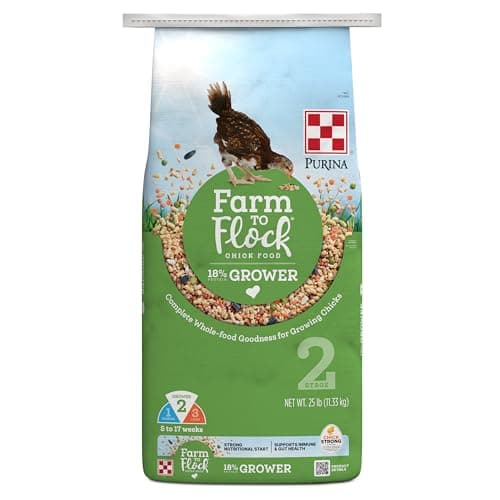
Purina Farm to Flock 18% Grower
18.00%
0.35%
0.80-1.30%
Yes
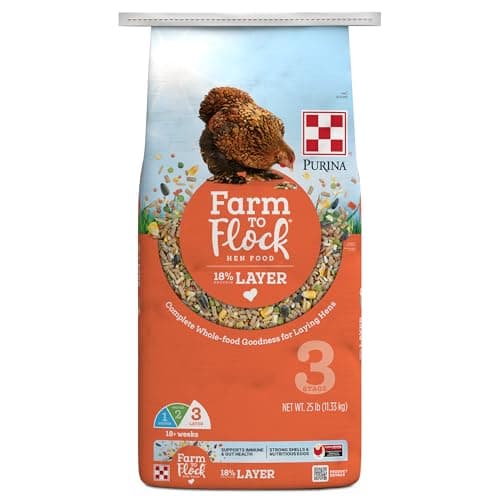
Purina Farm to Flock 18% Layer
18.00%
0.30%
3.25-4.25%
Yes
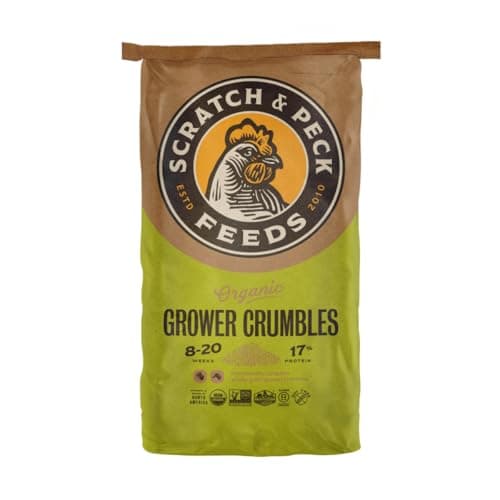
Scratch and Peck Organic Grower Crumbles
17.0%
0.3%
0.8-1.3%
Yes
Manna Pro All Flock Crumbles
16.00%
0.30%
1.50-2.00%
Yes
Typical layer ration (extension figure)
16%
not published
2.5-3.5%
—
One row deserves a note before anything else. The bag labeled All Flock is 16 percent protein — lower than either grower feed above it, and level with an ordinary layer ration. “All flock” is a category describing which species can eat it, not a protein level: Purina’s all-flock feed is 20 percent and Manna Pro’s is 16. Buy the number on the tag, not the phrase on the front.
The bag that advertises feathers publishes the least of the feather nutrient
Three feeds in that table publish 20 percent crude protein. Two of them — Purina Flock Raiser and Kalmbach 20% Flock Maker — say nothing about molt at all and publish 0.55 percent methionine. The third, Nutrena NatureWise Feather Fixer, is the one built and named for molt, and publishes 0.40 percent. On the single nutrient Mississippi State names as a major constituent of feathers, the molt feed guarantees about a quarter less than the two feeds that do not mention molt.
What Feather Fixer adds instead is calcium: 3.25 to 3.75 percent, laying level. That is not a mistake on Nutrena’s part, and it is worth being fair about the design. Their own instruction is that it “may also be fed as the sole ration at the first sign of feather loss,” then transitioned to their 17 percent layer pellet once the molt is complete. It is engineered as a drop-in replacement for a layer feed in a flock of adult hens — four protein points up, calcium unchanged, one bag, no second dish. For a keeper with six laying-age hens and no rooster, that is a coherent product.
The criticism is narrower than “it is bad.” It is that the marketing implies the feather nutrition is the distinguishing feature, and on the published figure for the feather nutrient it is behind the generic all-flock bags. If you were choosing on that number alone, you would not choose it.
What you can actually buy, which is the awkward part
Every one of the three 20 percent feeds was listed as currently unavailable when we checked. That is not a fluke of one afternoon so much as a fact about the category: feed is heavy, a 40 or 50 lb bag ships badly, and bagged poultry feed is a farm-store purchase far more than an online one.
So the honest recommendation splits in two. If you have a feed store within driving distance, ask for a 20 percent all-flock — Flock Raiser or Flock Maker — and you will have the best match on the published numbers to what a molting hen is doing: the most methionine of anything here, at grower-level calcium. If you are buying online, the picks below are what was genuinely in stock, and Purina’s 18 percent grower is the closest available shape: protein up, calcium capped at 1.30 percent.
One caveat on that grower bag, stated plainly because it is the kind of thing this site would want told to it: Purina’s own feeding direction runs the grower from 4 to 6 weeks until the onset of egg production, then switches to the 18 percent layer. Feeding it to an adult hen in molt is off-label use of a complete ration. The published numbers defend it — a molting hen is, nutritionally, back in the state that ration is written for — but the bag does not tell you to do it, and you should know that before you do.
The calcium dish that makes a low-calcium ration safe
Molt is rarely synchronized. Some of the flock will still be laying while others stand around looking like a burst cushion, and a grower ration on its own leaves those layers short of shell calcium. The fix is the one University of Maryland already publishes: “An extra source of calcium can be offered free choice in the form of ground oyster shell, calcite, or limestone.”
Free choice is the operative phrase and it is doing real work. In a separate dish, the hen still forming shells takes what she needs and the hen in full molt ignores it, which is exactly the discrimination you cannot get by mixing calcium into feed. It is what lets a single low-calcium ration serve a mixed flock, and it is the same method this site recommends for grit and oyster shell generally and for shell strength when eggs start breaking.
What feed cannot do
It is worth closing the loop on the claim this whole category is built on. Mississippi State attributes molt duration to which kind of molter the bird is — 2 to 3 months for a late molter, 4 to 6 for an early one — not to what she was fed. We could not find an extension publication that puts molt length under the keeper’s control through nutrition.
What a better ration does is supply the material for the feathers she is going to grow anyway. That is a real and worthwhile thing, and it is a smaller claim than “shortens the molt.” If your hen is an early molter, you are going to be collecting fewer eggs for months, and the right feed will not change the calendar.
Heads up: some links on this page are affiliate links. If you buy through one we may earn a commission at no extra cost to you. It never changes a ranking, and we take no payment for placement. The full version.
The short answer
The short list
Ranked on the published rubric. Every row jumps to that product's full write-up below; the button goes straight to Amazon.
#
Pick
Best for
Key spec
Score
Price
1
Our pick
Purina
Farm to Flock 18% Grower Chick Food, 25 lb
The only bag we could buy today that raises protein WITHOUT raising calcium, which is the exact pair of moves a hen who has stopped laying and started growing feathers needs.
Two protein points above the layer level extension services call common, with the calcium left where a laying hen needs it — the one-bag answer when some birds are molting and some are still filling the nest box.
The same low-calcium grower shape as the Purina bag, certified organic and free of corn and soy, but it publishes the least protein of the three and 0.3 percent methionine puts it level with ordinary layer feed on the nutrient that builds a feather.
Thirty-three to thirty-eight percent calcium in a crushed form, offered free-choice — the supplement that fixes thin shells and the one most first-time keepers confuse with grit.
#adPrices as of September 14, 2026. Scores are our own published rubric, not customer ratings.
#1 · A hen in full molt
Purina Farm to Flock 18% Grower Chick Food, 25 lb
The only bag we could buy today that raises protein WITHOUT raising calcium, which is the exact pair of moves a hen who has stopped laying and started growing feathers needs.
Who it is for. Anybody whose hens have visibly stopped laying and are dropping feathers, and who is willing to run a free-choice oyster-shell dish for the stragglers.
Published specifications
Crude protein (min)
18.00%
Methionine (min)
0.35%
Lysine (min)
1.00%
Crude fat (min)
3.00%
Crude fiber (max)
5.00%
Calcium
0.80% min, 1.30% max
Phosphorus (min)
0.40%
Salt (NaCl)
0.35% min, 0.55% max
Form
Textured — ten whole grains, seeds and mini pellets
Labeled for
Chicks and pullets, 4 to 6 weeks until onset of egg production
Bag size
25 lb
Source: Purina Animal Nutrition, Farm to Flock 18% Grower Food product page and guaranteed analysis (purinamills.com), retrieved 2026-09-14
Rubric — 8.0 / 10
Capacity honesty9/10 · weight 26%
Documentation9/10 · weight 24%
Build and weather8/10 · weight 20%
Running cost7/10 · weight 15%
Daily use6/10 · weight 15%
What it gets right
Publishes 0.35 percent methionine — the sulfur amino acid Mississippi State Extension names as a major constituent of feathers, and more than Purina's own 18 percent layer bag carries
Calcium capped at 1.30 percent instead of the 3.25 to 4.25 percent in the matching layer feed, which is the right direction for a bird that has stopped putting calcium into shells
A complete ration, so nothing needs adding to it except free-choice oyster shell for any hen still in lay
In stock at the time of writing, which none of the three 20 percent feeds in the table below were
What it costs you
Purina's own feeding direction stops this feed at the onset of egg production, so feeding it to an adult hen in molt is off-label use — defensible on the published numbers, but it is not what the bag tells you to do
18 percent is a compromise: the 20 percent all-flock feeds publish more protein and more methionine, they are simply not buyable here right now
The textured medley lets birds pick out the grains they like and leave the pellet, and the pellet is where the vitamins and amino acids are
25 lb is the only listed size, and a molt runs for weeks across a whole flock
Skip it if. Several of your hens are still laying and you will not put out a separate oyster-shell dish. A grower ration alone does not carry the calcium a hen in lay needs.
Two protein points above the layer level extension services call common, with the calcium left where a laying hen needs it — the one-bag answer when some birds are molting and some are still filling the nest box.
Who it is for. Anybody with an all-hen, all-adult flock who wants one bag in the bin and no second dish to keep topped up.
Published specifications
Crude protein (min)
18.00%
Methionine (min)
0.30%
Lysine (min)
0.70%
Crude fat (min)
2.50%
Crude fiber (max)
7.50%
Ash (max)
14.00%
Calcium
3.25% min, 4.25% max
Phosphorus (min)
0.45%
Salt (NaCl)
0.20% min, 0.70% max
Microorganisms (min)
84,000,000 CFU/lb
Labeled for
Laying chickens after 18 weeks of age, throughout the laying cycle
Label caution
Not to be fed to male birds of any age, or to birds under 18 weeks
Bag size
25 lb
Source: Purina Animal Nutrition, Farm to Flock 18% Layer Hen Food product page and guaranteed analysis (purinamills.com), retrieved 2026-09-14
Rubric — 8.3 / 10
Capacity honesty8/10 · weight 26%
Documentation10/10 · weight 24%
Build and weather8/10 · weight 20%
Running cost7/10 · weight 15%
Daily use8/10 · weight 15%
What it gets right
18 percent protein is two points above the 16 percent that poultry.extension.org calls the more common layer level, without asking you to run a second feed
Carries laying calcium, so hens that keep laying straight through the molt need no separate supplement
Purina publishes the whole analysis down to the probiotic count and the vitamin levels, which most of this category does not
The label caution about roosters and under-18-week birds is stated plainly, and it is the mistake this feed most invites
What it costs you
Methionine is published at 0.30 percent, the lowest figure in our table and lower than Purina's own grower bag — on the one nutrient extension literature ties directly to growing a feather
Lysine at 0.70 percent is also the lowest here
3.25 to 4.25 percent calcium goes into a bird who has stopped laying and has nowhere to put it; that is the trade you make for the convenience of a single bag
Cannot be the flock's only feed if you keep a rooster or have pullets coming up behind — the label rules both out
Skip it if. You keep a rooster, or pullets under 18 weeks share the feeder. The label rules this feed out for both, and a shared trough does not let you enforce it.
Scratch and Peck Feeds Organic Grower Crumbles, 25 lb
The same low-calcium grower shape as the Purina bag, certified organic and free of corn and soy, but it publishes the least protein of the three and 0.3 percent methionine puts it level with ordinary layer feed on the nutrient that builds a feather.
Who it is for. Keepers who already run an organic, corn-free or soy-free flock and want to stay in that system through the molt without switching to a layer ration.
Published specifications
Crude protein (min)
17.0%
Methionine (min)
0.3%
Lysine (min)
0.8%
Crude fat (min)
2.5%
Crude fiber (max)
6.0%
Calcium
0.8% min, 1.3% max
Phosphorus (min)
0.6%
Salt (NaCl)
0.2% min, 0.7% max
Form
Crumbles
Labeled for
Chickens 8 to 20 weeks, ducks 4 to 20 weeks
Certification
Certified organic, Non-GMO Project verified, soy and corn free
Bag sizes
25 lb and 50 lb
Source: Scratch and Peck Feeds, Organic Grower Crumbles product page and guaranteed analysis (scratchandpeck.com), retrieved 2026-09-14
Rubric — 7.7 / 10
Capacity honesty7/10 · weight 26%
Documentation9/10 · weight 24%
Build and weather9/10 · weight 20%
Running cost5/10 · weight 15%
Daily use8/10 · weight 15%
What it gets right
Calcium capped at 1.3 percent, the same grower-level ceiling as the Purina bag, so it suits a bird that is off lay
Scratch and Peck publish the full guaranteed analysis and the ingredient list, including the fish meal that carries the amino acids
Crumble form rather than a textured medley, so birds cannot sort the expensive fraction out and leave it
The only certified-organic, corn-free and soy-free option here whose maker publishes a complete analysis we could read
What it costs you
17 percent is the lowest protein of the three picks, and only one point above the common layer level
0.3 percent methionine is the same figure as a standard layer feed, so the feather-building nutrient is not where this bag improves on what you already feed
Markedly the most expensive per pound of the picks on this page
Published shelf life is six months, shorter than most bagged feed, which matters if you buy ahead for a molt
Skip it if. Organic certification is not what you are buying for. On the published numbers alone the Purina grower carries more protein and more methionine for less money.
Thirty-three to thirty-eight percent calcium in a crushed form, offered free-choice — the supplement that fixes thin shells and the one most first-time keepers confuse with grit.
Who it is for. Anybody whose hens have started laying, particularly if shells are thinning or breaking in the nest.
#ad We have no verified Amazon listing for this one, so no number is shown. How this is funded.
FAQ
Questions people actually ask
+How long do chickens molt?
It depends which kind of molter the bird is. Mississippi State Extension publishes that late molters lay for 12 to 14 months before molting and then shed and regrow in 2 to 3 months, while early molters may begin after only a few months in production and can take 4 to 6 months to finish. The tell is on the wing: late molters drop primary feathers in groups of two or more, early molters drop them individually.
+Why has my chicken stopped laying and lost her feathers?
Almost certainly the annual molt. Mississippi State Extension publishes that most hens stop producing eggs until the molt is completed, and poultry.extension.org publishes that there is a significant loss of body weight during molt, 25 percent of which is the reproductive tract regressing to the pullet state. She is rebuilding the egg-making apparatus and a full coat of feathers at the same time, out of what she eats.
+What should I feed chickens during a molt?
A complete ration with more protein and less calcium than a layer feed. Feathers are built from sulfur-containing amino acids, and Mississippi State Extension names methionine as the one to look for on the tag. Because a molting hen has stopped laying, she no longer needs the 2.5 to 3.5 percent calcium an extension service publishes as typical for a laying mash - which points at a grower or all-flock ration, with oyster shell offered free-choice for any hen still in lay.
+Should I keep feeding layer feed during the molt?
You can, and nothing catastrophic happens, but it is the wrong shape twice over: it is lower in protein than a molting bird needs and higher in calcium than she can use. If most of your flock is still laying and you want one bag rather than two, an 18 percent layer feed is a reasonable compromise. If they have genuinely stopped, a grower ration plus free-choice oyster shell matches the published figures better.
+Does high-protein feed shorten a chicken's molt?
Not on anything we could find published. Mississippi State Extension attributes molt duration to whether the bird is an early or late molter, not to nutrition. What a higher-protein ration does is supply the amino acids for the feathers she is going to grow regardless. That is worth doing, and it is a smaller claim than the one most molt products make.
+Do the feeds sold specifically for molting work better?
Not on the published numbers. Of the three 20 percent feeds we compared, the two that say nothing about molt publish 0.55 percent methionine and the one named for feathers publishes 0.40 percent, while carrying laying-level calcium a non-laying bird cannot use. The molt-branded bag is designed as a single-bag substitute for layer feed in an all-hen flock, which is a real convenience - it is just not ahead on the nutrient that builds a feather.
+How do I tell a molt from mites?
By the pattern. A molt takes feathers from the head first and then in order down the neck, breast, body, wings and tail, with pin feathers visibly coming in behind. Mite and lice damage comes with birds that are restless and itchy and with insects you can find around the vent, and mating wear is patchy and localized to a hen's back and the back of her head. Mississippi State Extension lists parasites and breeding activity as distinct causes of poor feathering, separate from molt.
Where the numbers came from
Sources
Every figure cited on this page came from one of these documents. If one of them has changed since we read it, the number here is out of date and we would like to know.