Chicken leg bands, and the sizing rule nobody prints
Every supplier publishes a different breed-to-size chart and none of them agrees. They do not need to: the size number turns out to be the inside diameter in sixteenths of an inch, and a hen's leg can be measured in five seconds.
The band size number is the inside diameter in sixteenths of an inch. Size 9 is 9/16 in, size 11 is 11/16 in, size 12 is 3/4 in, size 14 is 7/8 in. Every published diameter we could find follows it without exception. So the entire breed-to-size chart problem — and the charts genuinely disagree with each other — reduces to measuring one hen’s shank with a ruler and rounding up.
The rule, and the evidence for it
We did not find this stated anywhere. It emerged from lining up every published size-and-diameter pairing we could get hold of, from two independent kinds of source: a supplier’s chick-band chart, and the product listings themselves.
Published band size against published inside diameter. Chick sizes from Smith Poultry & Game Bird Supply and Rogier Poultry; adult sizes from the product listings named on this page. The sixteenths column is our arithmetic.
Band size
Published diameter
As sixteenths
Matches the rule?
3
3/16 in
3/16
Yes
4
1/4 in
4/16
Yes
5
5/16 in
5/16
Yes
6
3/8 in
6/16
Yes
11
11/16 in
11/16
Yes
12
3/4 in
12/16
Yes
14
7/8 in
14/16
Yes
Why the breed charts contradict each other
The usual way to buy leg bands is to find a chart, look up your breed, and order that size. It works badly, and the reason is visible the moment you compare two charts.
The widely circulated guideline chart puts Rhode Island Red hens and Wyandottes at size 11. A hatchery chart puts Rhode Islands and Wyandottes in the size 12 group. Those are different bands — 11/16 in against 3/4 in. Neither chart is careless; they are describing birds that genuinely vary. Cutler Supply’s own chart says so in as many words: “Charts Are Guides Only As Sizes May Vary Within Breeds”.
Within a single breed, a cockerel’s shank is heavier than a pullet’s, a hatchery line differs from a heritage line, and a bird at sixteen weeks is not a bird at a year. A breed name is a poor proxy for a diameter, which is why the charts cannot be made to agree and why measuring wins.
Measuring, which takes five seconds
Do this after dark, when birds are calm on the perch and catchable — the same trip you would make to check vents for mites.
Measure the shank, the scaled section between the foot and the hock, at its thickest point. That is what the band sits on.
Convert to sixteenths and round UP. A 5/8 in shank is 10/16, and size 10 is not commonly made, so size 11 is the band. A band should turn freely on the leg.
Measure two or three birds, not one. If the flock spans two sizes, that is the argument for a band that fits a range rather than a fixed diameter.
Never size a growing bird tightly. A pullet’s shank is still thickening; a band that fits at sixteen weeks can bind at a year. This is the single way leg bands cause harm.
The four designs, and what each one is actually for
Band types compared on what the makers publish. Sizing figures as cited above.
Type
Sizing
Reopens?
Numbered?
Tool needed
Zip-style band
Fits several sizes
No, cut off
Yes
None
Adjustable clip
A published range
Yes
Usually
None
Spiral
One fixed size
Yes
No, color only
None
Aluminum butt-end
Fixed, crimped
No
Yes
Banding pliers
The honest summary is that growth decides this, not budget. For pullets that are still filling out, anything you can reopen is the right answer and a crimped metal band is the wrong one. For a settled adult flock where the identification has to be on paper — a breeding program, NPIP records, show birds — the metal band is the only one of these that is genuinely permanent.
What the makers do not publish
This category documents itself worse than almost anything else on this site, and it is worth being specific about the gaps because they are the reason three of these four score poorly on documentation:
Material, almost universally. Only the aluminum bands publish what they are made of. The plastic ones sit in UV and frost for years and publish nothing — no polymer, no UV rating, no temperature range.
Diameter, on the permanent option. The metal bands are the product where a wrong size is hardest to correct, and the maker publishes no size at all — only that they are “the perfect size for chicken legs.”
Retention, anywhere. One maker states that its bands “will not fall off” and publishes no test. Nobody publishes a pull figure.
A maker at all, on the cheapest option. The adjustable bands are generic, which means no specification to hold anyone to and no reason to expect the next order to match this one.
What people actually band for
Worth saying plainly, because it changes which product is right. Three uses account for nearly all backyard banding, and only one of them needs numbers.
Telling similar hens apart. Six birds of the same breed become six individuals, which is what makes working out who has stopped laying possible at all. Color alone usually does this.
Marking a treated bird. This is the one we would argue is underrated. If a bird has been treated with anything carrying an egg withdrawal period, a band is how you know whose eggs to discard a week later. Memory is not a withdrawal record, and the first aid kit page treats withdrawal as the figure that decides most treatment choices.
Age or hatch groups. Color-coding by year tells you at a glance which hens are in their second molt and which are pullets, which is the information behind every decision about replacing birds.
Heads up: some links on this page are affiliate links. If you buy through one we may earn a commission at no extra cost to you. It never changes a ranking, and we take no payment for placement. The full version.
The short answer
The short list
Ranked on the published rubric. Every row jumps to that product's full write-up below; the button goes straight to Amazon.
#
Pick
Best for
Key spec
Score
Price
1
Our pick
Chicken Hill
ZBand Numbered Poultry Leg Bands, 50
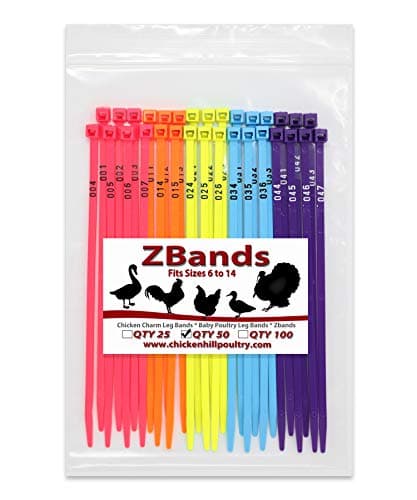
A numbered zip-tie band rather than a ring, which is the one design that sidesteps the sizing problem entirely — the maker publishes a fit across six band sizes, which is the whole chart in one product.
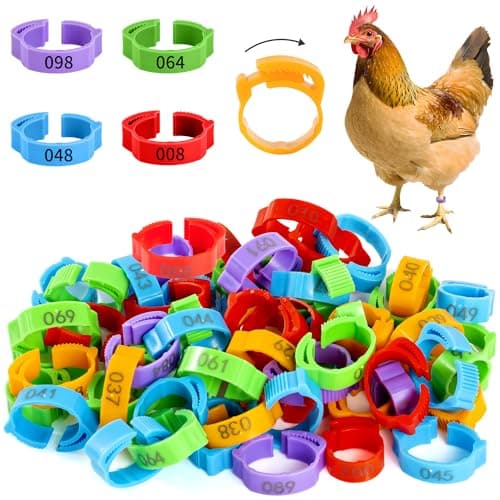
A clip band with a published adjustment range of 14 to 22 mm — which is 0.55 to 0.87 inches, or band sizes 9 through 14 in one product, and the only design here you can open again.
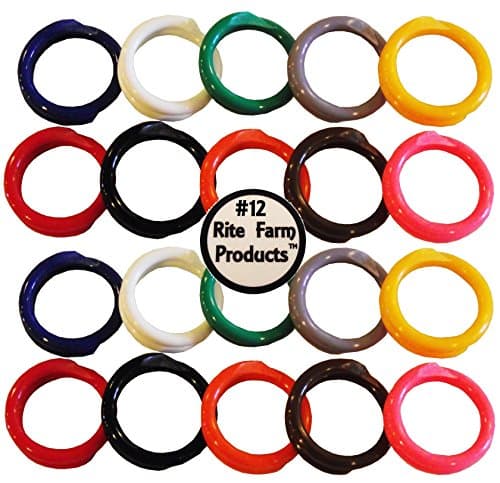
The classic spiral band, and the one product on this page that prints the size number and the diameter together — which is how you discover that the size number is simply the diameter in sixteenths of an inch.
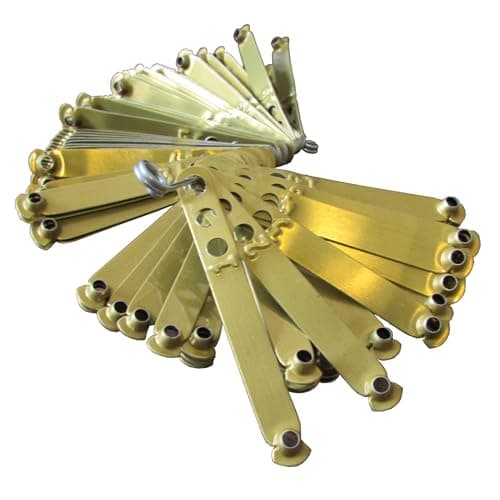
A crimped metal band for the case where identification has to survive years and be defensible on paper — and the one product here whose maker publishes what it is actually made of.
#adPrices as of September 27, 2026. Scores are our own published rubric, not customer ratings.
#1 · One band size for the whole flock
Chicken Hill ZBand Numbered Poultry Leg Bands, 50
A numbered zip-tie band rather than a ring, which is the one design that sidesteps the sizing problem entirely — the maker publishes a fit across six band sizes, which is the whole chart in one product.
Who it is for. A mixed-age or mixed-breed flock where one leg size does not fit all, and anyone who does not want to own a banding tool.
“Put the end through the head and start the zip, slide it around the leg, zip until the band is in place.”
Published material
NOT PUBLISHED
Published tension or retention test data
NOT PUBLISHED
Source: Chicken Hill published ZBand product page (chickencharm.co), retrieved 2026-09-27, for fit range, dimensions, application and pack numbering. Material and retention test data are not published.
Rubric — 7.4 / 10
Capacity honesty9/10 · weight 26%
Documentation6/10 · weight 24%
Build and weather6/10 · weight 20%
Running cost7/10 · weight 15%
Daily use9/10 · weight 15%
What it gets right
One product covers six band sizes, which removes the single hardest part of buying leg bands
Numbered and color-blocked in one pack, so ten birds get ten numbers and five color groups without buying two products
Goes on by hand with no crimping pliers, which is the tool most backyard keepers do not own
Published length and width, which almost nothing else in this category gives you
What it costs you
The maker publishes no material, so you cannot tell whether it embrittles in UV or cold
“ZBands will not fall off” is a claim with no published test behind it, and the maker separately concedes the stamped numbers “may eventually show wear”
A zip band is cut off rather than reopened, so re-sorting a flock consumes bands
Fifty bands is far more than a backyard flock needs, and the numbering is sequential rather than chosen
Skip it if. You want to move birds between groups often. A reusable clip band is cheaper per change because a zip band is a one-way fastening.
A clip band with a published adjustment range of 14 to 22 mm — which is 0.55 to 0.87 inches, or band sizes 9 through 14 in one product, and the only design here you can open again.
Who it is for. A first flock, growing pullets, or anyone who expects to change the grouping more than once.
Published specifications
Type
Adjustable clip-on band
Published adjustment range
14 to 22 mm (about 0.55 to 0.87 in)
Equivalent band sizes
Roughly size 9 through size 14, computed from the published range
Quantity
100
Published material
NOT PUBLISHED
Numbering
Numbered, per the listing
Published brand or maker
NOT PUBLISHED
Source: Published product listing (adjustment range, quantity), retrieved 2026-09-27. No maker, material or retention data is published. The band-size equivalence is our arithmetic from the published millimeter range.
Rubric — 6.5 / 10
Capacity honesty9/10 · weight 26%
Documentation2/10 · weight 24%
Build and weather5/10 · weight 20%
Running cost9/10 · weight 15%
Daily use9/10 · weight 15%
What it gets right
A published millimeter range is the most useful figure in this whole category, because it converts directly and covers the adult standard-breed sizes
Reopens, so a bird can be re-sorted or a band moved without cutting anything off
Adjusts outward as a pullet grows, which is the failure mode of a fixed band bought at sixteen weeks
The cheapest way to band a flock, by a wide margin
What it costs you
No published maker, so there is nobody to hold to a specification and no reason to expect two orders to match
No published material, UV rating or temperature range on a product that lives outdoors year-round
A clip that opens can also be opened by a snag, and no retention claim is published either way
The lowest documentation score here, and we have scored it accordingly rather than quietly ignoring it
Skip it if. You need permanent identification for records, NPIP paperwork or a breeding program. A band that opens is the wrong tool for that.
The classic spiral band, and the one product on this page that prints the size number and the diameter together — which is how you discover that the size number is simply the diameter in sixteenths of an inch.
Who it is for. A flock of standard heavy breeds where the question is which group a bird belongs to rather than which individual she is.
Pinnon Hatch Farms Numbered Aluminum Leg Bands, 100
A crimped metal band for the case where identification has to survive years and be defensible on paper — and the one product here whose maker publishes what it is actually made of.
Who it is for. Breeding programs, NPIP paperwork, show birds, and anyone whose identification has to still be right in three years.
Published specifications
Type
Butt-end metal band, crimped closed
Material
“durable aluminum or brass for long-term use”, water resistant
Material note
“The brass bands refer to the material the bands are made of, not the color”; all other bands are aluminum
Numbering
Numbers 1-2000 stocked; other numbers are a 3 to 6 week special order
NOT PUBLISHED — the maker states only that they are “the perfect size for chicken legs”
Published application instructions
NOT PUBLISHED — pliers are sold separately
Source: Pinnon Hatch Farms published product page (pinnonhatch.com), retrieved 2026-09-27, for material, numbering range, colors and quantity. Sizes, diameters and application instructions are not published.
Rubric — 6.5 / 10
Capacity honesty6/10 · weight 26%
Documentation6/10 · weight 24%
Build and weather9/10 · weight 20%
Running cost6/10 · weight 15%
Daily use5/10 · weight 15%
What it gets right
Metal rather than plastic, and the maker publishes the material, which nothing else on this page does
A stocked numbering range of 1 to 2000 makes it the only option here for a flock large enough to need real records
Thirteen published colors, so number and color together identify a bird twice over
A crimped band does not open by accident, which is the point of it
What it costs you
No published diameter or size, on the one product where getting the size wrong cannot be undone without cutting metal off a bird's leg
Needs banding pliers, which are sold separately and are not in the box
Permanent by design, so a growing pullet is the wrong bird to put one on
Costs several times the plastic options for the same hundred birds
Skip it if. Your flock is six hens and the question is which one is broody. This is a records tool, and a crimped metal band on a growing bird is a real risk.
Measure rather than look up the breed. The size number is the inside diameter in sixteenths of an inch, so size 9 is 9/16 in, size 11 is 11/16 in and size 12 is 3/4 in. Measure the shank at its thickest point, convert to sixteenths and round up to a size that is actually made - 8, 10 and 13 are commonly skipped. Standard heavy breeds usually land at 11 or 12.
+Why do leg band charts disagree about breeds?
Because a breed name is a poor proxy for a leg diameter. Cockerels are heavier in the shank than pullets, hatchery lines differ from heritage lines, and a bird at sixteen weeks is not a bird at a year. One supplier's chart states it directly: charts are guides only as sizes may vary within breeds.
+Can a leg band hurt a chicken?
Yes, if it is too tight or if a growing bird outgrows it. A band that restricts circulation can injure the leg. Band loosely enough that the band turns freely, check banded birds periodically, and on a bird that is still growing use a design you can reopen or cut off by hand rather than a crimped metal band. A leg that looks swollen below a band is a veterinary call.
+What is the difference between spiral, zip and aluminum leg bands?
A spiral is one fixed diameter that wraps around the shank, comes on and off by hand, and is color-only rather than numbered. A zip-style band fits several sizes and carries a number, but has to be cut off to remove. An adjustable clip covers a published range and reopens. An aluminum butt-end band is crimped on permanently with pliers and is the only genuinely permanent option.
+Do I need numbered leg bands?
Usually not. For six hens of similar appearance, color-coding answers every practical question - which one is broody, which one stopped laying, which one was treated. Numbers earn their place when the identification has to go on paper: breeding records, NPIP paperwork, show birds, or a flock large enough that you run out of colors.
+What leg band size is a bantam?
Smaller than a standard bird, and this is exactly where a fixed-size band bought off a breed chart goes wrong. The published chick-band sizes run from 3 at 3/16 in through 6 at 3/8 in, and adult bantams sit above that range but below standard breeds. Measure the shank - a mixed flock of bantams and standards is the clearest case for a band that fits a range rather than one diameter.
Where the numbers came from
Sources
Every figure cited on this page came from one of these documents. If one of them has changed since we read it, the number here is out of date and we would like to know.
Eight beginner breeds compared on published egg figures, standard weights and the registry's own temperament wording — including where no figure is published at all.