Why your chickens stopped laying, in the order worth checking
Mississippi State Extension names one cause as the most common in a well-managed flock, and it is not the one most keepers reach for. It comes with a number you can check tonight and a fix that draws three watts.
Start with day length, because Mississippi State Extension does: “If laying hens are receiving proper management, the most common reason for reduction of lay is a reduction of light.” The published requirement is at least 16 hours of light every day, with 16 to 18 hours recommended, and the same page notes that between June 21 and December 21 — as the days shorten — “the birds cease to produce eggs.” Everything else on this page is worth checking, but check the calendar first.
1. Day length, and the number to check tonight
This is the cause that gets skipped because it does not feel like a cause. Nothing is visibly wrong with the bird. She is eating, her comb is red, she looks well — and the egg count has halved since August. Mississippi State publishes the mechanism and the figures together, and they are specific enough to act on:
Mississippi State Extension, Why Do Hens Stop Laying Eggs.
What is published
Figure
Minimum day length to hold production
At least 16 hours of light every day
Recommended day length
16 to 18 hours daily
Minimum intensity
1 foot-candle, or enough light to clearly see the level of feed
Light color
Yellow or orange, approximating the spectrum of sunlight
The window that does the damage
June 21 to December 21, as daylight falls
The intensity figure is the useful one, because it is checkable without a meter: Mississippi State glosses one foot-candle as “sufficient light to clearly see the level of feed”. Stand in the coop at the hour the light is meant to be working. If you cannot read the feed level in the feeder, it is too dim to be doing the job.
What a supplemental light actually costs to run
This site is skeptical of powered coop gadgets, and the coop heater page is largely an argument against one. Light is the exception, and the arithmetic is the reason: it is the only published fix for the most common published cause of lost eggs, and it runs on almost nothing.
Running the light, without getting it wrong
Four practical points follow from the published figures, and none of them is on the box a coop light comes in.
Count the total, not the addition. The figure is 16 to 18 hours of light in the day, including daylight. In December that can mean five or six hours of lamp; in September it might mean two. A timer set once in autumn is wrong by midwinter, which is the commonest reason a light “does not work”.
Put the hours at the front of the day. A light that switches off at night drops the flock into darkness wherever they are standing. Birds need fading light to find the perch, so the safe pattern is lamp on before dawn, off once daylight has taken over, and natural dusk at the other end.
Check the intensity where the birds are. One foot-candle is the published minimum, and Mississippi State's own gloss is the practical test: enough light to clearly see the level of feed. A lamp at the apex of a tall coop can satisfy nobody at floor level.
Decide whether you want to do this at all. Supplemental light brings hens into lay through the months they would naturally rest. That is a legitimate management choice and it is what commercial layers live under, but a keeper who would rather let the flock take the winter off is not doing anything wrong. The eggs come back either way.
2. Molt
If the birds are dropping feathers and there are pin feathers coming in, you are not looking at a light problem. Mississippi State publishes that most hens stop laying entirely until the molt is finished, and that a late molter takes 2 to 3 months while an early molter can take 4 to 6. No light schedule shortens that. The molting page covers the timeline and the feed change the published guaranteed analyses actually support.
3. Broodiness
One hen, flat in the nest box, fluffed up, growling at you, and coming off once a day. A broody hen stops laying and occupies a nest the others want. The broody hen page covers the published method for breaking it — a wire-floored cage for 3 to 4 days — and the three conditions that caused it.
4. Age, which is not a fixable cause
Laying is heavily front-loaded. The figures this site uses throughout come from University of Minnesota Extension and are set out on the laying breeds page: roughly six eggs a week while in lay, a five to ten year life, and peak production in the first two years. A four-year-old hen laying less than she did at eighteen months is not broken.
5. Feed and water
Two failure modes, both easy to create by accident. The first is dilution: filling the birds up on scratch or treats so the complete ration is a minority of what they eat. University of Maryland Extension puts scratch at “about 10% of the birds total daily food consumption”, and University of Georgia warns that mixing it into formulated feed “causes a nutrient imbalance in the total diet”. The feed types page has the detail.
The second is water. An egg is mostly water and a hen that cannot drink stops laying quickly. In winter that usually means a frozen drinker rather than an empty one — the water freezing page covers what actually works.
6. Mites and lice
A heavy mite burden drops production, and it is invisible until you go looking after dark. Part the vent feathers and look for movement. The mites and lice page covers confirming it before treating and the label-directed options with no egg withdrawal.
7. The eggs are being laid somewhere else
Worth ruling out before you change anything, because it costs nothing. A free-ranging flock that suddenly stops laying has often just moved: a clutch under a hedge, behind the feed bin, in the long grass. Shut the flock in the run for two or three days and see whether the eggs reappear in the boxes. The same check catches egg eating, which has its own page and its own published fixes.
How long to give it before you act
Most of the causes above resolve on their own timetable, so the useful question is not what to buy first but how long to watch. A hidden clutch shows up within three days of shutting the flock in. A broody hen declares herself in a day. Mites can be confirmed the first night you go out with a torch. Those three are worth ruling out inside a week, because each has a cheap and immediate answer.
Day length and molt are the slow ones. A molt runs for months on a schedule you cannot compress, and a light schedule needs a couple of weeks before the effect on laying is readable. Change one thing at a time and give it that fortnight — a keeper who adds light, switches feed and worms the flock in the same weekend has learned nothing when the eggs come back, and has no idea what to do the next time it happens.
Heads up: some links on this page are affiliate links. If you buy through one we may earn a commission at no extra cost to you. It never changes a ranking, and we take no payment for placement. The full version.
The picks
One product per published cause
Light for the cause an extension service calls most common, feed and calcium for the nutritional ones, and a labeled treatment for the parasite that quietly stops a flock.
Incubator Warehouse
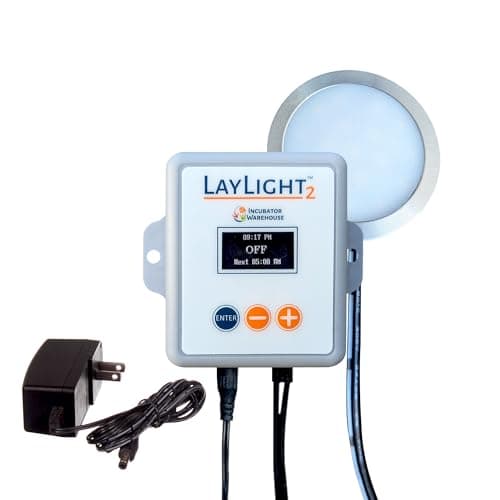
AutoCoop LayLight2 with Smart Timer
Under 3 W, up to 50 sq ft
A 3-watt LED on a programmable timer, which is the whole mechanism Mississippi State names for keeping hens in lay through short days — and it costs roughly a third of a dollar to run for a whole winter.
Two protein points above the layer level extension services call common, with the calcium left where a laying hen needs it — the one-bag answer when some birds are molting and some are still filling the nest box.
Thirty-three to thirty-eight percent calcium in a crushed form, offered free-choice — the supplement that fixes thin shells and the one most first-time keepers confuse with grit.
#ad We have no verified Amazon listing for this one, so no number is shown. How this is funded.
Score7.6no photo yet
Elanco
Elector PSP
Nil egg withdrawal
Spinosad with a nil egg withdrawal period in the US, which is the reason it exists on a backyard shelf at all — every other effective option means throwing eggs away.
#ad We have no verified Amazon listing for this one, so no number is shown. How this is funded.
FAQ
Questions people actually ask
+Why did my chickens suddenly stop laying eggs?
Check day length first. Mississippi State Extension publishes that in a well-managed flock the most common reason for a reduction in lay is a reduction of light, and that hens need at least 16 hours of light a day, with 16 to 18 recommended. Production falls as daylight shortens between June 21 and December 21. If the birds are also dropping feathers it is a molt instead, and if one hen is sitting flat in a nest box she is broody.
+How many hours of light do chickens need to lay eggs?
At least 16 hours every day, with 16 to 18 hours recommended, at a minimum intensity of one foot-candle - which Mississippi State Extension glosses as enough light to clearly see the level of feed in the feeder. The recommended color is yellow or orange, approximating the spectrum of sunlight.
+Is it cruel to put a light in the chicken coop?
The published guidance treats supplemental light as normal management for laying flocks, and the extension figure is a total day length of 16 to 18 hours rather than round-the-clock light. Adding the hours before sunrise rather than after sunset matters practically: birds need to roost in fading light rather than be dropped into sudden darkness. Hens in a natural molt should be left to finish it.
+How much does a coop light cost to run?
Almost nothing. A light drawing just under 3 watts, run 5 hours a day for a 120-day winter, uses about 1.8 kWh - roughly 33 cents at the US average residential rate of 18.34 cents per kWh (EIA, June 2026). It is the cheapest powered thing you can add to a coop, and unlike a heater it addresses a cause an extension service actually names.
+Do chickens stop laying in winter?
Most do, and the mechanism is day length rather than cold. Mississippi State Extension publishes that as daylight falls between June 21 and December 21 the birds cease to produce. A flock held at 16 or more hours of light a day keeps laying; a flock on natural light in a northern winter usually will not.
+Will more protein make my chickens lay again?
Not if the cause is day length, which is the most commonly published cause. Extra protein is the right answer during a molt, when the hen is rebuilding feathers - see the molting page for the published guaranteed analyses. It does not override a short day.
Where the numbers came from
Sources
Every figure cited on this page came from one of these documents. If one of them has changed since we read it, the number here is out of date and we would like to know.
A broody hen stops laying and guards the nest. The extension method for breaking it, the three levers that caused it, and what the breed registry actually says.