Calcium is the dividing line. Starter and grower feeds cap calcium around 1.25 percent because growing birds cannot use more. Layer feed carries much more for shell formation. All-flock splits the difference at low calcium and expects you to offer oyster shell separately. Scratch is not a complete feed at all.
The four bags
What each feed type is for.
Feed
For
Protein
Calcium
Complete feed?
Starter
Day one to laying
Around 18%
Capped, around 1.25% max
Yes
Grower
Mid-growth in some ranges
Around 16-18%
Capped
Yes
Layer
From the first egg onward
Around 16%
High, for shell formation
Yes
All-flock / flock raiser
Mixed-age or mixed-species flocks
Around 18-20%
Low
Yes, plus free-choice oyster shell
Scratch
A treat
Low
Low
No — it is a snack
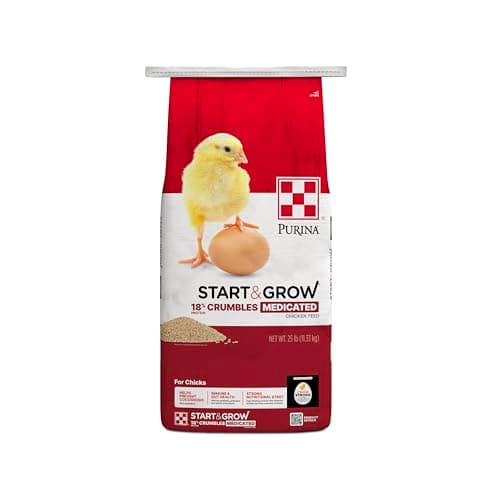
Purina publishes 18.00 percent crude protein and calcium of 0.75 to 1.25 percent for Start & Grow, and its feeding direction is explicit: feed it continuously as the sole ration from day one until the onset of egg production, then switch to a layer feed. That single line answers the switching question better than any rule of thumb about weeks.
Why calcium is the dividing line
An eggshell is largely calcium carbonate, and a laying hen puts a remarkable amount of calcium into one every day or two. Layer feed exists to supply it.
A growing pullet is not doing that. Feed her the same calcium and she cannot use it, and the excess is handled by her kidneys — which is the reason chick starter caps calcium rather than simply not adding it. This is why “feed layer pellets from the start, it is simpler” is bad advice, and why the caps on the starter labels are maximums rather than minimums.
All-flock, and why it exists
All-flock or flock-raiser feeds are formulated at a decent protein level with low calcium, on the assumption that you will put oyster shell out free-choice so the laying birds take what they need and everybody else does not.
That makes it the right answer for a mixed flock: pullets and laying hens together, or chickens with ducks, or a flock with a rooster in it. Roosters have no use for layer calcium either.
If the mixed flock in question actually includes ducks, chickens and ducks together carries the rest of it: the published space figures, the one nutrient a chick ration does not supply enough of, the drinker a duck can physically use — and the species that should not join the coop at all.
For a flock of laying hens all the same age, layer feed plus free-choice oyster shell is simpler and usually cheaper. All-flock is a solution to a mixing problem.
There is one period when even a same-age flock stops fitting layer feed, and it arrives every year: the molt. A hen who has stopped laying no longer has anywhere to put shell calcium, and she needs more protein than usual to rebuild a coat of feathers. Chicken molting compares the published guaranteed analyses for that stretch, and finds the bag marketed for molt is not the one the numbers point at.
Scratch is not chicken feed
Scratch is cracked corn and grains. It is a treat, it is low in protein, and it is not balanced. Birds love it, which is exactly the problem: a flock filling up on scratch is a flock not eating its complete feed, and the effects show up in shell quality and feather condition before they show up anywhere obvious.
The usual guidance is to keep treats of all kinds to a small proportion of the diet and to feed scratch in the afternoon, so the birds have eaten properly first. In winter a little scratch before roosting is genuinely useful because digesting it generates heat overnight.
Any bird eating scratch also needs grit, because whole grain has to be ground in the gizzard and a bird with no stones cannot do it. Grit and oyster shell covers that.
Reading a guaranteed analysis
Four lines tell you nearly everything:
Crude protein, minimum. 18 percent for growing birds, around 16 for layers, higher for all-flock.
Calcium, minimum and maximum. A maximum near 1.25 percent means a growing feed. A high minimum means a layer feed.
Lysine and methionine. The two limiting amino acids, which is why they are broken out separately. Higher is better within the same feed type.
Crude fiber, maximum. Lower means more of the bag is doing nutritional work.
Heads up: some links on this page are affiliate links. If you buy through one we may earn a commission at no extra cost to you. It never changes a ranking, and we take no payment for placement. The full version.
The short answer
The short list
Ranked on the published rubric. Every row jumps to that product's full write-up below; the button goes straight to Amazon.
#
Pick
Best for
Key spec
Score
Price
1
Our pick
Purina
Start & Grow Medicated Chick Feed
Eighteen percent crude protein with amprolium at 0.0125 percent, and a feeding direction that tells you exactly when to stop: day one until the first egg, then switch.
Thirty-three to thirty-eight percent calcium in a crushed form, offered free-choice — the supplement that fixes thin shells and the one most first-time keepers confuse with grit.
Insoluble crushed granite, which is the actual definition of grit and the reason it is not oyster shell — a bird with no access to stones cannot digest whole grain, scratch or grass.
#adPrices as of October 18, 2026. Scores are our own published rubric, not customer ratings.
#1 · Chicks from a mixed-source order
Purina Start & Grow Medicated Chick Feed
Eighteen percent crude protein with amprolium at 0.0125 percent, and a feeding direction that tells you exactly when to stop: day one until the first egg, then switch.
Who it is for. Anybody with unvaccinated chicks, and particularly anybody brooding on reused bedding or in a space that has held birds before.
Published specifications
Crude protein (min)
18.00%
Medication
Amprolium, max 0.0125% (113.50 g/ton), to help prevent coccidiosis
Lysine (min)
0.90%
Methionine (min)
0.30%
Crude fat (min)
3.00%
Crude fiber (max)
5.00%
Calcium
0.75% min, 1.25% max
Phosphorus (min)
0.40%
Vitamin A (min)
5,000 IU/lb
Feeding directions
Feed continuously as the sole ration from day one until onset of egg production, then switch to a layer feed
Thirty-three to thirty-eight percent calcium in a crushed form, offered free-choice — the supplement that fixes thin shells and the one most first-time keepers confuse with grit.
Who it is for. Anybody whose hens have started laying, particularly if shells are thinning or breaking in the nest.
#ad We have no verified Amazon listing for this one, so no number is shown. How this is funded.
#3 · Birds eating anything but crumble
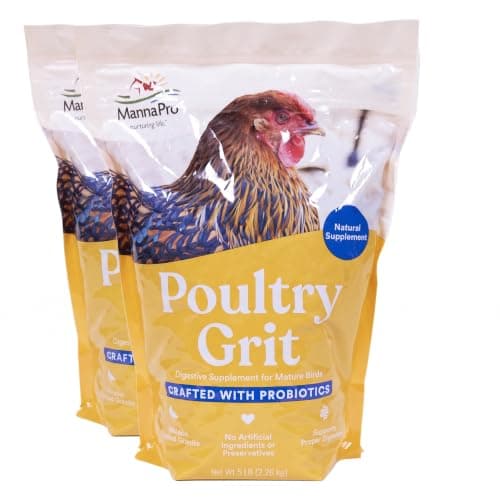
Manna Pro Poultry Grit with Probiotics
Insoluble crushed granite, which is the actual definition of grit and the reason it is not oyster shell — a bird with no access to stones cannot digest whole grain, scratch or grass.
Who it is for. Any confined flock that gets scratch, treats or greens, which is very nearly every backyard flock.
Published specifications
Material
Insoluble crushed granite
Added
Probiotics
Purpose
Aids proper digestion of coarse grains for all classes of poultry
Guaranteed analysis
Not published for the grit itself
Source: Manna Pro, Poultry Grit product listings, retrieved 2026-09-01
Rubric — 7.6 / 10
Capacity honesty8/10 · weight 26%
Documentation5/10 · weight 24%
Build and weather8/10 · weight 20%
Running cost9/10 · weight 15%
Daily use9/10 · weight 15%
What it gets right
Insoluble is the operative word and it is stated plainly: this stays in the gizzard and grinds, where oyster shell dissolves
Suitable for all classes of poultry, so one bag covers pullets and hens
Necessary the moment a bird eats anything that is not a complete crumble or pellet — treats, scratch, grass, kitchen scraps
What it costs you
Manna Pro publishes no guaranteed analysis or particle size for the grit itself, so you cannot check it is sized for your birds' age
The added probiotics have no published inclusion rate, which makes them hard to value
Birds with free range over stony ground find their own grit and do not need this at all
Skip it if. Your birds free-range over gravel or coarse soil and eat nothing but complete feed. They are already sorted.
+What is the difference between layer feed and all flock?
Calcium. Layer feed carries a high level for shell formation and suits a flock of laying hens all the same age. All-flock is formulated with low calcium and higher protein for mixed-age or mixed-species flocks, on the assumption that you offer oyster shell free-choice so only the laying birds take the calcium.
+What is the difference between chicken feed and scratch?
Complete feed is nutritionally balanced and is the whole diet. Scratch is cracked corn and grains — a low-protein treat that is not balanced. Birds prefer it, which is the problem: a flock filling up on scratch is not eating its complete feed, and shell quality and feather condition suffer before anything obvious does.
+When do I switch from starter to layer feed?
At the onset of egg production. Purina's own feeding direction on Start & Grow is to feed it continuously as the sole ration from day one until egg production starts, then switch. Age is a proxy that varies by breed; the first egg is the actual signal.
+Can I feed layer feed to a rooster?
It is not ideal. A rooster has no use for the calcium in layer feed and, like a growing pullet, has to excrete the excess. A mixed flock with a rooster is the situation all-flock feed with free-choice oyster shell exists for — the hens take the calcium they need and nobody else does.
Where the numbers came from
Sources
Every figure cited on this page came from one of these documents. If one of them has changed since we read it, the number here is out of date and we would like to know.
Layer feeds compared on published protein, calcium, methionine and fiber against the extension figures for a hen in production - plus when a layer ration is the wrong choice.
The published 10% ceiling, the dilution arithmetic that shows where a ration actually breaks, and the treats worth buying - with the grit their makers say to provide alongside.