Chicken treats, and the arithmetic of the 10 percent rule
Extension services put scratch and treats at about 10 percent of daily intake. That sounds arbitrary until you run the protein numbers, at which point it turns out to have real headroom - and a hard edge not far past it.
Every treat dilutes the complete ration it displaces, and the published ceiling is modest. University of Maryland Extension publishes that “generally scratch grain should be about 10% of the birds total daily food consumption”, and University of Georgia Extension warns that mixing it into formulated feed “causes a nutrient imbalance in the total diet of the birds, increasing the calories while reducing the protein, vitamin, and mineral content.” The arithmetic below shows what that costs at 10 percent, and where it genuinely breaks.
What 10 percent actually costs you
The rule is usually repeated without a number attached, which makes it easy to dismiss. So here it is with numbers, using two published guaranteed analyses: a 16 percent layer feed and Manna Pro's own 7-Grain scratch at 9 percent crude protein.
Two honest caveats. This is a protein calculation only; the UGA warning also covers vitamins and minerals, and those dilute on the same curve without a single headline number to track. And calcium dilutes hardest of all — the treat on this page publishes 0.01 to 0.25 percent calcium against a layer feed's 3.25 to 4.25, so treats are doing far more damage to shell calcium than to protein.
How we judged treats
Does it publish a guaranteed analysis? Almost nothing in the treat aisle does, and without one you cannot run the arithmetic above at all.
How badly does it dilute? A 14 percent treat barely moves a 16 percent ration. A 9 percent scratch moves it more. A fat-heavy seed mix moves the calorie balance most of all.
Does it come with a per-bird quantity? “Feed as a treat” is not a direction. A tablespoon figure is.
Does the maker mention grit? Anything coarse needs it, and the makers that say so are the ones paying attention.
The requirement most treat sellers leave out
A chicken has no teeth. Coarse food is ground in the gizzard against grit the bird has swallowed, and University of Maryland publishes that insoluble grit should be provided when feeding scratch grain. Manna Pro puts it directly in the Harvest Delight feeding directions: when feeding coarse grains, always provide a source of natural stones or free-choice poultry grit.
That is why a bag of grit is the third pick on a treats page. It is not an upsell; it is the condition under which the other two products are safe to feed. The grit and oyster shell page covers the adult flock, and the chick grit page covers the brooder, where the same rule applies the first time a chick gets anything other than crumble.
Why the high-protein treats are the better buy
It follows directly from the arithmetic. If dilution is the cost of treating, the treat that dilutes least is the one closest to the ration it displaces. Dried black soldier fly larvae are listed at 49 percent protein — well above any feed — so modest amounts pull the total diet's protein up rather than down.
What not to feed, with the reasons
Scratch as a winter “warming” feed. The habit is to pile it on in cold weather, which is exactly when a flock most needs the balanced ration. The winter care page covers what actually helps.
Treats during a heat wave. poultry.extension.org specifically says to limit treats and not overfeed scratch grains in extreme heat — see the hot weather page.
Anything mixed into the feed. UGA's warning is about mixing specifically: it unbalances the whole ration rather than just adding to it. Scatter treats separately, and late in the day once the birds have eaten their feed.
Treats for birds in molt. A molting hen needs more protein and more methionine, not diluted feed. That is a feed change, not a treat.
Heads up: some links on this page are affiliate links. If you buy through one we may earn a commission at no extra cost to you. It never changes a ranking, and we take no payment for placement. The full version.
The short answer
The short list
Ranked on the published rubric. Every row jumps to that product's full write-up below; the button goes straight to Amazon.
#
Pick
Best for
Key spec
Score
Price
1
Our pick
Manna Pro
Harvest Delight Poultry Treat, 2.25 lb
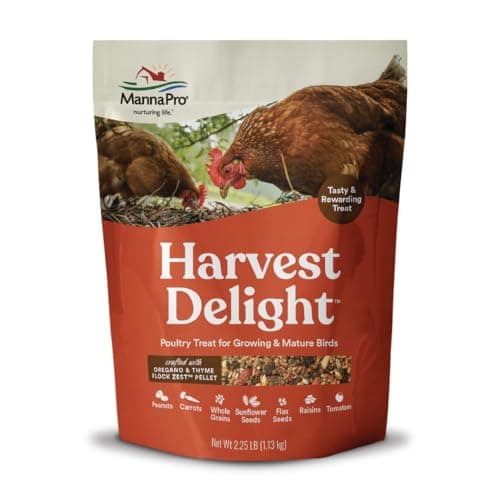
The rare treat that publishes a full guaranteed analysis, and at 14 percent protein it dilutes a layer ration far less than plain scratch does — though its 10 percent fat and near-zero calcium are the reason it is still a treat.
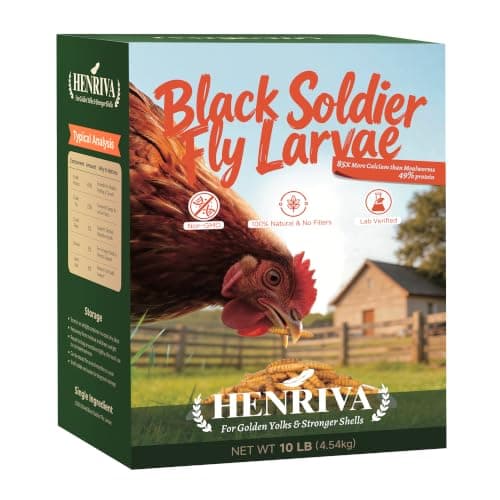
Black soldier fly larvae are the high-protein treat worth buying over mealworms, and the listed 49 percent protein is the reason — but no supplier in this category publishes a guaranteed analysis, so that figure is a claim rather than a label guarantee.
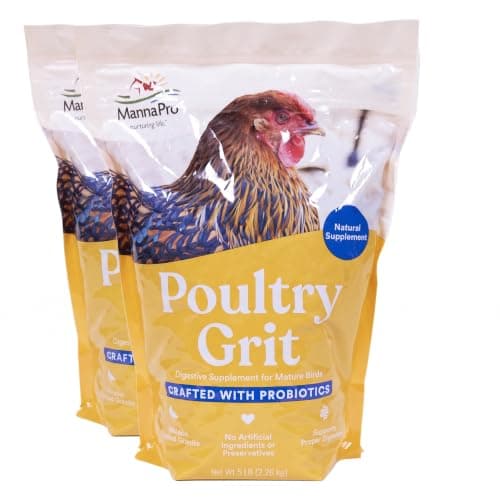
Insoluble crushed granite, which is the actual definition of grit and the reason it is not oyster shell — a bird with no access to stones cannot digest whole grain, scratch or grass.
#adPrices as of September 21, 2026. Scores are our own published rubric, not customer ratings.
#1 · A treat with a published analysis
Manna Pro Harvest Delight Poultry Treat, 2.25 lb
The rare treat that publishes a full guaranteed analysis, and at 14 percent protein it dilutes a layer ration far less than plain scratch does — though its 10 percent fat and near-zero calcium are the reason it is still a treat.
Who it is for. Keepers who want a treat they can account for nutritionally, and who will measure the tablespoons rather than pour by eye.
Published specifications
Crude protein (min)
14.00%
Lysine (min)
0.40%
Methionine (min)
0.10%
Crude fat (min)
10.00%
Crude fiber (max)
10.00%
Calcium
0.01% min, 0.25% max
Phosphorus (min)
0.25%
Feeding directions
Feed 1/2 to 2 tablespoons per bird daily depending on size; when feeding coarse grains, always provide natural stones or free-choice poultry grit
Source: Manna Pro, Harvest Delight Poultry Treats published guaranteed analysis, ingredients and feeding directions (mannapro.com), retrieved 2026-09-21
Rubric — 8.2 / 10
Capacity honesty8/10 · weight 26%
Documentation10/10 · weight 24%
Build and weather8/10 · weight 20%
Running cost6/10 · weight 15%
Daily use8/10 · weight 15%
What it gets right
Publishes a complete guaranteed analysis, which almost nothing else in the treat aisle does
14 percent protein is close enough to a 16 percent layer ration that modest amounts barely move the flock's total
The feeding direction states a per-bird quantity rather than 'feed as a treat', so it can actually be followed
Manna Pro's own directions tell you to provide grit alongside it, which is the instruction most treat sellers omit
What it costs you
10 percent minimum crude fat is high, and fat is where treat calories quietly displace balanced ones
Calcium is essentially zero at 0.01 to 0.25 percent, against 3.25 to 4.25 percent in a layer feed — every gram of this dilutes shell calcium
0.10 percent methionine is a third of what a layer feed carries, so it dilutes the feather nutrient too
2.25 lb is a small bag, and a flock that likes it will go through it fast enough to make the per-pound cost sting
Skip it if. You are already at the extension ceiling of roughly 10 percent of daily intake from scratch and treats. Adding a second treat product does not reset that ceiling.
Black soldier fly larvae are the high-protein treat worth buying over mealworms, and the listed 49 percent protein is the reason — but no supplier in this category publishes a guaranteed analysis, so that figure is a claim rather than a label guarantee.
Who it is for. Anybody who needs a flock to come when called, and who wants the higher-protein option rather than corn scratch.
Published specifications
Protein
49%, as listed by the seller
Form
Whole dried larvae
Quantity
10 lb
Listed for
Chickens, ducks and wild birds
Guaranteed analysis
NOT PUBLISHED
Source: Published product listing (protein claim, quantity, form). No manufacturer guaranteed analysis exists for this category. Retrieved 2026-09-21
Rubric — 5.9 / 10
Capacity honesty7/10 · weight 26%
Documentation2/10 · weight 24%
Build and weather6/10 · weight 20%
Running cost7/10 · weight 15%
Daily use9/10 · weight 15%
What it gets right
Black soldier fly larvae carry substantially more calcium than mealworms, which is the reason to choose them for laying hens
A high-protein treat is the one kind that dilutes a ration least, because protein is what the ration is built around
Dried larvae are the most effective training and taming treat there is, which has real welfare value for a flock you need to handle
10 lb lasts a small flock a very long time at the published treat ceiling
What it costs you
No guaranteed analysis is published by any supplier we could find, so the 49 percent is a listing claim with no label behind it
The calcium comparison to mealworms is marketing language, not a published figure — we could not source a number for either
Unbranded and interchangeable: this category has no manufacturer documentation at all
Extremely palatable, which makes it the treat most likely to blow past the 10 percent ceiling
Skip it if. You want a treat you can account for nutritionally. Nothing in this category publishes a guaranteed analysis, and a treat with a label beats one with a claim.
Insoluble crushed granite, which is the actual definition of grit and the reason it is not oyster shell — a bird with no access to stones cannot digest whole grain, scratch or grass.
Who it is for. Any confined flock that gets scratch, treats or greens, which is very nearly every backyard flock.
Published specifications
Material
Insoluble crushed granite
Added
Probiotics
Purpose
Aids proper digestion of coarse grains for all classes of poultry
Guaranteed analysis
Not published for the grit itself
Source: Manna Pro, Poultry Grit product listings, retrieved 2026-09-01
Rubric — 7.6 / 10
Capacity honesty8/10 · weight 26%
Documentation5/10 · weight 24%
Build and weather8/10 · weight 20%
Running cost9/10 · weight 15%
Daily use9/10 · weight 15%
What it gets right
Insoluble is the operative word and it is stated plainly: this stays in the gizzard and grinds, where oyster shell dissolves
Suitable for all classes of poultry, so one bag covers pullets and hens
Necessary the moment a bird eats anything that is not a complete crumble or pellet — treats, scratch, grass, kitchen scraps
What it costs you
Manna Pro publishes no guaranteed analysis or particle size for the grit itself, so you cannot check it is sized for your birds' age
The added probiotics have no published inclusion rate, which makes them hard to value
Birds with free range over stony ground find their own grit and do not need this at all
Skip it if. Your birds free-range over gravel or coarse soil and eat nothing but complete feed. They are already sorted.
The ones that dilute the ration least and come with a published analysis. Manna Pro Harvest Delight publishes a full guaranteed analysis at 14% protein, close enough to a 16% layer feed that modest amounts barely move the total. Dried black soldier fly larvae are higher in protein again, though no supplier in that category publishes a guaranteed analysis.
+How many treats can chickens have a day?
University of Maryland Extension publishes that scratch grain should be about 10% of total daily food consumption. Running the numbers, a 16% layer ration with 10% scratch still gives 15.3% protein in the total diet. It falls below the published 14% layer minimum at just under 30% treats.
+Do chickens need grit with treats?
Yes, for anything coarse. A chicken grinds food in the gizzard against swallowed stone. University of Maryland publishes that insoluble grit should be provided when feeding scratch grain, and Manna Pro's own Harvest Delight directions say to always provide natural stones or free-choice grit when feeding coarse grains.
+Is scratch bad for chickens?
Not in itself - it is bad as a substitute for a complete ration. University of Georgia Extension says scratch should not be considered a complete feed for any bird, and that mixing it into formulated feed causes a nutrient imbalance by increasing calories while reducing protein, vitamins and minerals. Scatter it separately, keep it near the published 10% ceiling, and provide grit.
+Are dried mealworms or black soldier fly larvae better for chickens?
Black soldier fly larvae are the usual recommendation for laying hens because they carry more calcium than mealworms. We have to be careful here: no supplier in the category publishes a guaranteed analysis, and the frequently repeated calcium comparison is marketing language with no published figure behind it on either side.
+Should I give chickens extra scratch in winter to keep them warm?
It is a popular habit with a weak basis, and winter is when a flock most needs its balanced ration intact. The extension warnings about dilution do not pause for cold weather. Deal with cold through ventilation and a dry coop rather than through the feed scoop.
Where the numbers came from
Sources
Every figure cited on this page came from one of these documents. If one of them has changed since we read it, the number here is out of date and we would like to know.
Layer feeds compared on published protein, calcium, methionine and fiber against the extension figures for a hen in production - plus when a layer ration is the wrong choice.