A chick on nothing but starter crumble does not need grit. The day she gets a treat, a blade of grass or a scoop of scratch, she does - and the two makers here put the start age two weeks apart.
Grit is not a supplement, it is machinery. A chicken has no teeth; the gizzard grinds food against small stones the bird has swallowed. The published rule is about the food, not the age: University of Maryland Extension says an insoluble grit should be provided when feeding scratch grain, and notes that birds with access to the ground usually find enough for themselves. A chick eating only complete starter crumble needs none. A chick eating anything else does.
The rule, and why crumble is the exception
Complete starter feed is manufactured to be swallowed and digested without grinding. That is the entire reason a brooder full of chicks on crumble can run for weeks with no grit and no problem, and it is why the “do chicks need grit” question has two correct answers depending on what is in the feeder.
The moment anything else enters the diet the answer flips. Scratch, mealworms, kitchen scraps, chopped greens, or the simple act of putting the brooder box on grass for an afternoon all introduce material that has to be ground. Without grit in the gizzard it does not get ground properly, and the classic result is an impacted crop in a bird that looked fine yesterday.
Where the makers disagree
Here is the thing the search results will not tell you cleanly, because the two best-documented products on the shelf give different answers.
Published feeding directions, read from each maker 2026-09-21.
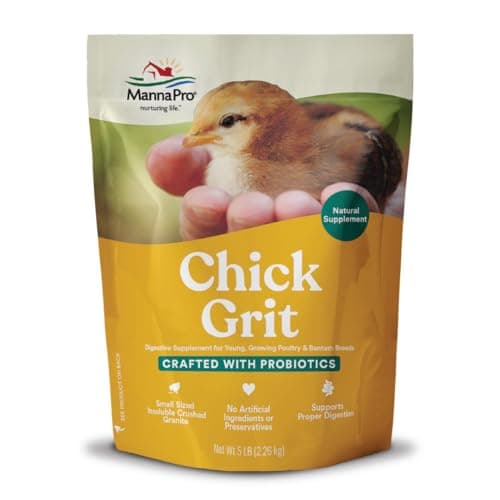
Manna Pro Chick Grit
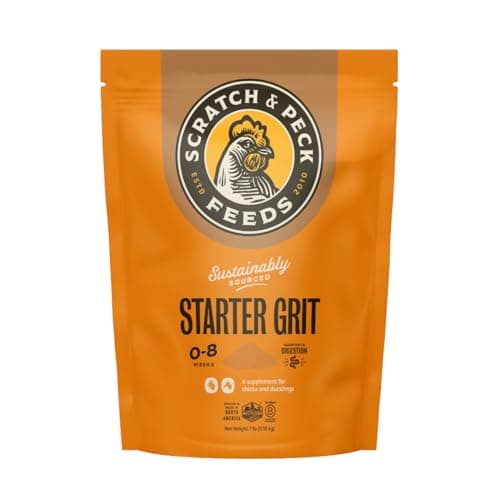
Scratch and Peck Starter Grit
Published start
“beginning at two weeks of age”
Labeled “Chicken 0-8 Weeks”
Material
Insoluble crushed granite
Insoluble crushed quartzite and/or granite
How to offer
In a separate feeder, protected from the elements
Sprinkled on feed for the first few days, then a separate dish free-choice
Monitoring
Monitor intake for the first few days
Not specified
Neither maker publishes its reasoning, and we are not going to invent one. What we can say is that the disagreement does not matter much in practice, because the extension rule overrides both: if the chicks are eating only crumble, neither product is needed yet; once they are eating anything else, both makers agree grit should be available. The start age is a proxy for “about when people start offering treats”, and your own brooder will tell you that date more accurately than either label.
What we judged these on
Is it genuinely insoluble? Granite and quartzite are. Anything that dissolves is calcium, not grit, and belongs in a different dish.
Is the particle chick-sized? The one spec that separates chick grit from adult grit — and, frustratingly, the one neither maker publishes as a number.
Does the maker publish a start age and a way to offer it? Directions are documentation. A bag of rock with no instructions is doing less work than it could.
Is the quantity sane for a brooder? Grit is eaten in tiny amounts. A 25 lb sack is not a better deal if the birds outgrow the particle size first.
How to offer it, and the mistake to avoid
Free-choice, in a separate shallow dish, is the method both makers converge on and the one this site recommends everywhere else. The reason is that the bird self-regulates: she takes what her gizzard needs and ignores the rest. Mixing grit into feed removes that choice and means every bird gets the same dose whether she needs it or not.
The mistake worth naming is the one that comes from good intentions: do not offer chick grit and oyster shell as a pair to chicks. Oyster shell is soluble calcium for birds actively forming eggshells, and the same extension material this site cites elsewhere is clear that excess calcium is hard on growing birds. Chicks get grit. They do not get oyster shell.
Heads up: some links on this page are affiliate links. If you buy through one we may earn a commission at no extra cost to you. It never changes a ranking, and we take no payment for placement. The full version.
The short answer
The short list
Ranked on the published rubric. Every row jumps to that product's full write-up below; the button goes straight to Amazon.
#
Pick
Best for
Key spec
Score
Price
1
Our pick
Manna Pro
Chick Grit with Probiotics, 5 lb
Insoluble crushed granite in a chick-sized particle, and the only product here whose maker publishes a start age — two weeks — which is the question the whole category leaves unanswered.
The same insoluble rock in a chick particle, labeled from day one rather than two weeks, with feeding directions that tell you to sprinkle it on feed at first and move to free-choice after.
Insoluble crushed granite, which is the actual definition of grit and the reason it is not oyster shell — a bird with no access to stones cannot digest whole grain, scratch or grass.
#adPrices as of September 21, 2026. Scores are our own published rubric, not customer ratings.
#1 · Chicks from two weeks old
Manna Pro Chick Grit with Probiotics, 5 lb
Insoluble crushed granite in a chick-sized particle, and the only product here whose maker publishes a start age — two weeks — which is the question the whole category leaves unanswered.
Who it is for. Anybody whose chicks are past two weeks and getting anything other than crumble — treats, greens, scratch, or time on grass.
Published specifications
Material
Insoluble crushed granite
Particle size
Small size, for growing poultry and bantam breeds
Guaranteed analysis
Total microorganisms, min 2.5 x 10^8 CFU/lb
Directions
Feed to young birds beginning at two weeks of age; provide in a separate feeder, protected from the elements; monitor intake for the first few days
Other ingredients
Grit, vegetable oil, and five dried fermentation products
Bag
5 lb
Source: Manna Pro, Chick Grit with ProBiotics published product information and feeding directions, retrieved 2026-09-21
Rubric — 7.9 / 10
Capacity honesty9/10 · weight 26%
Documentation6/10 · weight 24%
Build and weather8/10 · weight 20%
Running cost9/10 · weight 15%
Daily use8/10 · weight 15%
What it gets right
Publishes a start age — two weeks — which no other grit on this page does, and it is the number keepers actually search for
Says to provide it in a separate feeder rather than mixed into feed, which is the same free-choice principle this site applies to oyster shell
Insoluble crushed granite is the correct material: it grinds and does not dissolve, unlike the oyster shell it is routinely confused with
5 lb is a sensible quantity for a brooder — grit is consumed in tiny amounts and a big bag would outlive the birds' need for chick-sized particles
What it costs you
The only guaranteed analysis published is the probiotic count; there is no published particle-size range, which is the spec that actually distinguishes chick grit from adult grit
The probiotics are a marketing addition to a product made of rock — useful or not, they are not why you are buying grit
Manna Pro's two-week start age contradicts Scratch and Peck's 0-8 week labeling, and neither publishes the reasoning
Monitoring intake for the first few days is real work that the packaging makes sound trivial
Skip it if. Your chicks are eating nothing but starter crumble and have no access to the ground. A complete crumble needs no grinding, and that is the one case where grit genuinely is not required yet.
Scratch and Peck Feeds Starter Grit for Chickens & Ducks, 7 lb
The same insoluble rock in a chick particle, labeled from day one rather than two weeks, with feeding directions that tell you to sprinkle it on feed at first and move to free-choice after.
Who it is for. Keepers who want grit available from the first week, and anybody already running the Scratch and Peck system who wants the matching product.
Published specifications
Material
Insoluble crushed quartzite and/or granite
Particle size
Small sized for baby chicks
Labeled for
Chicken 0-8 weeks; duck 0-8 weeks
Directions
Sprinkle directly on feed for the first few days, then offer in a separate dish, free-choice, for birds to consume as they need
The published age range starts at zero, so there is no window where the label leaves you guessing
The two-stage direction — on the feed first, then free-choice — is a genuinely better onboarding instruction than 'provide free-choice' alone
Quartzite as well as granite, both insoluble, both correct for a gizzard
From a maker that publishes full guaranteed analyses on its feeds, which is why its grit labeling is more careful than most
What it costs you
No guaranteed analysis at all is published for the grit itself, and no particle-size figure — you are trusting the word 'small'
Labeled only to 8 weeks, so you are buying a second product for the adult flock either way
Sprinkling grit on feed runs against the free-choice principle the same makers apply elsewhere; it is a deliberate exception for very young birds and the reasoning is not published
Costs noticeably more per pound than the crushed granite alternative, for a bag of rock
Skip it if. You are already buying Manna Pro's chick grit and your birds are over two weeks. These do the same job and the difference is labeling, not chemistry.
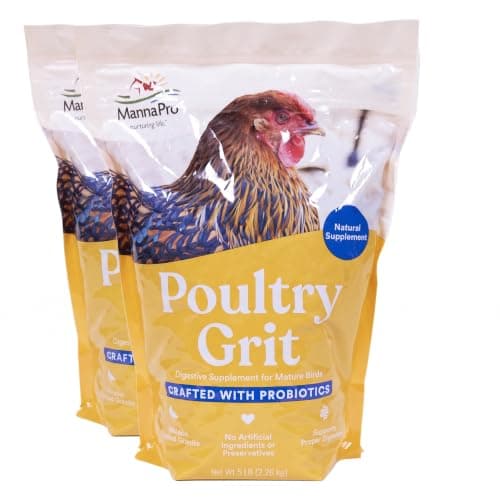
Insoluble crushed granite, which is the actual definition of grit and the reason it is not oyster shell — a bird with no access to stones cannot digest whole grain, scratch or grass.
Who it is for. Any confined flock that gets scratch, treats or greens, which is very nearly every backyard flock.
Published specifications
Material
Insoluble crushed granite
Added
Probiotics
Purpose
Aids proper digestion of coarse grains for all classes of poultry
Guaranteed analysis
Not published for the grit itself
Source: Manna Pro, Poultry Grit product listings, retrieved 2026-09-01
Rubric — 7.6 / 10
Capacity honesty8/10 · weight 26%
Documentation5/10 · weight 24%
Build and weather8/10 · weight 20%
Running cost9/10 · weight 15%
Daily use9/10 · weight 15%
What it gets right
Insoluble is the operative word and it is stated plainly: this stays in the gizzard and grinds, where oyster shell dissolves
Suitable for all classes of poultry, so one bag covers pullets and hens
Necessary the moment a bird eats anything that is not a complete crumble or pellet — treats, scratch, grass, kitchen scraps
What it costs you
Manna Pro publishes no guaranteed analysis or particle size for the grit itself, so you cannot check it is sized for your birds' age
The added probiotics have no published inclusion rate, which makes them hard to value
Birds with free range over stony ground find their own grit and do not need this at all
Skip it if. Your birds free-range over gravel or coarse soil and eat nothing but complete feed. They are already sorted.
Only if they are eating something other than complete starter crumble. Crumble is manufactured to be digested without grinding. As soon as chicks get treats, greens, scratch or time on the ground, they need insoluble grit - University of Maryland Extension publishes that grit should be provided when feeding scratch grain.
+When should I start giving chicks grit?
The makers disagree: Manna Pro's directions say to begin at two weeks of age, while Scratch and Peck labels its starter grit for chickens 0 to 8 weeks. Neither publishes the reasoning. The practical answer is to have it available from the first time you offer anything other than crumble.
+What is the difference between chick grit and regular grit?
Particle size, and nothing else that matters - both are insoluble crushed rock, usually granite or quartzite. Chick grit is ground small enough for a chick's gizzard. Neither maker on this page publishes an actual particle-size figure, which is the one specification that would let you verify the difference.
+Is grit the same as oyster shell?
No, and confusing them is the most common mistake in this category. Grit is insoluble rock that stays in the gizzard and grinds food. Oyster shell is soluble calcium that dissolves and goes into eggshells. Chicks need grit once they eat coarse food; they should not be given oyster shell, because excess calcium is hard on growing birds.
+How do you feed grit to chicks?
Free-choice in a separate shallow dish, so each bird takes what she needs. Manna Pro says to provide it in a separate feeder protected from the elements and to monitor intake for the first few days. Scratch and Peck suggests sprinkling it on the feed for the first few days before moving to a free-choice dish.
+Do free range chicks need grit?
Often much less. University of Maryland Extension notes that birds with access to the ground usually find enough grit themselves in the form of small stones. Confined birds, and birds on ground with no stone in it, are the ones that depend on you providing it.
Where the numbers came from
Sources
Every figure cited on this page came from one of these documents. If one of them has changed since we read it, the number here is out of date and we would like to know.