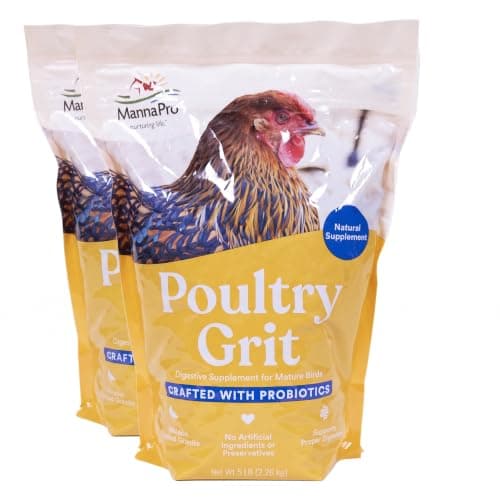
Grit is insoluble crushed granite that stays in the gizzard and grinds food. Oyster shell is a soluble calcium supplement at 33 to 38 percent calcium for laying hens forming shells. They do different jobs, they are needed at different times, and both go in separate free-choice dishes rather than mixed into feed.
Grit: the teeth a chicken does not have
A chicken has no teeth. Food goes to the gizzard, a muscular organ that grinds it against small stones the bird has swallowed. Without those stones the gizzard cannot process anything that is not already ground.
That is not an abstraction. The published cause of an impacted crop is a bird eating poorly digestible material — long grass being the one that catches backyard keepers out — and the crop problems page covers how to tell an impaction apart from the two other conditions people call sour crop.
Manna Pro publishes its poultry grit as insoluble crushed granite, and insoluble is the operative word. It stays in the gizzard and does its job for weeks before wearing down. Oyster shell dissolves in acid within hours and grinds nothing.
When grit is needed: the moment a bird eats anything that is not complete crumble or pellets. Scratch, treats, kitchen scraps, grass, insects — all of it needs grinding. Birds ranging over stony ground find their own; confined birds on complete feed plus treats do not.
Oyster shell: calcium on demand
Manna Pro publishes 33 to 38 percent calcium, from oyster shell and coral calcium, in a coarse crushed form. A laying hen forms a shell overnight and needs a supply of calcium available while she does it. The coarse form matters: it sits in the gizzard and dissolves slowly, releasing calcium over hours rather than all at once.
When oyster shell is needed: from the first egg, and not before. A growing pullet has no use for it and the excess is a burden on her kidneys.
How much it matters scales with how hard your hens are working. A breed published at 250 or more eggs a year is building 250 shells out of calcium she does not carry, and it is the high-output birds in the egg-laying breed comparison that show thin or soft shells first when free-choice calcium is not available.
Side by side
The two products, on their published properties.
Grit
Oyster shell
What it is
Insoluble crushed granite
Crushed oyster shell and coral calcium
Published composition
Insoluble granite (Manna Pro)
33.00% to 38.00% calcium (Manna Pro)
What it does
Grinds food in the gizzard
Supplies calcium for eggshells
Dissolves?
No
Yes
Needed by
Any bird eating anything but complete crumble
Laying hens only
When
From the first treat onward
From the first egg onward
How offered
Free-choice, separate dish
Free-choice, separate dish
Mixed into feed?
Never
Never
Why free-choice, and never in the feed
Both products go in their own small dish where the birds can help themselves. There are two reasons and they are different for each.
Grit: birds regulate their own intake and take more when they are eating more coarse material. Mixing it into feed means they eat it in proportion to feed rather than to need, and it displaces nutrition.
Oyster shell: this is the important one. In any flock some birds are laying and some are not — pullets coming up to lay, hens in molt, a rooster. Free-choice means the laying birds take calcium and the others leave it alone. Mixed into feed, every bird gets it whether they can use it or not.
How much to put out
A small amount, topped up when it goes down. These are supplements consumed in grams, not pounds; a bag of either lasts a backyard flock a very long time, which is why the sensible purchase is the smallest bag you can find rather than the best value per pound.
Both keep indefinitely if dry. Both turn into an unusable lump if they get wet, so a covered dish or a spot under shelter is worth arranging — the same storage discipline as feed, scaled down.
Heads up: some links on this page are affiliate links. If you buy through one we may earn a commission at no extra cost to you. It never changes a ranking, and we take no payment for placement. The full version.
The picks
The two dishes, and somewhere to keep the bags
Grit and oyster shell go in separate free-choice dishes, never mixed into feed, and both come in bags that outlast a small flock by a long way.
Manna Pro
Poultry Grit with Probiotics
Insoluble crushed granite
Best for: Birds eating anything but crumble
Insoluble crushed granite, which is the actual definition of grit and the reason it is not oyster shell — a bird with no access to stones cannot digest whole grain, scratch or grass.
Thirty-three to thirty-eight percent calcium in a crushed form, offered free-choice — the supplement that fixes thin shells and the one most first-time keepers confuse with grit.
#ad We have no verified Amazon listing for this one, so no number is shown. How this is funded.
Score7.7no photo yet
Gamma2
Vittles Vault Outback, 20 lb
20-25 lb, 12 x 12 x 9.75 in
Best for: Grit, oyster shell and scratch
The small version, and the honest use for it is not feed at all — it is the second and third container you need once you are also storing grit, oyster shell and scratch.
#ad We have no verified Amazon listing for this one, so no number is shown. How this is funded.
FAQ
Questions people actually ask
+Is oyster shell the same as grit?
No. Grit is insoluble crushed granite that stays in the gizzard and grinds food. Oyster shell is a soluble calcium supplement at 33 to 38 percent calcium, for laying hens forming eggshells. Oyster shell dissolves within hours and grinds nothing, so it cannot substitute for grit.
+Do chickens need grit?
Any bird eating anything other than complete crumble or pellets does, because whole grain, treats, grass and scraps all have to be ground in the gizzard against swallowed stones. Birds ranging over stony ground find their own; confined birds getting treats need it offered free-choice in a separate dish.
+When should I start giving oyster shell?
From the first egg, and not before. A growing pullet cannot use the calcium and the excess is a burden on her kidneys. Offer it free-choice in a separate dish rather than mixing it into feed, so the birds that are laying take it and the ones that are not leave it alone.
+Can I use crushed eggshells instead of oyster shell?
Yes — dried, crushed eggshell is calcium carbonate and hens will take it. Crush it thoroughly so it does not resemble an egg, because a hen that makes the connection can start eating eggs in the nest and that habit is close to incurable. Dry it properly before offering it.
Where the numbers came from
Sources
Every figure cited on this page came from one of these documents. If one of them has changed since we read it, the number here is out of date and we would like to know.
Layer feeds compared on published protein, calcium, methionine and fiber against the extension figures for a hen in production - plus when a layer ration is the wrong choice.
The published 10% ceiling, the dilution arithmetic that shows where a ration actually breaks, and the treats worth buying - with the grit their makers say to provide alongside.
Why the published definition of egg-bound is internal laying rather than a stuck egg, what extension sources actually say about treatment, and the calcium that prevents the version you can prevent.