Chickens and ducks together: the feed, the water, and the species that cannot join
A mixed flock works, and the published figures say what has to change: ducks need 50 percent more indoor space, a drinker a chicken waterer cannot be, and a feed that nobody formulated for both. Turkeys are a different answer entirely.
Yes, and two things have to change. Feed: ducks and non-laying birds should not be on a layer ration, so an all-flock crumble at about 16 percent protein with oyster shell offered separately is the published shape of the answer. Water: a duck has to submerge its bill, so the nipple drinker that keeps chicken water clean is unusable by one. Space: Penn State Extension publishes 3 sq ft indoors per duck against 2 for a large chicken. Turkeys are the exception — poultry.extension.org says not to house or range them with chickens at all.
Space, which is where the plan usually breaks
Ducks are not chicken-sized in housing terms. Penn State Extension publishes minimum space requirements for poultry, and the difference is a flat 50 percent indoors.
Minimum space requirements. Penn State Extension, Small Scale Poultry Housing; the same figures appear in University of Maryland Extension's predation publication, sourced to Virginia Cooperative Extension.
Bird
Inside (sq ft)
Outside run (sq ft)
Large chickens
2
10
Laying hens
1.5
8
Bantam chickens
1
4
Ducks
3
15
Geese
6
18
A separate poultry.extension.org publication on raising ducks gives a higher indoor figure again: ducks “need a clean, dry, draft-free shelter that provides at least 4 sq. ft. of space per duck.” Two extension sources, two numbers — we are showing both rather than picking the convenient one. Plan on 3 to 4 sq ft a duck, and treat the higher figure as the safer one given everything in the next section about moisture.
Water is the real incompatibility
This is the one nobody warns you about, and it has two halves.
The drinker does not transfer. This site’s standing recommendation for chicken water is a closed nipple system, because an open fount fouls within a day. A duck cannot use one. It has to dip its bill — to drink, and to clear its nostrils and eyes — so a mixed flock needs an open drinker the ducks can get their whole bill into, which means accepting the fouling the nipple system was solving.
And ducks make the litter wet. poultry.extension.org puts it plainly: ducks drink a lot and produce very watery manure that must be cleaned daily. Its litter guidance is 3 to 4 inches deep, with caked litter removed daily, the rest stirred once a day, and the whole lot changed weekly depending on dampness. That is a materially heavier routine than a chicken coop.
The feed, and the bag that is wrong for a mixed flock
Start with the problem: layer feed is formulated for a bird that is laying, and a mixed flock contains birds that are not. Drakes, ducks that are not in lay, growing birds and hens in molt are all being given a calcium load aimed at eggshell production.
The published figures make the size of that mismatch obvious.
Published calcium and protein, from each maker's own guaranteed analysis and from poultry.extension.org.
Ration
Protein
Calcium
Who it is for
Layer, published typical (poultry.extension.org)
16%
2.5% to 3.5%
Hens in lay
Layer, hen in production (MSU)
16% to 18%
3.50% to 4.50%
Hens in lay
Manna Pro All Flock (published)
16.00% min
1.50% to 2.00%
Everybody
Purina Duck Feed (published)
19.00% min
0.75% to 1.25%
Ducks, all ages
Oyster shell (Manna Pro published)
—
33% to 38%
Offered free choice
That table is the whole argument. An all-flock ration sits at roughly half the calcium of a layer feed, which is what makes it safe for every bird in the coop — and Manna Pro’s own feeding direction completes the design rather than apologizing for it: “When feeding laying hens, offer Manna Pro Oyster Shell to help ensure strong eggshells.”
So the layers take the calcium they need from a separate dish and nobody else has to. That is the same free-choice logic the grit and oyster shell page sets out, and in a mixed flock it stops being good practice and becomes the mechanism that makes one bag workable. The feed types page covers what divides the four bags in the first place.
Niacin: the one duck-specific requirement, and the figure nobody guarantees
There is exactly one nutrient where published guidance says a chicken ration is wrong for ducks, and it bites hardest in the brooding weeks. poultry.extension.org, on feeding ducks: a chick starter or grower diet is formulated for egg-type chicks, “which have a lower niacin requirement than ducks”, and if you use one “you need to add supplemental niacin to the ducks’ water.”
The same source names the alternatives and their catches. A broiler starter or grower has a niacin requirement “similar to that of ducks”, but its protein “may be higher than ducks require in the later stages of growth”. Turkey and game bird starters “contain sufficient niacin for ducks, but the much-higher protein content can be detrimental to the health of ducklings.”
The protein side, by contrast, is properly published. Ducklings “have a higher protein requirement for the first two weeks of life (20% of the diet should be protein)”, after which “the requirement decreases rapidly” and “there is no benefit in feeding a diet composed of more than 16% protein”. Purina’s duck ration at 19 percent minimum sits sensibly across that span, which is why it is on this page for the brooding weeks and the all-flock crumble is on it for everything after.
Turkeys: the species that does not join
If the question is really “can I keep turkeys with my chickens”, the published answer is different and it is unusually blunt. poultry.extension.org: “you should not house or range turkeys with chickens or in areas where chickens recently have been.”
The reason is blackhead disease. Turkeys “can contract histomoniasis by eating chicken manure containing infected cecal worm eggs”, or earthworms that have eaten them. The asymmetry is what makes it dangerous: cecal worms “are commonly found in chickens” and “chickens generally are immune to problems caused by cecal worms” — so a healthy-looking chicken flock is the reservoir, with no sign anything is wrong.
And there is no way out of it afterwards: “There is no effective treatment for histomoniasis.” Penn State Extension adds that the ground itself stays risky for turkeys for several years after chickens have been on it. This is the one mixed-flock question where the answer is simply no.
What actually changes in your week
Bedding. From topping up to a daily job. Caked litter out, the rest stirred, 3 to 4 inches maintained, changed weekly if damp.
The drinker. An open cup drinker fouls. It gets rinsed daily, not topped up.
Two bags, for part of the year. All-flock for the coop, a duck ration while there are ducklings, oyster shell free-choice throughout.
Footing. poultry.extension.org warns against slick surfaces for ducklings — cardboard, plastic or newspaper — because of leg problems. The same point the brooder page makes about chicks, with more at stake.
Parasites. Wetter litter is better habitat for several things you do not want. Mites and lice and flies both start with moisture.
Heads up: some links on this page are affiliate links. If you buy through one we may earn a commission at no extra cost to you. It never changes a ranking, and we take no payment for placement. The full version.
The picks
What a mixed flock actually needs buying
One ration everybody can eat, the calcium the layers take separately, a drinker a duck can use, and a duck ration for the brooding weeks where the published requirement differs.
Manna Pro
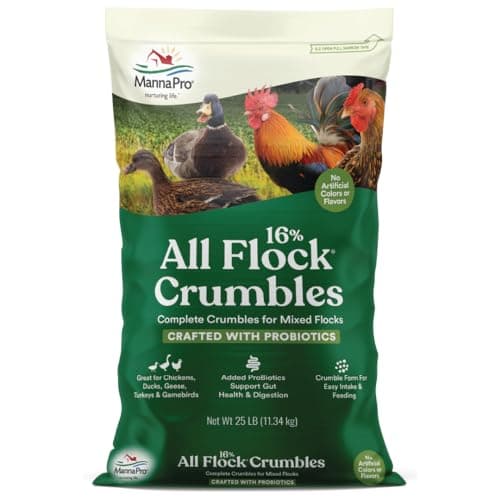
16% All Flock Crumbles with Probiotics, 25 lb
16% protein, 1.5-2.0% calcium
Best for: One bag for a mixed flock
The one-bag answer for a coop with ducks, drakes, young birds and hens in it, and the published calcium figure is the whole reason: 1.5 to 2.0 percent, which is low enough that nothing in the flock is being overdosed.
Best for: The one thing a duck needs that a hen does not
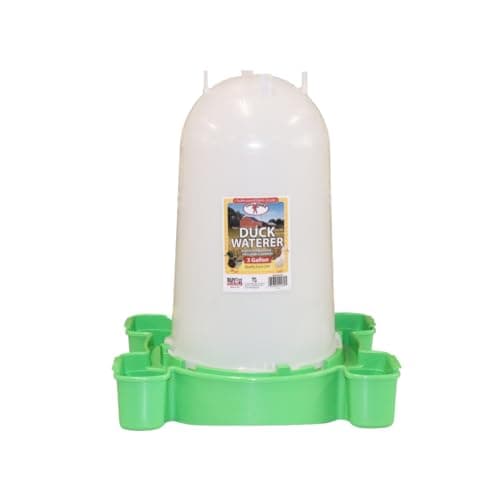
The hardware answer to the real reason mixed coops fail, which is water rather than feed: a duck has to submerge its bill, and the nipple drinker that solves fouling for chickens cannot be used by a duck at all.
Thirty-three to thirty-eight percent calcium in a crushed form, offered free-choice — the supplement that fixes thin shells and the one most first-time keepers confuse with grit.
#ad We have no verified Amazon listing for this one, so no number is shown. How this is funded.
Purina
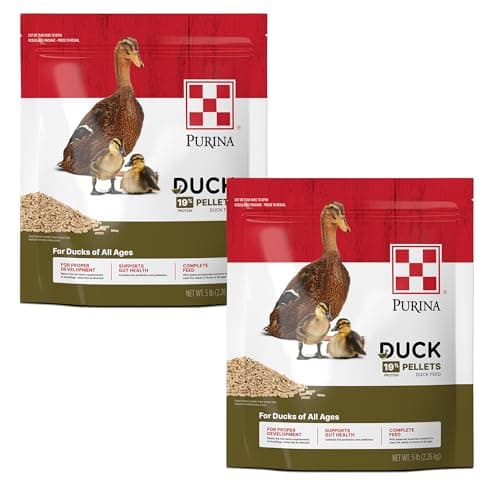
Duck Feed Pellets, All Life-Stages
19% protein; niacin not guaranteed
Best for: The duckling weeks specifically
The one purpose-made duck feed on an ordinary shelf, and the one to read carefully: Purina's guaranteed analysis covers protein and calcium properly, and does not guarantee the niacin figure its own marketing copy prints.
Yes, with three changes. Ducks need more space - Penn State Extension publishes 3 sq ft indoors against 2 for a large chicken, and another extension source says at least 4. They need an open drinker deep enough to submerge a bill, because a duck cannot use the nipple system that keeps chicken water clean. And the flock needs an all-flock ration with oyster shell offered separately, because layer feed is formulated for birds that are laying.
+Can ducks eat chicken feed?
Adult ducks do fine on an all-flock ration, which is formulated at about 16 percent protein and well under layer-feed calcium. Ducklings are the problem: poultry.extension.org publishes that chick starter is made for egg-type chicks, which have a lower niacin requirement than ducks, and that if you use it you need to add supplemental niacin to the water. It gives no dose, which is why a feed formulated for ducks is the cleaner answer for the brooding weeks.
+Can ducks eat layer feed?
They should not be on it as a sole ration. Layer feed carries 2.5 to 4.5 percent calcium on published figures, aimed at eggshell formation, and a drake or a duck not in lay has no use for that load. An all-flock ration at 1.5 to 2.0 percent with oyster shell offered free choice in a separate dish gives the laying birds what they need without imposing it on everybody.
+Do ducks and chickens need separate waterers?
In practice yes, and it is the most-missed part of a mixed flock. A duck drinks by submerging its bill and uses water to clear its nostrils and eyes, so a closed nipple drinker is unusable by one. The mixed-coop compromise is an open cup drinker the ducks can use, rinsed daily, with the chickens' nipple system kept as well if you have it.
+Do ducks need a pond?
No. poultry.extension.org states plainly that ducks do not need water to swim in. In a shared coop a pool is actively unhelpful, because it is the quickest way to permanently wet bedding, which is what causes most of the problems in a duck-and-chicken setup. If you do provide one, the same source says ducklings should not swim for their first three weeks.
+Can chickens and turkeys live together?
No, and this is the one mixed-flock question with a flat published answer. poultry.extension.org states you should not house or range turkeys with chickens or in areas where chickens recently have been, because turkeys contract blackhead from chicken manure containing infected cecal worm eggs. Chickens carry those worms without being harmed, so the chicken flock looks perfectly healthy, and there is no effective treatment for the disease in turkeys.
+How much space do ducks need compared to chickens?
Half again as much indoors and 50 percent more outside, on Penn State Extension's published figures: 3 sq ft inside and 15 sq ft of run per duck, against 2 and 10 for a large chicken. A separate poultry.extension.org publication puts the indoor figure at a minimum of 4 sq ft. Four ducks take more coop floor than six laying hens do.
+Do ducks make the coop wetter?
Considerably. poultry.extension.org notes that ducks drink a lot and produce very watery manure that must be cleaned daily, and sets litter at 3 to 4 inches deep with caked material removed daily, the rest stirred daily, and the whole lot changed weekly depending on dampness. That is a heavier routine than a chicken coop, and it is the real cost of a mixed flock.
Where the numbers came from
Sources
Every figure cited on this page came from one of these documents. If one of them has changed since we read it, the number here is out of date and we would like to know.
Layer feeds compared on published protein, calcium, methionine and fiber against the extension figures for a hen in production - plus when a layer ration is the wrong choice.