Flies in the chicken coop, and the published reason traps do not fix it
A pound of the right material can produce a thousand houseflies in under two weeks. The published control is moisture, not a trap — and an extension entomology service says so in as many words.
Flies in a coop are a moisture problem wearing a disguise. Texas A&M AgriLife Extension publishes the threshold plainly: “You can practically eliminate fly breeding in this material by reducing the moisture content to 30 percent or less.” Fresh poultry manure runs 75 to 80 percent. The same guide states that “most entomologists believe that fly traps used alone are ineffective,” so a trap is how you measure the problem, not how you end it.
Almost every product sold for this problem is a trap, and almost every article about it is a list of traps. The published entomology points somewhere else entirely, and it is worth understanding why before spending anything.
Published house fly figures for poultry housing. Source: Texas A&M AgriLife Extension, Poultry Pest Management.
Figure
Published value
Why it matters
Development, egg to adult
7 to 10 days under ideal conditions
A problem compounds inside two weeks
Flies per pound of breeding material
As many as 1,000
A small wet patch is a large hatch
Fresh poultry manure moisture
75 to 80 percent
Ideal for egg laying, straight out of the bird
Moisture that stops breeding
30 percent or less
The actual control
What actually works, in the order the guidance puts it
Texas A&M is explicit that sanitation and manure management come first, and its recommendations are specific enough to act on.
Get the moisture below 30 percent. That is the published threshold, and it is the same variable that governs ammonia — Mississippi State Extension P2744 puts ideal litter at 20 to 30 percent moisture. A coop running correctly for flies is a coop running correctly for ammonia, which is a genuinely useful coincidence: one routine fixes both.
Remove manure at least twice a week, or dry it. The published instruction is to remove it “at least twice a week” and to “scatter the manure in thin layers outdoors to kill the eggs and larvae by drying them.” Thin layers is the operative phrase — a heap stays wet in the middle and keeps breeding.
Fix the wet spots, which are almost always the waterer. A drinker inside the coop, or a leaking one in the run, creates exactly the damp patch the arithmetic above describes. Moving it out of the coop solves more fly problems than any product.
Clean up spills, dead birds and broken eggs immediately. The guide names all three: “Quickly remove and dispose of dead birds and broken eggs” and “Immediately clean up and dispose of feed spills and manure spills, especially if they are wet.”
Then, and only then, hang a trap — to count. See below.
The routine that actually holds the threshold
“Keep it dry” is not a schedule. The published guidance is, and it has two parts that people reliably get wrong.
Twice a week, not when it looks bad. The instruction is to remove manure “at least twice a week.” That cadence is set by the life cycle rather than by appearance: if development takes 7 to 10 days, removing breeding material twice a week means nothing completes a generation in it. Waiting until the litter looks dirty is waiting about three generations too long.
Thin layers, not a heap. The other half of the instruction is to “scatter the manure in thin layers outdoors to kill the eggs and larvae by drying them.” A pile behind the coop does the opposite — the middle of a heap stays wet, which is a breeding site you built on purpose. If you are composting it, that is a managed hot pile you turn, not a corner you tip a bucket into.
And if the manure stays in the coop, as it does under a deep-litter routine, the published requirement is to dry it to “30 percent moisture level and be maintained at this level.” Maintained is the operative word: the threshold is not something you hit once in June and coast on.
Seasonally, this is a summer job. The development time of 7 to 10 days is quoted for ideal conditions, and warmth is most of what makes conditions ideal — which is why a coop that was fine all winter produces a swarm in the first properly hot week. The routine starts before that week, not during it.
The trap question, answered with the citation
This is the part that will cost this page conversions and it is the honest answer. Texas A&M states: “Most entomologists believe that fly traps used alone are ineffective in controlling flies, especially in and around livestock and poultry operations.”
So why buy one at all? Because the same guide gives traps a job worth doing, which is measurement: for sticky ribbons, “a weekly count of 100 flies per ribbon may indicate that fly control is required.” That converts a vague impression — it feels worse this week — into a number you can act on.
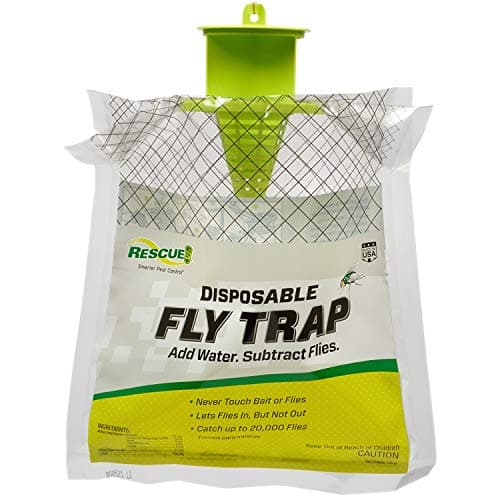
Used that way, a trap is genuinely useful. Hang one, count it weekly, and treat a rising count as evidence that the litter has gone damp rather than as evidence that you need more traps. The RESCUE! disposable trap publishes a capacity of up to 20,000 flies and contains no insecticide, which is what makes it usable around birds whose eggs you eat.
What we are not going to recommend
Diatomaceous earth as a fly control. It appears in a great deal of coop advice and it is not what the published label is for. The DE page is blunt about the limits of that product, and none of the extension guidance here names it.
Scatter baits inside a run. Fly baits with an insecticide in them exist and they work, and a backyard run full of birds that eat anything at ground level is the wrong place for them. If you use one, it goes in a bait station well away from the flock, used to its label — which is beyond what this page will recommend blind.
More traps as a strategy. Covered above, with the citation. A second trap is a second monitor, not twice the control.
The tidy part: it is the same job as everything else
Litter below 30 percent moisture stops fly breeding. Litter at 20 to 30 percent moisture is the published ideal for avoiding ammonia. Dry litter is also what prevents winter frostbite, because frostbite is a moisture problem too, and dry feed stored in a sealed container is what does not attract rodents.
Four different problems, four different pages, one variable. If you only ever fix one thing in a coop, fix how wet it is.
Heads up: some links on this page are affiliate links. If you buy through one we may earn a commission at no extra cost to you. It never changes a ranking, and we take no payment for placement. The full version.
The picks
One thing that controls flies, one that measures them, one that removes the food
In the order the published guidance puts them: keep the litter dry, count what you catch so you know whether it is working, and stop spilling feed where flies can find it.
Lucerne Farms
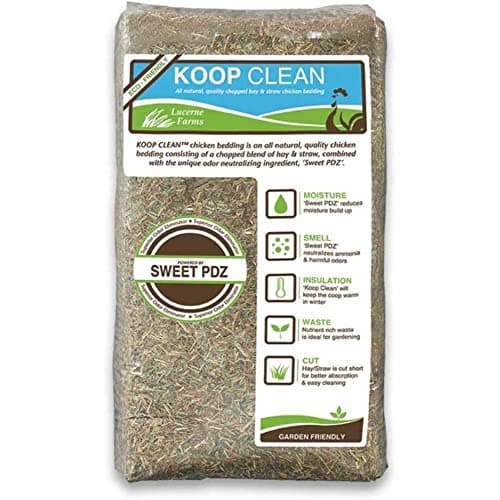
Koop Clean Chicken Bedding
63 sq ft at 2 in
Chopped hay and straw with zeolite already blended in, and the only bedding here that publishes its coverage — 63 square feet at two inches, which is a number you can divide by your coop.
A water-activated bag trap with no insecticide in it, published at up to 20,000 flies — useful as the weekly count that tells you whether your manure management is working, and not useful as the fix.
The small version, and the honest use for it is not feed at all — it is the second and third container you need once you are also storing grit, oyster shell and scratch.
#ad We have no verified Amazon listing for this one, so no number is shown. How this is funded.
FAQ
Questions people actually ask
+How do I get rid of flies in my chicken coop?
Dry the litter. Texas A&M AgriLife Extension publishes that reducing the moisture content of breeding material to 30 percent or less practically eliminates fly breeding, and that manure management is the first control. Remove manure at least twice a week or scatter it outdoors in thin layers to dry, clean up feed spills immediately, and move any waterer out of the coop.
+Do fly traps work in a chicken coop?
Not as a control on their own. Texas A&M AgriLife Extension states that most entomologists believe fly traps used alone are ineffective around livestock and poultry. They are genuinely useful as a measurement: the same guide gives a weekly count of 100 flies per sticky ribbon as the point at which fly control is required.
+Why does my coop suddenly have so many flies?
It is not sudden. House flies develop from egg to adult in 7 to 10 days under the conditions found in poultry manure, and as many as 1,000 can complete development in a single pound of breeding material. A damp patch a week ago is the swarm today, which is why the fix is finding the moisture rather than killing the adults.
+Does diatomaceous earth stop flies in a coop?
None of the extension guidance cited here names it as a fly control, and we are not going to recommend it as one. Diatomaceous earth has published uses and this is not among them. Moisture management is the published control.
+Where should I hang a fly trap near a chicken coop?
Outdoors, and not beside the door. Sterling International publishes placement at roughly 20 feet from home entrances, patios and decks, hung in a well-ventilated spot in direct sunlight to activate the lure — and describes the activated lure as unpleasant to people. A trap attracts flies toward itself, so where you hang it is where they will gather.
Where the numbers came from
Sources
Every figure cited on this page came from one of these documents. If one of them has changed since we read it, the number here is out of date and we would like to know.