How to clean a chicken coop, in the published order
Extension guidance sets out dry cleaning, soaking, washing, rinsing, drying, repairs and only then disinfecting. The order is not housekeeping preference: a disinfectant applied to organic material does not work, and bleach applied to a coop still full of ammonia produces a toxic gas.
Extension guidance from Dr. Michael Darre, Extension Poultry Specialist at the University of Connecticut, published through Cornell Small Farms, gives the sequence: dry cleaning, soaking, washing, rinsing, drying, repairs, disinfecting. It is blunt about the order — “Every step is important. Skipping one step or doing an incomplete job at any point will make the next step harder and lead to failure.” And a full clean is recommended “after each flock or at minimum once each year.”
Why the order is the whole thing
Almost everyone does this in the wrong order, and it is not laziness — it is that the reason for the order is never explained. There are two, and they are both worth knowing before you start.
First, a disinfectant applied to dirt is wasted. The guidance is explicit: “Disinfectants should be applied only after the building and equipment have been thoroughly cleaned, ideally right after rinsing.” Organic material physically shields what is underneath it and chemically consumes the active ingredient. Spraying disinfectant onto a manure-caked perch does nothing that a garden hose would not have done.
Second, the dirt itself is the hazard. A coop that needs cleaning is a coop with ammonia in it, and chlorine bleach is the most common thing people reach for. Washington State Department of Health is unambiguous: “Don’t mix bleach with ammonia, acids, or other cleaners”, because “when bleach is mixed with ammonia, toxic gases called chloramines are produced.” The listed symptoms run from watery eyes and coughing through to “pneumonia and fluid in the lungs.”
The seven steps, with the published instruction for each
Cleaning and Disinfecting Your Poultry House, Michael Darre, University of Connecticut Extension, via Cornell Small Farms. Quoted and condensed.
Step
What the guidance says
Dry cleaning
Sweep or blow dust off ceilings, fixtures, walls, nest boxes and vents onto the floor. Remove feed, scrape perches, remove all litter, sweep the floor.
Soaking
“Turn the power off to the building prior to using any water for cleaning.” Low pressure sprayer, warm or hot water, soak until dirt softens.
Washing
Every surface, not just the floor. Neutral detergent pH 6 to 8 or alkaline above pH 8, in hot water — “160F or hotter is best.”
Rinsing
“A final rinse immediately after washing is recommended to remove any harmful residues.” Mop puddles.
Drying
“Thoroughly air-dry the building if disinfection cannot immediately follow rinsing.” Windows open, fan if you have one.
Repairs
Before disinfecting, not after. Seal rodent holes with foam, steel wool, then more foam.
Disinfecting
Only on clean surfaces. Follow the product’s own dilution. Roughly one gallon of diluted disinfectant per 150 to 200 sq ft.
Dry cleaning: top down, and further than you think
The instruction is to work downward — ceilings, light fixtures, walls, nest boxes, fans and air inlets, all swept onto the floor, and only then is the floor dealt with. The reason is obvious once stated and nearly always got wrong: sweep the floor first and you will be doing it again.
The specific note for small coops is a wet-dry shop vacuum, with a caution: “be careful to clean the filter often as the fine dust from the coop may easily clog the filter and make the vacuum work harder or lead to burn out of the motor.” Coop dust is fine, dry and relentless. It is also worth a dust mask for your own sake, and worth picking a breezy day.
The litter that comes out is not waste. The guidance notes it “can be added to a compost pile”, which is the same argument the deep litter page makes at greater length.
Wet cleaning: the three stages people collapse into one
Soaking, washing and rinsing are separate stages doing separate jobs, and the temperature matters throughout — “warm or hot water will do a better job getting through organic matter than cold water.”
Soaking uses a low pressure sprayer and patience. The point is to let water do the loosening so you do not have to chisel.
Washing is where a high pressure sprayer helps, but the guidance is clear that “manual scrubbing with a moderately stiff brush is one of the best ways to insure a thorough cleaning”, followed by inspecting by hand to confirm the manure is actually gone. A cheap neutral detergent — dish soap — is named as sufficient.
Rinsing removes detergent residue, and then you mop up: standing puddles “can rapidly become breeding grounds for salmonellae.” A coop that has been washed and left wet is arguably worse than one that was never washed.
Two specifics worth carrying over. If you have metal surfaces with hard water scale, the guidance points to an acid detergent to dissolve mineral deposits, naming vinegar and citric acid among the organic options — which is the one place a household acid has a defined job in this process. And electrical parts get named directly: “Make sure you carefully clean electrical parts. You may have to remove cover plates and vacuum those areas.” With the power off, which is where this stage started.
Disinfecting, and the difference from cleaning
The published disinfectant groups are phenolic compounds, iodine or iodophors, chlorine compounds, quaternary ammonium compounds and oxidizing compounds. For a backyard coop the application method named is deliberately unglamorous: “for most small flock facilities, using a garden type sprayer is the easiest method, and chances are you already have a suitable disinfectant around the house.”
Feeders and waterers get their own treatment, and it is the most precise figure in the whole piece: “soak waterers and feeders in a 200 ppm chlorine solution (1 tablespoon chlorine bleach per gallon of boiling water).” Do that in a bucket outside, well away from the coop and anything ammoniacal.
How much disinfectant a small coop actually takes
The one-gallon-per-150-to-200-square-feet rule of thumb is about surface area, not floor area, and that catches people out. A coop is a box, so you are covering the floor, the ceiling and four walls.
How often, and what happens in between
The published frequency is “after each flock or at minimum once each year”, and spring is named as the natural time — “especially true if you are considering bringing in new birds or replacing your flock.” A full strip-and-disinfect is a once-a-year job, not a monthly one.
What happens in between is a different discipline, and it is mostly about moisture rather than dirt. Litter that stays dry does not smell, does not grow flies and does not cake — the flies page has the published litter moisture threshold, and the ventilation page covers why a coop gets damp in the first place. Deep litter is the deliberate alternative to frequent clean-outs, and it changes the schedule rather than removing it.
When the coop is dry and the fresh bedding goes back in, the bedding page compares the materials on published absorbency and coverage. The one on this page publishes a coverage figure at a stated depth, which is what makes it possible to work out how many bags a re-bed takes instead of guessing at the store.
Heads up: some links on this page are affiliate links. If you buy through one we may earn a commission at no extra cost to you. It never changes a ranking, and we take no payment for placement. The full version.
The picks
The three things the published sequence actually needs
A cleaner for the wash step, something to apply the disinfectant with, and the bedding that goes back in once the coop is dry. The hot water and the scrub brush do most of the work and cost nothing.
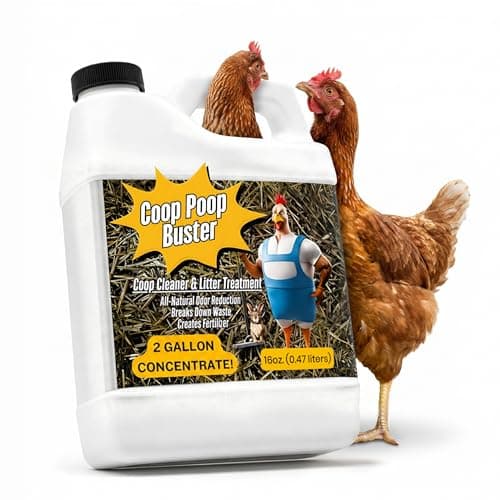
Coop Poop Buster
Chicken Coop Cleaner and Ammonia Odor Eliminator
Coop-specific cleaner spray
A cleaner formulated for coops rather than kitchens, which matters mostly because it is not bleach — and bleach is the thing most people reach for and the thing most likely to go wrong in a shed full of ammonia.
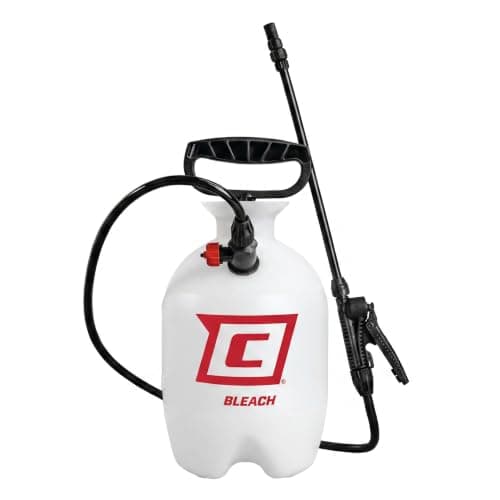
A one-gallon pump sprayer with bleach-resistant seals — which matters because the extension guidance on cleaning a hen house names a garden-type sprayer as the easiest way to apply disinfectant, and the disinfectants it names include chlorine compounds.
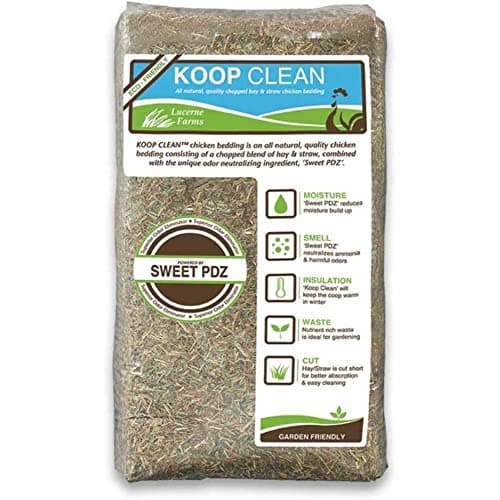
Chopped hay and straw with zeolite already blended in, and the only bedding here that publishes its coverage — 63 square feet at two inches, which is a number you can divide by your coop.
Remove the birds and portable equipment, then dry clean from the ceiling down and take out all the litter. Turn the power off to the building, soak the heavy soiling with a low pressure sprayer, wash every surface with detergent in hot water, and rinse. Dry the building, make any repairs, and only then disinfect. That is the order University of Connecticut Extension publishes, and it warns that skipping any step makes the next one fail.
+What is the best disinfectant for a chicken coop?
The published groups are phenolic compounds, iodine or iodophors, chlorine compounds, quaternary ammonium compounds and oxidizing compounds - used at the maker's own dilution. What matters more than the choice is that the surface is already clean, and that the product publishes an EPA registration number, a dilution and a contact time. A product with none of those is a cleaner, not a disinfectant.
+Can I use bleach to clean a chicken coop?
Chlorine compounds are on the published disinfectant list, and a 200 ppm chlorine solution - one tablespoon of bleach per gallon of boiling water - is the published soak for feeders and waterers. But never mix bleach with ammonia: Washington State Department of Health warns that the combination produces toxic chloramine gases. Because a dirty coop is full of ammonia, bleach belongs at the disinfecting stage, after the litter is out and the surfaces have been washed and rinsed.
+How often should you clean out a chicken coop?
A complete dry cleaning, washing and disinfection is recommended after each flock, or at minimum once each year. Spring is the natural time, particularly if new birds are coming in. Between full cleans the important work is keeping litter dry rather than cleaning more often.
+How much disinfectant do I need for my coop?
About one gallon of diluted disinfectant per 150 to 200 square feet of surface area. Count the floor, ceiling and all four walls: a 4 by 8 foot coop at 6 feet high is roughly 208 square feet of surface, so about 1.0 to 1.4 gallons. Most people mix far too little because they only count the floor.
+Do I need to pressure wash the coop?
It helps at the washing stage, but the guidance is clear that manual scrubbing with a moderately stiff brush is one of the best ways to ensure a thorough clean, followed by inspecting by hand. For the soaking stage a low pressure sprayer is what is named, because the aim there is to let water soften the dirt rather than blast it around.
Where the numbers came from
Sources
Every figure cited on this page came from one of these documents. If one of them has changed since we read it, the number here is out of date and we would like to know.
Reduce manure moisture to 30 percent and fly breeding practically stops. Traps are a monitor, not a control — with the extension citation that says so.