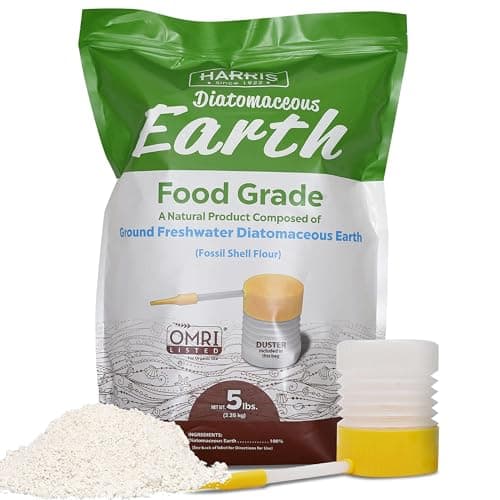
Food-grade diatomaceous earth is ground freshwater diatom fossils, published by Harris at 89 percent or more silicon dioxide and OMRI listed. Its published poultry directions are half to one percent of the dry ration, or placing it in the birds’ favorite dusting spots. It works mechanically and only when completely dry.
What it actually is
Diatoms are microscopic algae with silica shells. Diatomaceous earth is a deposit of those shells, mined and ground. Under magnification the particles are sharp and abrasive, which is the entire mechanism: an insect walking through it has its waxy cuticle abraded, loses water and desiccates.
That mechanism has two consequences that decide everything else about the product. It only works dry, because damp DE does not abrade. And it works by contact, so it has to be where the insect walks.
Food grade versus pool grade — this matters
There are two products called diatomaceous earth and they are not interchangeable.
Food grade is amorphous silica, and Harris publishes 89 percent and often more silicon dioxide, 100 percent ground freshwater diatomaceous earth with no additives, and OMRI listing as organic under the USDA National Organic Program.
Pool or filter grade has been heat-treated, which converts much of the silica to a crystalline form. Crystalline silica is a serious respiratory hazard. It is not for use around animals and it should never be substituted.
The published percentage and the OMRI listing are how you tell them apart on a shelf, and they are the reason it is worth buying a product that publishes both.
The published poultry directions
Harris publishes two uses for fowl and poultry: use half to one percent of the total weight of the dry ration, or place the material in the birds’ favorite dusting spots, where they throw it over themselves.
The second use is the one we would actually recommend, and it is the one that fits the mechanism. In a dust bath the DE stays dry, the birds apply it themselves to exactly the places parasites live, and there is no withdrawal period on anything. That is a genuinely good product-and-behavior fit.
The claims we are not going to repeat
DE attracts an unusual volume of unsupported claim, and this site’s rule is that we do not pass along a claim we cannot source. So, plainly:
It is not a treatment for an active mite infestation. A coop with birds in it is humid, DE is inert when damp, and by the time you have an infestation you need something labeled for treating one. Use it as a preventive, not a cure.
We are not going to tell you it deworms chickens. That claim is everywhere and we have not found label support for it. Internal parasites are a veterinary question with an actual diagnostic answer — a fecal test — and guessing is worse than asking.
Feeding it is a claim we are neutral on. Harris publishes a ration inclusion rate, so it is a labeled use, and we will report that. We are not going to build a case for the benefits, because we could not source one.
The dust hazard is real, in both directions
DE is a very fine dust. Fine dust in a chicken coop is a respiratory irritant for birds, which have an efficient and delicate respiratory system, and for you.
If you apply it: wear a mask, do it when the birds are out, and let it settle before they come back. Do not dust it liberally through a coop the flock is standing in, which is a thing people do and which trades one problem for another.
How to use it well
Buy food grade with a published silicon dioxide percentage and OMRI listing.
Mix it into a dust bath of dry soil, sand or wood ash rather than applying it to birds directly.
Keep the bath dry and covered. Wet DE is doing nothing.
Top it up rather than replacing it. Birds redistribute it constantly.
Do not rely on it for an active infestation. See mites and lice.
Heads up: some links on this page are affiliate links. If you buy through one we may earn a commission at no extra cost to you. It never changes a ranking, and we take no payment for placement. The full version.
The picks
The dust bath additive, and the thing that actually treats an infestation
These are not alternatives to each other. One is a preventive you put where birds bathe; the other is a labeled treatment for a confirmed problem.
Harris
Food Grade Diatomaceous Earth
89%+ silicon dioxide, OMRI
Best for: A dust bath additive
Eighty-nine percent silicon dioxide, OMRI listed, and honest about what it is for — a dusting powder for the places birds bathe, not a treatment for an infestation you already have.
Spinosad with a nil egg withdrawal period in the US, which is the reason it exists on a backyard shelf at all — every other effective option means throwing eggs away.
#ad We have no verified Amazon listing for this one, so no number is shown. How this is funded.
FAQ
Questions people actually ask
+How do you use diatomaceous earth for chickens?
Harris publishes two poultry uses: half to one percent of the total weight of the dry ration, or placing it in the birds' favorite dusting spots where they throw it over themselves. The dust bath use fits the mechanism best, because the DE stays dry and the birds apply it to exactly the places parasites live.
+Is food grade diatomaceous earth safe for chickens?
Food grade is amorphous silica, OMRI listed, and is used around animals. Pool or filter grade has been heat-treated into a crystalline form that is a serious respiratory hazard and must never be substituted. Either way it is a very fine dust, so wear a mask when applying it and do it while the birds are out.
+Does diatomaceous earth deworm chickens?
We have not found label support for that claim, so we are not going to repeat it. Internal parasites have an actual diagnostic answer — a fecal test through a veterinarian — and treating on the basis of an unsupported claim means the real problem goes unaddressed.
+Can diatomaceous earth be used in a chicken coop?
It can, but be careful about how. A fine dust applied liberally through a coop with birds standing in it trades a parasite problem for a respiratory one. The better use is in a dust bath, where it stays dry and the birds apply it themselves, and where humidity in the coop cannot render it inert.
Where the numbers came from
Sources
Every figure cited on this page came from one of these documents. If one of them has changed since we read it, the number here is out of date and we would like to know.