A closed nipple system stays clean because there is no open surface to foul — and “slimy or unclean water” is a published cause of sour crop. Harris Farms publishes three chickens per nipple, so a four-nipple bucket covers twelve birds. The only real difficulty is the switchover: run the old drinker alongside for a week and remove it only once you have watched the flock drink.
Why open drinkers fail
A chicken drinks by dipping its beak and tipping its head back. Whatever is on the beak goes into the water: dirt, feed, bedding. Birds also stand on the rim of anything low enough, and what they leave there ends up in the water too.
Within a day an open drinker in a run is visibly dirty. That is not just unpleasant — the fecal-oral route is how coccidiosis and a number of other things move through a flock, and the water dish is the most efficient shared surface in the coop.
The alternative is a closed container the birds cannot get into. That is the entire design argument for nipples and cups.
The options
Waterer designs compared.
Design
Stays clean?
Published rating
Main drawback
Open gravity drinker
No — fouls within a day
None standard
Daily scrubbing; disease route
Vertical nipples in a bucket
Yes
Harris Farms: 3 chickens per nipple
Drips; can freeze open in winter
Horizontal side-mount nipples
Yes
Farm Innovators: 3 nipples for up to 15 chickens
Needs correct mounting height
Cup drinkers
Mostly — a small open surface
Varies by maker
The cup itself can collect debris
Heated closed system
Yes
Premier 1: 3 nipples, up to 35 birds, -20 F
Needs mains power at the coop
The birds-per-nipple figure is the one to size from. Harris Farms publishes three chickens per nipple for its watering nipples, and Farm Innovators publishes that the three nipples on its 2-gallon drinker accommodate up to fifteen chickens — a slightly more generous five per nipple. Take three as the conservative planning figure: four nipples for twelve birds, which covers nearly every backyard flock.
Switching a flock over
Adult birds that have drunk from an open dish all their lives do not immediately understand a nipple, and a flock that stops drinking is a serious problem within a day. The reliable procedure:
Hang the nipple system where they already congregate, at the height a bird can reach with its head slightly raised. Too low and they will not use it; too high and they cannot.
Leave the old drinker in place and do not restrict it.
Tap the nipples yourself so they drip. Movement and a bead of water attract attention — chickens investigate shiny moving things.
Watch until you have seen several birds drink from it. Not one bird — several, over a couple of days.
Then remove the old drinker. Check the flock is drinking normally that evening.
Chicks learn faster than adults because they have no habit to unlearn, which is a good argument for starting a new flock on nipples in the brooder. See chick feeders and waterers.
Height and siting
Nipple height: roughly at the level of a bird’s eye when standing normally, so it reaches slightly upward. This is also what stops water running back down the beak and wetting the chest.
Hang rather than stand. A hung bucket cannot be knocked over and stays cleaner underneath.
In shade. Warm water is unappealing and algae grow in sunlight, even in a closed bucket.
Not directly under a roost. Obvious, and still the most common siting error.
Heads up: some links on this page are affiliate links. If you buy through one we may earn a commission at no extra cost to you. It never changes a ranking, and we take no payment for placement. The full version.
The short answer
The short list
Ranked on the published rubric. Every row jumps to that product's full write-up below; the button goes straight to Amazon.
#
Pick
Best for
Key spec
Score
Price
1
Score7.6
Our pick
Harris Farms
Poultry Watering Nipples, 4-pack
Four nipples and a bucket you already own, which is the cheapest way to end the open-water problem for good and is rated by the maker at three chickens per nipple.
Sixty thermostatic watts across two gallons and three side-mounted nipples — the lowest published draw of the heated waterers here, and the one whose running-cost ceiling is under thirty-two dollars for a whole winter.
The only heated waterer here that publishes the temperature it is rated to and the thermostat's actual switching points — 100 watts, on below 40 F, off at 60 F, unfrozen to minus twenty.
#adPrices as of October 18, 2026. Scores are our own published rubric, not customer ratings.
Score7.6no photo yet
#1 · Water that stays clean by design
Harris Farms Poultry Watering Nipples, 4-pack
Four nipples and a bucket you already own, which is the cheapest way to end the open-water problem for good and is rated by the maker at three chickens per nipple.
Who it is for. Anybody tired of scrubbing a fouled open waterer daily, who is comfortable drilling a bucket.
Published specifications
Quantity
4 nipples
Rated capacity
Each watering nipple accommodates three chickens
Installation
Fits a plastic container or PVC pipe to create a closed watering system
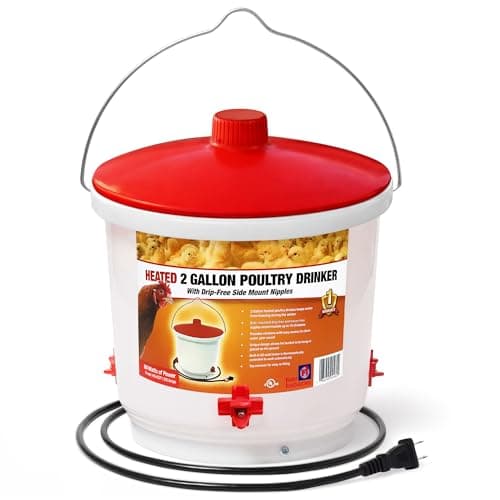
Sixty thermostatic watts across two gallons and three side-mounted nipples — the lowest published draw of the heated waterers here, and the one whose running-cost ceiling is under thirty-two dollars for a whole winter.
Who it is for. A flock of up to about ten birds in a climate that dips below freezing but not far below it.
Published specifications
Capacity
2 gallons
Heater
Built-in 60 watt heater, thermostatically controlled to work automatically
60 W is the lowest published draw of the three heated options here, and the thermostat means it does not run continuously
A closed nipple system, so it stays clean in a way an open heated base never does
Fifteen birds off three nipples is published, which sizes it for almost any backyard flock
Hangs or stands, which matters because a hung waterer stays cleaner
What it costs you
Farm Innovators does not publish the thermostat's switching temperatures, so you cannot tell when it actually comes on
No published minimum temperature rating, unlike the Premier 1 unit's stated -20 F
Two gallons is a two-day supply for a flock of ten in summer
Side-mount nipples need the bucket hung at the right height or birds strain to reach
Skip it if. You are in a genuinely cold climate and need to know the unit works at a stated temperature. Premier publishes -20 F; this one publishes nothing.
Premier 1 Supplies All-Season Heated Poultry Waterer, 3 Gallon
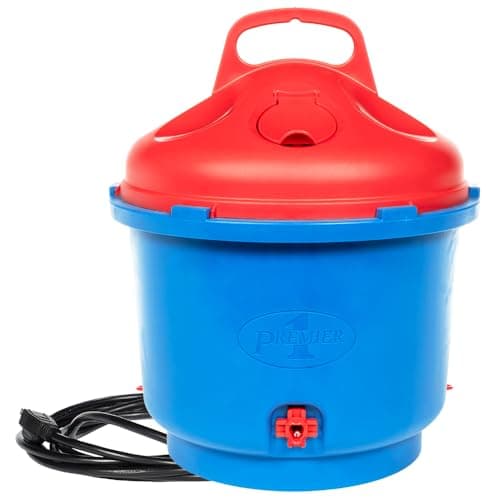
The only heated waterer here that publishes the temperature it is rated to and the thermostat's actual switching points — 100 watts, on below 40 F, off at 60 F, unfrozen to minus twenty.
Who it is for. Anybody north of a hard-freeze line who wants a published temperature rating rather than a hopeful one.
Published specifications
Capacity
3 gallons
Heater
100 W heating element with a built-in thermostat
Thermostat behavior
Turns on when ambient temperature is below 40 F and off at 60 F
Harris Farms publishes three chickens per watering nipple, and Farm Innovators publishes three nipples accommodating up to fifteen chickens on its 2-gallon drinker, which is five per nipple. Three is the conservative planning figure, so a four-nipple bucket comfortably covers a twelve-bird flock.
+How do I teach chickens to use a nipple waterer?
Hang it where they already gather at roughly standing eye height, leave the old drinker in place and unrestricted, and tap the nipples so they drip — movement and a bead of water attract investigation. Only remove the old drinker after watching several birds drink from the new one over a couple of days.
+What is the best chicken waterer that stays clean?
Any closed system with nipples, because there is no open surface for the birds to foul. Open gravity drinkers are visibly dirty within a day, and since the fecal-oral route is how several poultry diseases spread, the water dish is the most efficient shared surface in the coop.
+How high should a chicken waterer be?
Nipples should sit at roughly the level of a standing bird's eye, so it reaches slightly upward to drink. That angle is also what stops water running back down the beak and wetting the chest. Hang the container rather than standing it, so it cannot be knocked over.
Where the numbers came from
Sources
Every figure cited on this page came from one of these documents. If one of them has changed since we read it, the number here is out of date and we would like to know.
The published order is shade, water, ventilation. What to buy for each, the signs of heat stress in severity order, and the CFM arithmetic that rules a fan out of most coops.