Raise the feeder and drinker off the bedding. That single change removes most of the daily work in a brooder, because chicks scratch bedding into anything at floor level within minutes of you filling it. Size both from Penn State Extension’s published figures: 1 inch of feeder space per chick in week one and half an inch of waterer space.
The actual problem
A brooder is a warm box with an absorbent floor, and chicks spend the day scratching that floor backwards. Anything sitting on it fills with shavings. A drinker fills with shavings and droppings, and a drinker full of droppings is how coccidiosis moves through a brood.
You do not need a clever product for this. You need height. A brick, an offcut of two-by-four, an upturned dish — anything that lifts the rim of the vessel above the depth of the bedding works. What a purpose-made stand buys you is stability, because a drinker balanced on a brick becomes a spilled drinker the first time a chick lands on the edge.
How much feeder and drinker you actually need
Feeder and waterer space per chick. Figures published by Penn State Extension.
Age
Feeder space per chick
10 chicks need
Waterer space per chick
10 chicks need
Week 1
1 in
10 in
1/2 in
5 in
Weeks 2-3
1.5 in
15 in
1/2 in
5 in
Weeks 3-5
2 in
20 in
1/2 in
5 in
Weeks 5-8
2 in
20 in
3/4 in
7.5 in
These are linear measurements around the accessible edge of the vessel, not volume. It is the number that tells you a single small round drinker is not enough for a dozen chicks past week three — not because it runs dry, but because there is not enough rim for the birds at the bottom of the order to get a turn.
Nipple drinkers work in a brooder too
The closed-system argument that applies in the coop applies here with more force, because a brooder is where fouled water does the most damage. Harris Farms publishes three chickens per nipple, which for chicks is conservative — but the real constraint in a brooder is teaching them.
Chicks do learn nipples, and they learn them faster than adult birds do because they have no habit to unlearn. The reliable approach is to run both for the first few days: the open drinker they already understand and the nipple bucket alongside, positioned so they bump into it. Once you see several chicks using the nipples, the open drinker comes out. Do not remove it before you have watched them drink.
What to avoid
Deep open water. Day-old chicks drown in surprisingly little water. If you use an open drinker in the first week, put clean pebbles or marbles in the trough so there is nowhere deep enough to get into trouble.
Feed on the floor. Scattering feed seems friendly and it guarantees waste and contamination. Use a vessel with a lip.
A drinker the chicks can roost on. They will, and then they will foul it from above. Cone-topped or narrow-rimmed vessels solve this.
Dusty bedding under an enclosed brooder. Chicks have small lungs in a small volume of air. This is the one place where a published dust figure on bedding is worth paying for.
Heads up: some links on this page are affiliate links. If you buy through one we may earn a commission at no extra cost to you. It never changes a ranking, and we take no payment for placement. The full version.
The short answer
The short list
Ranked on the published rubric. Every row jumps to that product's full write-up below; the button goes straight to Amazon.
#
Pick
Best for
Key spec
Score
Price
1
Score6.9
Our pick
RentACoop
Chick Feeder, Waterer and Accessory Stand
A raised stand that takes the feeder and drinker off the shavings, which is the single change that stops you refilling a waterer full of bedding three times a day.
Four nipples and a bucket you already own, which is the cheapest way to end the open-water problem for good and is rated by the maker at three chickens per nipple.
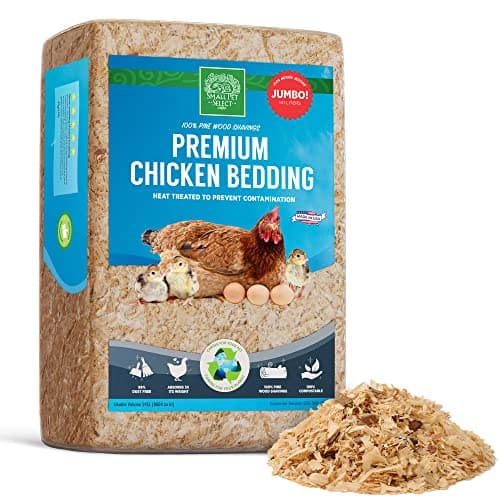
Ordinary pine shavings with an unusual claim attached: triple-screened to 99 percent dust-free, which is the one bedding spec that matters in an enclosed brooder.
#adPrices as of October 18, 2026. Scores are our own published rubric, not customer ratings.
Score6.9no photo yet
#1 · Keeping bedding out of the water
RentACoop Chick Feeder, Waterer and Accessory Stand
A raised stand that takes the feeder and drinker off the shavings, which is the single change that stops you refilling a waterer full of bedding three times a day.
Who it is for. A first-time brooder who has just discovered how fast chicks fill a waterer with shavings.
Published specifications
Compatibility
Accommodates 1 L drinkers, 2 L drinkers, 5 lb feeders and 1 gallon waterers
Mounting
Attaches to RentACoop heat plates or stands on its own
Purpose
Raises feeder and waterer above brooder bedding
Source: RentACoop chick feeder, waterer and accessory stand listing, retrieved 2026-09-01
Rubric — 6.9 / 10
Capacity honesty7/10 · weight 26%
Documentation4/10 · weight 24%
Build and weather7/10 · weight 20%
Running cost8/10 · weight 15%
Daily use10/10 · weight 15%
What it gets right
Solves the actual daily problem in a brooder, which is bedding kicked into water within minutes of a fill
Works freestanding as well as attached, so it is not locked to one brand of plate
Takes several vessel sizes, so it survives the move from a 1 L drinker to a gallon waterer
What it costs you
RentACoop does not publish stand dimensions or a height, so you cannot check it against your own vessels before ordering
It is an accessory, not a feeder — you still buy the feeder and the drinker
Chicks will still perch on it, and it needs the same daily wipe as everything else in a brooder
Skip it if. You are already raising your vessels on a paver or an offcut of scrap wood. That works and costs nothing.
#ad We have no verified Amazon listing for this one, so no number is shown. How this is funded.
Score7.6no photo yet
#2 · Water that stays clean by design
Harris Farms Poultry Watering Nipples, 4-pack
Four nipples and a bucket you already own, which is the cheapest way to end the open-water problem for good and is rated by the maker at three chickens per nipple.
Who it is for. Anybody tired of scrubbing a fouled open waterer daily, who is comfortable drilling a bucket.
Published specifications
Quantity
4 nipples
Rated capacity
Each watering nipple accommodates three chickens
Installation
Fits a plastic container or PVC pipe to create a closed watering system
#ad We have no verified Amazon listing for this one, so no number is shown. How this is funded.
#3 · Dust-sensitive birds and brooders
Small Pet Select Pine Shavings Chicken Bedding
Ordinary pine shavings with an unusual claim attached: triple-screened to 99 percent dust-free, which is the one bedding spec that matters in an enclosed brooder.
Who it is for. Brooders, nest boxes and any coop where a bird has shown respiratory trouble.
Published specifications
Composition
100% natural pine shavings; no dyes, additives or irritants
Dust
Triple-screened to be 99% dust-free
Bag volume
141 liter expanded capacity
Origin
Made in the USA from sustainably sourced material
Source: Small Pet Select, Pine Shavings Chicken Bedding product listing, retrieved 2026-09-01
Rubric — 7.4 / 10
Capacity honesty8/10 · weight 26%
Documentation7/10 · weight 24%
Build and weather7/10 · weight 20%
Running cost6/10 · weight 15%
Daily use9/10 · weight 15%
What it gets right
A published dust figure, which almost no bedding brand states at all — and dust is the specific hazard in a small enclosed brooder
Volume published in liters expanded, so you can compare bags rather than guess from a picture
Pine shavings are the default bedding for good reasons: absorbent, cheap to replace, and they compost
No dyes or additives, which is what you want against a bird's respiratory tract
What it costs you
The 99 percent figure is the maker's own and comes with no published test method
Costs meaningfully more than a farm-store bale of shavings, for a difference you cannot see
No zeolite or odor control, so ammonia management is entirely down to your cleaning schedule
Skip it if. You are bedding a large, well-ventilated walk-in coop. Buy the cheap compressed bales and spend the difference on ventilation.
+How do I stop chicks kicking bedding into their water?
Raise the drinker so its rim sits above the depth of the bedding. A purpose-made stand, a brick or a stable offcut all work; the important part is that it is stable, because a drinker on an unstable base gets tipped. This one change removes most of the daily refilling work in a brooder.
+How many chicks per waterer?
Penn State Extension publishes half an inch of waterer space per chick for the first five weeks, rising to three quarters of an inch after that. That is linear space around the accessible rim, so ten chicks need about five inches of drinking edge in the first five weeks and about seven and a half inches thereafter.
+Can chicks drown in a waterer?
Yes, in surprisingly little water, particularly in the first week. If you use an open drinker, put clean pebbles or marbles in the trough so there is nowhere deep enough for a chick to get into trouble. Closed nipple systems remove the risk entirely.
+Can chicks use nipple waterers?
Yes, and they often learn faster than adult birds because they have no habit to unlearn. Run the open drinker they already understand alongside the nipple system for the first few days, and only remove it once you have actually watched several chicks drinking from the nipples.
Where the numbers came from
Sources
Every figure cited on this page came from one of these documents. If one of them has changed since we read it, the number here is out of date and we would like to know.