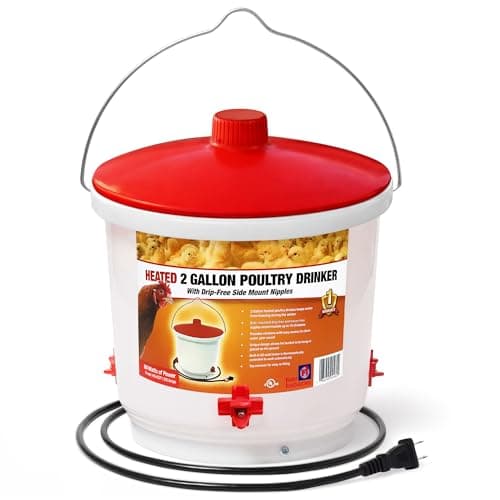
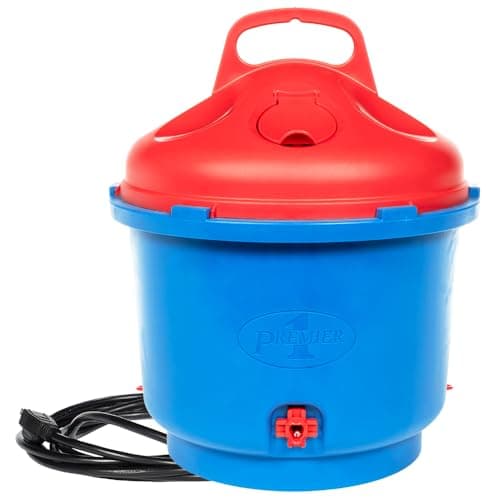
Buy on the published cold rating rather than the wattage, because the two do not track. Premier 1 publishes 100 W keeping water unfrozen to -20 F with a thermostat that switches on below 40 F. Farm Innovators publishes 60 W with no rating at all. Harris Farms publishes 125 W rated only to 10 F.
The published figures
Everything the three makers publish.
Premier 1
Farm Innovators HB-60P
Harris Farms base
Type
Complete 3-gallon waterer
Complete 2-gallon drinker
Heated base for your drinker
Power
100 W
60 W
125 W
Rated to
Unfrozen to -20 F
Not published
As low as 10 F
Thermostat
On below 40 F, off at 60 F
Thermostatically controlled (points not published)
Built-in, points not published
Nipples
3 recessed
3 side-mounted, drip-free
n/a — heats an open drinker
Birds
Up to 35
Up to 15
Not published
Cord
16 ft detachable
Not published
Not published
Premier 1 is the only maker here that publishes its thermostat switching points, and that is more useful than it sounds. “Thermostatically controlled” on its own tells you nothing — a thermostat set at 55 F runs the heater through most of autumn. On below 40 F and off at 60 F tells you exactly when you are paying for it.
Running cost, as ceilings
Now put the ceilings next to the cold ratings and the interesting result appears. The most expensive unit to run — the 125 W Harris Farms base at a $66 ceiling — has the worst published cold rating, at 10 F. The 100 W Premier unit costs less to run at its ceiling and is rated to minus twenty. More watts does not mean more capability; it means a bigger heating element in a different design.
A heated waterer or a heated base?
The base is the appealing option because you keep the drinker your birds already know. Two arguments against it:
It heats an open drinker. Everything on the waterer page about fouling applies, and in winter the birds are inside more, which makes it worse.
It is the least efficient shape. Heating a container from below, outdoors, in wind, is a worse thermal proposition than heating the water directly — which is part of why it needs 125 W to achieve a 10 F rating.
The base wins on one thing and it is a real one: no retraining. A flock that has never used nipples in November is a flock you should not be teaching nipples in November.
The cord is a safety item
You are running mains power to a wet outdoor location full of animals that peck at things. Premier publishes a 16 ft detachable cord, which is both long enough to reach an outlet and replaceable if a bird or a rodent damages it. Neither of the others publishes a cord length at all.
Whatever you buy: use a GFCI-protected outlet, run the cord where birds cannot peck it and rodents are unlikely to chew it, and check it at the start of every winter.
Heads up: some links on this page are affiliate links. If you buy through one we may earn a commission at no extra cost to you. It never changes a ranking, and we take no payment for placement. The full version.
The short answer
The short list
Ranked on the published rubric. Every row jumps to that product's full write-up below; the button goes straight to Amazon.
#
Pick
Best for
Key spec
Score
Price
1
Our pick
Premier 1 Supplies
All-Season Heated Poultry Waterer, 3 Gallon
The only heated waterer here that publishes the temperature it is rated to and the thermostat's actual switching points — 100 watts, on below 40 F, off at 60 F, unfrozen to minus twenty.
Sixty thermostatic watts across two gallons and three side-mounted nipples — the lowest published draw of the heated waterers here, and the one whose running-cost ceiling is under thirty-two dollars for a whole winter.
A heated base rather than a waterer: it takes the plastic or metal drinker already in your run and keeps it liquid to a published ten degrees Fahrenheit.
#adPrices as of October 18, 2026. Scores are our own published rubric, not customer ratings.
#1 · Cold climates, published to -20 F
Premier 1 Supplies All-Season Heated Poultry Waterer, 3 Gallon
The only heated waterer here that publishes the temperature it is rated to and the thermostat's actual switching points — 100 watts, on below 40 F, off at 60 F, unfrozen to minus twenty.
Who it is for. Anybody north of a hard-freeze line who wants a published temperature rating rather than a hopeful one.
Published specifications
Capacity
3 gallons
Heater
100 W heating element with a built-in thermostat
Thermostat behavior
Turns on when ambient temperature is below 40 F and off at 60 F
Sixty thermostatic watts across two gallons and three side-mounted nipples — the lowest published draw of the heated waterers here, and the one whose running-cost ceiling is under thirty-two dollars for a whole winter.
Who it is for. A flock of up to about ten birds in a climate that dips below freezing but not far below it.
Published specifications
Capacity
2 gallons
Heater
Built-in 60 watt heater, thermostatically controlled to work automatically
60 W is the lowest published draw of the three heated options here, and the thermostat means it does not run continuously
A closed nipple system, so it stays clean in a way an open heated base never does
Fifteen birds off three nipples is published, which sizes it for almost any backyard flock
Hangs or stands, which matters because a hung waterer stays cleaner
What it costs you
Farm Innovators does not publish the thermostat's switching temperatures, so you cannot tell when it actually comes on
No published minimum temperature rating, unlike the Premier 1 unit's stated -20 F
Two gallons is a two-day supply for a flock of ten in summer
Side-mount nipples need the bucket hung at the right height or birds strain to reach
Skip it if. You are in a genuinely cold climate and need to know the unit works at a stated temperature. Premier publishes -20 F; this one publishes nothing.
A heated base rather than a waterer: it takes the plastic or metal drinker already in your run and keeps it liquid to a published ten degrees Fahrenheit.
Who it is for. A mild-winter flock with a drinker that already works, where the only problem is a skim of ice in the morning.
Published specifications
Power
125 watts
Rated to
Prevents water freezing in temperatures as low as 10 F
Thermostat
Built-in thermostat automatically regulates the heating element
You keep the drinker the flock already knows, which removes the retraining problem entirely
Works with plastic as well as metal drinkers, which many heated bases do not
Publishes an actual temperature rating, at 10 F
What it costs you
125 W is more than double the Farm Innovators unit for a higher freezing threshold, not a lower one — the running-cost ceiling is around $66 for a four-month winter
10 F is not a deep-winter rating; below that you are back to carrying water
It heats an open drinker, so it does nothing about the fouling problem that nipple systems solve
No published cord length or dimensions
Skip it if. Your winter routinely drops below 10 F. The published rating is the published rating, and below it this stops working.
#ad We have no verified Amazon listing for this one, so no number is shown. How this is funded.
FAQ
Questions people actually ask
+How much does a heated chicken waterer cost to run?
At the June 2026 US average residential rate of 18.34 cents per kWh, running continuously for a 120-day winter: about $31.69 for a 60 W unit, $52.82 for 100 W and $66.02 for 125 W. Those are ceilings — all of these are thermostatic and will draw considerably less in practice.
+What temperature do heated chicken waterers work down to?
It varies more than the wattage suggests. Premier 1 publishes that its 100 W waterer keeps water unfrozen to -20 F. Harris Farms publishes 10 F for its 125 W heated base. Farm Innovators publishes no temperature rating at all for its 60 W drinker, so there is nothing to check it against.
+Is a heated base better than a heated waterer?
A base lets you keep the drinker your flock already uses, which removes any retraining problem — a real advantage in November. Against that, it heats an open drinker so the fouling problem remains, and heating a container from below outdoors is thermally inefficient, which is why it needs more watts for a worse cold rating.
+Do I need a heated waterer for chickens?
Only if your winter reliably freezes. If it drops below freezing on a handful of mornings a year, carrying out a jug of warm water is cheaper and safer than running mains power to a wet animal enclosure. Where it freezes for weeks, a heated waterer is the practical answer.
Where the numbers came from
Sources
Every figure cited on this page came from one of these documents. If one of them has changed since we read it, the number here is out of date and we would like to know.
Sav-A-Chick against Durvet on published guaranteed analysis - 15% potassium versus 2% - plus when electrolytes genuinely help and when plain water is the better answer.