Electrolytes for chickens, on the published analyses
Both tubs on the feed store shelf say vitamins and electrolytes. One publishes 15 percent potassium and 8 percent salt; the other publishes 2 percent potassium and 86 percent salt. For a panting bird those are not the same product.
Electrolytes are for a bird under a specific stress — heat, shipping, or recovery — and not for everyday use. When you do reach for them, the published guaranteed analyses of the two common brands differ more than the shelf suggests: Sav-A-Chick publishes a minimum of 15% potassium against 8 to 9% salt, while Durvet publishes 2% potassium against 86 to 91% salt. A panting hen is losing potassium, which makes that the figure to read.
When they actually help, and when they do not
The honest answer to “are chicken electrolytes worth it” is: situationally, and briefly. Three cases have published support behind them.
Heat.poultry.extension.org includes an electrolyte mix in its extreme-heat guidance, with a strict limit on how long to leave it out.
Shipped chicks. Durvet's own sheet calls the product “ideal for young chicks” and frames it as aiding “hydration & nutrition for a fast start”. Day-old chicks arrive dehydrated from transit.
Recovery. Sav-A-Chick's direction covers “hot weather or other stress”, which is the bracket a bird coming off an illness sits in.
The two analyses, side by side
Both makers publish a guaranteed analysis, which is more than most of this category does. The mineral percentages are directly comparable. The vitamin figures are not, and the reason is worth stating before the table: Sav-A-Chick publishes vitamins per pound of powder, Durvet publishes them per 5 gram dose. Those are different bases.
Published guaranteed analyses, read from each maker 2026-09-21. Minerals comparable; vitamin bases differ.
Sav-A-Chick
Durvet
Potassium
15.00% min
2%
Salt
8.00-9.00%
86% min, 91% max
Sodium
14.00-14.50%
32% min, 39% max
Zinc
120 ppm min
Not published
Vitamin A
1,280,000 IU/lb
22,500 IU per 5 g dose
Vitamin D3
3,200,000 IU/lb
9,000 IU per 5 g dose
Vitamin E
960 IU/lb
9 IU per 5 g dose
Vitamin C
Listed in ingredients
34 mg per 5 g dose
Dose
0.25 oz packet per gallon
5 g scoop per gallon; 100 g jar makes 20 gallons
Why the potassium line is the one that matters
A chicken cannot sweat. She loses heat by panting, and sustained panting is what drives the losses an electrolyte product is sold to replace. The two brands take visibly different approaches to that: one leads on potassium, the other is essentially a salt with vitamins in it. Sav-A-Chick's 15 percent minimum potassium is roughly seven times Durvet's published 2 percent, while Durvet's salt content is close to ten times Sav-A-Chick's.
Where Durvet is genuinely better documented
It would be easy to leave Durvet looking like the lesser product, and on one axis it is clearly the better-documented one. Publishing vitamin content per dose is more useful than publishing it per pound of powder, because the dose is the thing you administer. Durvet's sheet lists fourteen vitamins with a figure each, down to 0.6 mg of folic acid per scoop. Sav-A-Chick publishes three vitamins per pound.
There is a practical axis too. A 100 gram jar of Durvet makes 20 gallons; Sav-A-Chick comes as single-gallon packets. For a large flock or a brooder run that is a real cost and waste difference, in Durvet's favor.
The thing that outranks both of them
Clean, cool, constantly available water. Every published source on this page treats electrolytes as an addition to that, never a substitute, and the summer guidance spends far more words on multiple shaded water sources than on supplements. If you are choosing between another waterer and a tub of electrolytes for a hot climate, buy the waterer — the hot weather page sets out the published order, and the waterer roundup covers what keeps a drinker clean.
Heads up: some links on this page are affiliate links. If you buy through one we may earn a commission at no extra cost to you. It never changes a ranking, and we take no payment for placement. The full version.
The short answer
The short list
Ranked on the published rubric. Every row jumps to that product's full write-up below; the button goes straight to Amazon.
#
Pick
Best for
Key spec
Score
Price
1
Our pick
Sav-A-Chick
Electrolyte & Vitamin Supplement, 0.25 oz packets
The only electrolyte mix here whose published analysis is built around potassium rather than salt, and the maker's own instruction is the honest one: offer it alongside plain water, never instead of it.
A salt-and-vitamin mix rather than a potassium mix — it publishes its vitamin content per dose, which is genuinely more useful than a per-pound figure, but its mineral profile is the opposite shape to what a panting bird loses.
Four nipples and a bucket you already own, which is the cheapest way to end the open-water problem for good and is rated by the maker at three chickens per nipple.
#adPrices as of September 21, 2026. Scores are our own published rubric, not customer ratings.
#1 · Heat stress and shipping stress
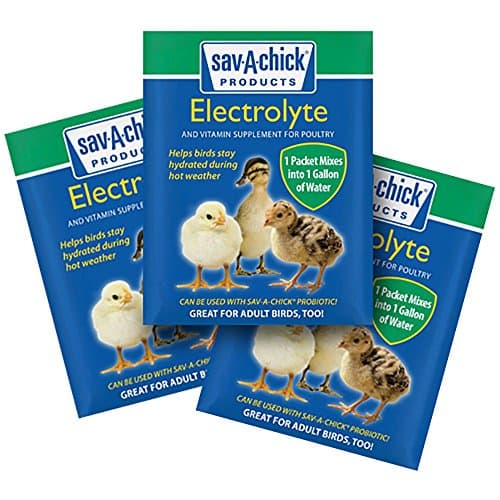
Sav-A-Chick Electrolyte & Vitamin Supplement, 0.25 oz packets
The only electrolyte mix here whose published analysis is built around potassium rather than salt, and the maker's own instruction is the honest one: offer it alongside plain water, never instead of it.
Who it is for. Anybody heading into a heat wave, collecting shipped chicks, or nursing a bird back after illness.
Published specifications
Potassium (min)
15.00%
Salt
8.00% min, 9.00% max
Sodium
14.00% min, 14.50% max
Zinc (min)
120 ppm
Vitamin A (min)
1,280,000 IU/lb
Vitamin D3 (min)
3,200,000 IU/lb
Vitamin E (min)
960 IU/lb
Packet
0.25 oz, mixed into 1 gallon of clean, cool water
Maker's direction
Offer alongside a source of plain drinking water in a separate container at all times during hot weather or other stress; make fresh solution daily
Publishes 15 percent minimum potassium — the mineral a panting bird is actually losing, and roughly seven times the figure Durvet publishes
The maker tells you to keep plain water available alongside it, which is the instruction most keepers get wrong
Single-gallon packets, so you mix exactly what you need and throw nothing away
Full guaranteed analysis published on the maker's own site, including zinc and three vitamins
What it costs you
Vitamins are published per pound of powder while Durvet publishes per 5 g dose, so the vitamin figures between the two brands cannot be compared directly
Packets are single-gallon, which is fiddly and more expensive per gallon than a jar if you run a big flock
Contains added colors (Yellow 6, Red 40) that do nothing for the bird
Must be made fresh daily, so it is a chore for as long as the heat lasts
Skip it if. Nothing is stressing the flock. Extension guidance is that clean cool water is the thing that matters; electrolytes are for heat, shipping and recovery, not a daily supplement.
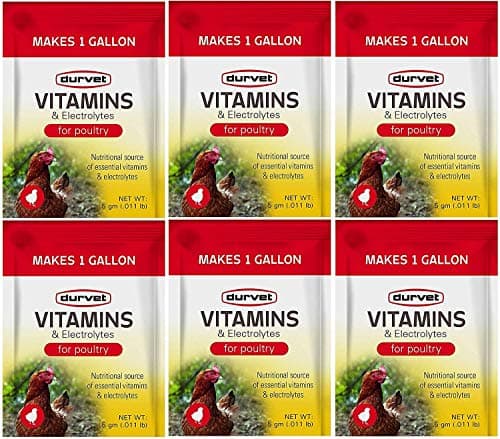
Durvet Vitamins & Electrolytes for Poultry, 5 g packets
A salt-and-vitamin mix rather than a potassium mix — it publishes its vitamin content per dose, which is genuinely more useful than a per-pound figure, but its mineral profile is the opposite shape to what a panting bird loses.
Who it is for. Keepers who want a per-dose vitamin figure, run a big enough flock for the jar to make sense, or are starting shipped chicks.
Published specifications
Salt
86% min, 91% max
Sodium
32% min, 39% max
Potassium
2%
Vitamin A
22,500 IU per 5 g scoop
Vitamin D3
9,000 IU per 5 g scoop
Vitamin E
9 IU per 5 g scoop
Ascorbic acid
34 mg per 5 g scoop
Directions
One scoop per gallon of drinking water; refresh water daily
Sizes
5 g packets, 40 per display; 100 g jar, which makes 20 gallons
Species
All classes of poultry
Source: Durvet, Vitamins & Electrolytes product literature (durvet.com published spec sheet, guaranteed analysis per 5 g scoop), retrieved 2026-09-21
Rubric — 8.1 / 10
Capacity honesty7/10 · weight 26%
Documentation9/10 · weight 24%
Build and weather8/10 · weight 20%
Running cost9/10 · weight 15%
Daily use8/10 · weight 15%
What it gets right
Publishes its vitamin content per 5 g dose rather than per pound of powder, which is the figure you can actually act on
A 100 g jar makes 20 gallons, so it is far cheaper per gallon than single-serve packets for a large flock
Durvet publishes a full product sheet with the guaranteed analysis, ingredients and UPCs — better documentation than most of this category
Labeled for all classes of poultry and specifically noted as suited to young chicks
What it costs you
2 percent potassium against Sav-A-Chick's published 15 percent minimum, on the mineral that matters most in heat
86 to 91 percent salt means the dose is overwhelmingly sodium chloride — fine as a rehydration salt, but know what you are buying
The mineral percentages are comparable between brands but the vitamin bases are not, so cross-brand vitamin comparisons are not possible
No duration limit is published on the sheet, and electrolytes are not meant to be a permanent fixture in the drinker
Skip it if. You are buying specifically for a heat wave. The potassium figure is the one that matters then, and it is the one this product is lowest on.
Four nipples and a bucket you already own, which is the cheapest way to end the open-water problem for good and is rated by the maker at three chickens per nipple.
Who it is for. Anybody tired of scrubbing a fouled open waterer daily, who is comfortable drilling a bucket.
Published specifications
Quantity
4 nipples
Rated capacity
Each watering nipple accommodates three chickens
Installation
Fits a plastic container or PVC pipe to create a closed watering system
#ad We have no verified Amazon listing for this one, so no number is shown. How this is funded.
FAQ
Questions people actually ask
+Are electrolytes good for chickens?
In specific situations, yes: heat waves, newly shipped chicks, and birds recovering from illness or other stress. They are not an everyday supplement. Extension guidance treats them as an addition to clean plain water rather than a replacement, and says to offer the mix for only a few hours before returning to fresh plain water.
+What is the best electrolyte for chickens?
For heat, the product whose published analysis leads on potassium. Sav-A-Chick publishes a 15% minimum potassium against 8-9% salt; Durvet publishes 2% potassium against 86-91% salt. A panting bird is losing potassium. For a large flock, or for per-dose vitamin figures, Durvet's sheet is better documented and its 100 g jar makes 20 gallons.
+Can chickens have electrolytes every day?
That is not what either the makers or the extension guidance describe. poultry.extension.org says to provide an electrolyte mix only for a few hours, then remove it and replace with fresh plain water. Sav-A-Chick says to keep plain water available in a separate container at all times. Clean water is the everyday product.
+Can I make my own chicken electrolytes?
Home recipes circulate widely, and we are not going to publish one, because the whole argument of this page is that the mineral proportions are what distinguish these products - and a kitchen mix has no guaranteed analysis at all. If the potassium-to-salt ratio is the thing that matters, a labeled product is the only version of it you can check.
+Do chicks need electrolytes when they arrive?
Shipped chicks arrive dehydrated, and Durvet's own literature calls its product ideal for young chicks and frames it as aiding hydration and nutrition for a fast start. Follow the same rule as for adults: mixed to the published dose, made fresh, and with plain water available too.
Where the numbers came from
Sources
Every figure cited on this page came from one of these documents. If one of them has changed since we read it, the number here is out of date and we would like to know.
The published order is shade, water, ventilation. What to buy for each, the signs of heat stress in severity order, and the CFM arithmetic that rules a fan out of most coops.