Layer feed, ranked on what is actually printed on the tag
Every layer feed claims complete nutrition. The guaranteed analysis is the only part you can check, so this page compares those - protein, calcium, methionine, fiber - against what extension services publish for a hen in lay.
A layer feed is defined by two numbers, and both are published on every tag. poultry.extension.org publishes that layer diets should contain at least 14 percent protein, that 16 percent is more common, and that laying mashes typically carry 2.5 to 3.5 percent calcium. University of Georgia Extension puts a hen in production at 16 to 18 percent protein and 3.50 to 4.50 percent calcium. Every feed below sits inside those bands, which means the tag is where the real differences are.
How we ranked them, before any product
We have not fed these to a flock and compared egg counts; nobody publishing a “best layer feed” list has. What can be done honestly is read the guaranteed analyses side by side against published requirements, and judge on four things.
Protein against the published band. 16 percent is the common figure; 18 is the top of the UGA range for a hen in production. Higher is not automatically better, but it is the number most keepers look at first.
Calcium inside the laying range. This is what makes a feed a layer feed at all, and it is also what makes it the wrong feed for any bird not laying.
Methionine. The amino acid that matters for feather quality, and the one where layer feeds cluster tightly at 0.30 percent — useful to know before you pay extra expecting a difference.
Fiber, as a proxy for filler. Two feeds at the same protein and a two-point difference in maximum crude fiber are not the same bag.
The published analyses, side by side
Guaranteed analyses read from each maker 2026-09-21. All figures are published minimums or maximums, not measurements.
Feed
Protein
Methionine
Calcium
Fiber (max)
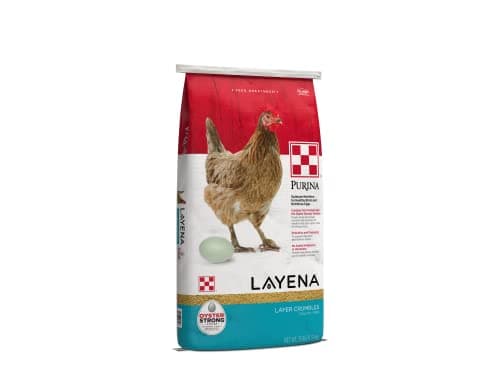
Purina Layena 16% Crumbles
16.00%
0.30%
3.25-4.25%
6.50%
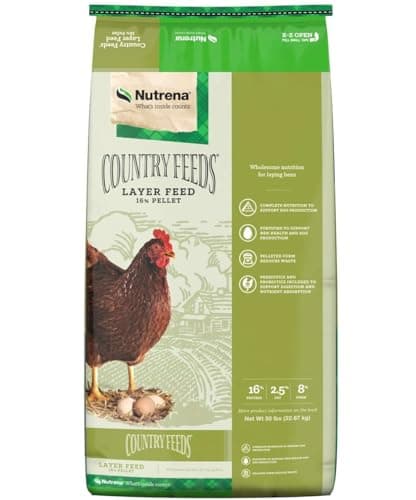
Nutrena Country Feeds 16% Layer Pellets
16.0%
0.3%
3.4-3.9%
8.0%
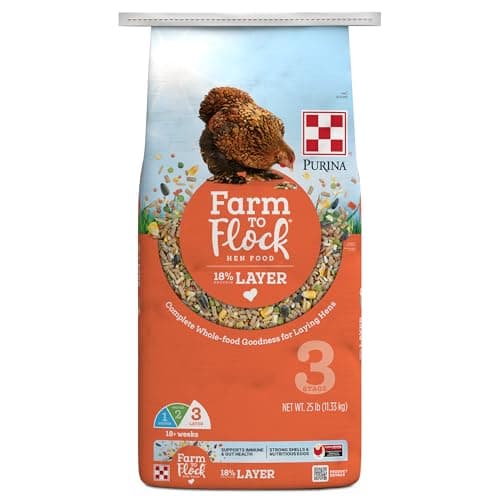
Purina Farm to Flock 18% Layer
18.00%
0.30%
3.25-4.25%
7.50%
Extension figure, hen in production
16-18%
not published
2.5-4.5%
—
Two things fall out of that table immediately. The first is that methionine is identical across all three at 0.30 percent. If you are choosing a layer feed hoping for better feather condition, the tag says you are not buying it — that is a point our molting page develops at length, and it is the reason a molting hen is better served by a grower ration than by any of these.
The second is fiber. Layena publishes a 6.50 percent maximum against Country Feeds' 8.0 percent, at the same protein and similar calcium. Maximum crude fiber is a ceiling rather than a measurement, but a two-point difference in the ceiling is the clearest quality signal available in this comparison.
16 percent or 18?
Both are inside the published range for a hen in production, so this is a genuine choice rather than a right answer. The case for 16 is that it is what extension services call the common layer level, it is cheaper, and it is what the great majority of backyard flocks have always been fed. The case for 18 is that it gives headroom for a mixed-age flock, cold weather, or birds that are also raising or recovering.
What 18 percent does not do is substitute for a grower ration during a molt, because the calcium is still at laying level. That is the distinction this site keeps coming back to: the protein number gets the attention, and the calcium number decides whether the feed suits the bird.
When a layer feed is the wrong bag entirely
Calcium is the reason. Every feed on this page carries roughly 3.25 to 4.25 percent, which is right for a hen putting several grams of it into a shell each day and wrong for anything else. University of Maryland Extension is blunt about what happens to a young bird on a layer diet: “the calcium level is so high that the chick will experience improper bone formation, kidney failure, and possibly death.”
A rooster has no use for shell calcium and has to excrete the excess.
Pullets not yet laying should be on grower feed until the first egg. Purina's own Farm to Flock direction is to switch at the onset of egg production.
A hen in molt has stopped laying and has nowhere to put the calcium — see the molting page.
A mixed-age flock sharing one feeder, which is the situation all-flock feed plus free-choice oyster shell exists to solve. The feed types page covers that decision.
Why oyster shell is on this page
Because a layer feed is a compromise the moment more than one kind of bird eats from the feeder, and because shell quality problems are not always a feed problem. University of Maryland publishes the fix plainly: “An extra source of calcium can be offered free choice in the form of ground oyster shell, calcite, or limestone.” Free choice is the operative phrase — the hen forming a shell takes it and the bird that is not, does not.
That is also the honest answer to a keeper whose hens are laying thin shells on a complete layer feed: add the free-choice dish before you change brands. The grit and oyster shell page covers the difference between the two supplements, which is the thing most often got wrong.
Heads up: some links on this page are affiliate links. If you buy through one we may earn a commission at no extra cost to you. It never changes a ranking, and we take no payment for placement. The full version.
The short answer
The short list
Ranked on the published rubric. Every row jumps to that product's full write-up below; the button goes straight to Amazon.
#
Pick
Best for
Key spec
Score
Price
1
Our pick
Purina
Layena 16% Layer Crumbles, 25 lb
The bag most American backyard keepers actually buy, and on published figures it earns the position: a complete 16 percent ration with the fullest guaranteed analysis in this comparison, down to the phytase.
The same 16 percent protein and a slightly tighter calcium band than Layena, in a 50 lb pellet bag that costs markedly less per pound — the value pick, if your flock is big enough to eat it before it ages.
Two protein points above the layer level extension services call common, with the calcium left where a laying hen needs it — the one-bag answer when some birds are molting and some are still filling the nest box.
Thirty-three to thirty-eight percent calcium in a crushed form, offered free-choice — the supplement that fixes thin shells and the one most first-time keepers confuse with grit.
#adPrices as of September 21, 2026. Scores are our own published rubric, not customer ratings.
#1 · The default layer ration
Purina Layena 16% Layer Crumbles, 25 lb
The bag most American backyard keepers actually buy, and on published figures it earns the position: a complete 16 percent ration with the fullest guaranteed analysis in this comparison, down to the phytase.
Who it is for. A flock of laying-age hens, all in production, whose keeper wants one bag that is stocked in every farm store in the country.
The same 16 percent protein and a slightly tighter calcium band than Layena, in a 50 lb pellet bag that costs markedly less per pound — the value pick, if your flock is big enough to eat it before it ages.
Who it is for. Eight birds or more, with a sealed container to keep it in and a farm store that reliably stocks it.
Published specifications
Crude protein (min)
16.0%
Lysine (min)
0.7%
Methionine (min)
0.3%
Crude fat (min)
2.5%
Crude fiber (max)
8.0%
Calcium
3.4% min, 3.9% max
Phosphorus (min)
0.45%
Probiotics
Lactobacillus acidophilus, Lactobacillus casei, Bifidobacterium thermophilum and Enterococcus faecium, min 2.55 million CFU/lb each
Bag
50 lb
Source: Nutrena, Country Feeds Layer 16% Pellet product page and guaranteed analysis (nutrenaworld.com), retrieved 2026-09-21
Rubric — 8.2 / 10
Capacity honesty8/10 · weight 26%
Documentation9/10 · weight 24%
Build and weather8/10 · weight 20%
Running cost9/10 · weight 15%
Daily use7/10 · weight 15%
What it gets right
A tighter published calcium band (3.4 to 3.9 percent) than Layena's 3.25 to 4.25, which is a small point in favor of consistency
Pellets rather than crumble: less dust, and birds cannot pick through them
Names its four probiotic strains individually with a CFU figure for each
50 lb is the cheapest way to buy a complete layer ration if you have the flock and the storage for it
What it costs you
8.0 percent maximum crude fiber is the highest here, against Layena's 6.5 — more filler for the same protein
50 lb sitting in a bin is weeks of feed for a small flock, and the shelf life is measured in weeks to a couple of months
Pellets suit adult birds but are too large for anything still growing, so this is not a whole-flock feed
Distribution is thinner than Purina's, so a mid-season switch is likelier if your store stops stocking it
Skip it if. You keep three or four hens. The bag will go stale before they finish it, and the saving per pound disappears when you throw the last third away.
Two protein points above the layer level extension services call common, with the calcium left where a laying hen needs it — the one-bag answer when some birds are molting and some are still filling the nest box.
Who it is for. Anybody with an all-hen, all-adult flock who wants one bag in the bin and no second dish to keep topped up.
Published specifications
Crude protein (min)
18.00%
Methionine (min)
0.30%
Lysine (min)
0.70%
Crude fat (min)
2.50%
Crude fiber (max)
7.50%
Ash (max)
14.00%
Calcium
3.25% min, 4.25% max
Phosphorus (min)
0.45%
Salt (NaCl)
0.20% min, 0.70% max
Microorganisms (min)
84,000,000 CFU/lb
Labeled for
Laying chickens after 18 weeks of age, throughout the laying cycle
Label caution
Not to be fed to male birds of any age, or to birds under 18 weeks
Bag size
25 lb
Source: Purina Animal Nutrition, Farm to Flock 18% Layer Hen Food product page and guaranteed analysis (purinamills.com), retrieved 2026-09-14
Rubric — 8.3 / 10
Capacity honesty8/10 · weight 26%
Documentation10/10 · weight 24%
Build and weather8/10 · weight 20%
Running cost7/10 · weight 15%
Daily use8/10 · weight 15%
What it gets right
18 percent protein is two points above the 16 percent that poultry.extension.org calls the more common layer level, without asking you to run a second feed
Carries laying calcium, so hens that keep laying straight through the molt need no separate supplement
Purina publishes the whole analysis down to the probiotic count and the vitamin levels, which most of this category does not
The label caution about roosters and under-18-week birds is stated plainly, and it is the mistake this feed most invites
What it costs you
Methionine is published at 0.30 percent, the lowest figure in our table and lower than Purina's own grower bag — on the one nutrient extension literature ties directly to growing a feather
Lysine at 0.70 percent is also the lowest here
3.25 to 4.25 percent calcium goes into a bird who has stopped laying and has nowhere to put it; that is the trade you make for the convenience of a single bag
Cannot be the flock's only feed if you keep a rooster or have pullets coming up behind — the label rules both out
Skip it if. You keep a rooster, or pullets under 18 weeks share the feeder. The label rules this feed out for both, and a shared trough does not let you enforce it.
Thirty-three to thirty-eight percent calcium in a crushed form, offered free-choice — the supplement that fixes thin shells and the one most first-time keepers confuse with grit.
Who it is for. Anybody whose hens have started laying, particularly if shells are thinning or breaking in the nest.
#ad We have no verified Amazon listing for this one, so no number is shown. How this is funded.
FAQ
Questions people actually ask
+What is the best layer feed for chickens?
On published figures, Purina Layena 16% Crumbles has the most complete guaranteed analysis in this comparison and the lowest maximum crude fiber at 6.50%. Nutrena Country Feeds 16% Layer Pellets matches it on protein with a slightly tighter calcium band and costs less per pound in a 50 lb bag. Both sit inside the extension figures for a hen in production. We have not fed either to a flock.
+What protein percentage should layer feed be?
poultry.extension.org publishes that layer diets should contain at least 14 percent protein and that 16 percent is more common. University of Georgia Extension puts a hen in production at 16 to 18 percent. Anything in that band is defensible; 16 percent is the standard backyard choice.
+How much calcium is in layer feed?
Roughly 3.25 to 4.25 percent in the feeds compared here. poultry.extension.org publishes 2.5 to 3.5 percent as typical for laying mashes and University of Georgia gives 3.50 to 4.50 percent for a hen in production. That calcium is exactly what makes a layer feed unsuitable for any bird that is not laying.
+Can roosters eat layer feed?
It is not ideal. A rooster has no use for shell calcium and has to excrete the excess. A mixed flock with a rooster is the situation all-flock feed with free-choice oyster shell exists for, so the hens take the calcium they need and nobody else does.
+Is 16% or 18% layer feed better?
Both are inside the published range for a hen in production. 16 percent is the common level extension services describe and is cheaper; 18 percent gives headroom for a mixed-age flock or a cold winter. Note that the 18 percent feed here publishes the same 0.30 percent methionine as the 16 percent ones, and still carries laying-level calcium - so it is not a substitute for a grower ration during a molt.
+Should I switch layer feed if my hens lay thin shells?
Add free-choice oyster shell first. University of Maryland Extension publishes that extra calcium can be offered free choice as ground oyster shell, calcite or limestone, and a hen forming a shell will take what she needs. Changing brands is a bigger disruption than putting out a second dish, and every feed here already carries laying-level calcium.
Where the numbers came from
Sources
Every figure cited on this page came from one of these documents. If one of them has changed since we read it, the number here is out of date and we would like to know.