This is a roundup that spends most of its length arguing you probably should not buy the product. Then it tells you which one, and what it costs to run.
Most healthy adult standard-breed birds in a dry, well-ventilated coop do not need supplemental heat, and a heated coop creates a dependency that is dangerous during a power cut. If you do heat, a flat radiant panel running at roughly 130 F is far safer than a 250 W bulb, and 200 W run continuously for a 90-day winter has a ceiling of about $79.
The case against, first
Three arguments, in order of importance.
Chickens are better at cold than you think. A chicken is wearing down. It roosts pressed against other chickens with its feet tucked into its feathers and its head under a wing. Dry cold is something it handles well. The winter problem in a coop is not temperature, it is moisture, and heat does not fix moisture — it can make it worse by raising the air’s capacity to hold water that then condenses on the coldest surfaces available.
A heated coop is a dependency. Birds acclimated to a warm coop have not developed the cold tolerance they would otherwise have. When the power fails on the coldest night of the year — which is precisely when power fails — they are in far more danger than an unheated flock would have been. This is not hypothetical; it is the predictable consequence of removing an adaptation.
It is the leading fire risk in a coop. Particularly if the heat source is a lamp with a bulb, suspended over dry bedding, in a wooden building nobody visits at night.
When it genuinely is justified
There are real cases and it would be dishonest to pretend otherwise:
Genuinely extreme cold — sustained well below zero Fahrenheit, where even a well-feathered bird is at the edge.
Breeds with large single combs in cold climates, which have more exposed tissue to lose. Though ventilation still helps them more than warmth does.
A sick or injured bird that needs warmth while recovering, usually in an isolation crate rather than the coop.
Birds that have not fully feathered — young birds moved out too early, which is a reason to move them later rather than to heat the coop.
If you do heat: what and what it costs
A flat radiant panel is the right shape of product. Cozy Products publishes an operational surface temperature of approximately 130 F for its 200 W panel, against a 250 W bulb running at several hundred degrees, and a zero-clearance safety rating that means it can be mounted flat against a wall. There is no bulb to shatter and none to replace.
What the panel publishes
Cozy Products Cozy Coop, published specifications.
Specification
Published
Power
200 watts
Surface temperature
Approximately 130 F
Dimensions
19 in L x 13 in W x 5/8 in deep
Weight
5 lb
Heat type
Radiant and convection, two settings, built-in thermostat
Clearance
Safety-rated with zero clearance
Bulbs
None
Thermostat switching points
Not published
Better uses of the same money
If your concern is winter, the interventions that actually help, in order:
Ventilation above roost height. Free, and it addresses the actual cause of frostbite. The ventilation page.
A heated waterer. Frozen water is the winter problem that genuinely threatens birds, and a 60 W drinker costs less to run than a 200 W panel. Heated waterers.
Blocking low drafts while keeping the high openings. Also free.
Dry bedding, changed more often in winter, because damp bedding is a moisture source inside the coop.
Heads up: some links on this page are affiliate links. If you buy through one we may earn a commission at no extra cost to you. It never changes a ranking, and we take no payment for placement. The full version.
The short answer
The short list
Ranked on the published rubric. Every row jumps to that product's full write-up below; the button goes straight to Amazon.
#
Pick
Best for
Key spec
Score
Price
1
Score7.2
Our pick
Cozy Products
Cozy Coop Flat Panel Heater, 200 W
A flat radiant panel that runs at roughly 130 F rather than a bulb at several hundred, which is the whole safety argument — and 200 watts, which is the whole cost argument against it.
The only heated waterer here that publishes the temperature it is rated to and the thermostat's actual switching points — 100 watts, on below 40 F, off at 60 F, unfrozen to minus twenty.
#adPrices as of October 18, 2026. Scores are our own published rubric, not customer ratings.
Score7.2no photo yet
#1 · Radiant heat with no bulb
Cozy Products Cozy Coop Flat Panel Heater, 200 W
A flat radiant panel that runs at roughly 130 F rather than a bulb at several hundred, which is the whole safety argument — and 200 watts, which is the whole cost argument against it.
Who it is for. Genuinely marginal cases: very cold climates with small or lightly feathered breeds, or a sick bird that needs warmth.
Published specifications
Power
200 watts
Operational surface temperature
Approximately 130 F
Dimensions
19 in L x 13 in W x 5/8 in deep
Weight
5 lb
Heat type
Radiant and convection, two heat settings, built-in thermostat
A published surface temperature of about 130 F, which is the number that makes this fundamentally different from a 250 W bulb
Zero-clearance safety rating means it can be mounted flat against a coop wall
No bulb to shatter, and a shattered bulb over bedding is how coops burn down
A built-in thermostat means the 200 W figure is a ceiling, not a constant
What it costs you
200 W is still 200 W: run flat out for a 90-day winter it would draw about 432 kWh, roughly $79 at the current national average residential rate
Most healthy adult birds in a dry, well-ventilated coop do not need supplemental heat at all, and a heated coop makes a power cut dangerous
Cozy Products does not publish the thermostat's switching temperatures
Requires mains power in the coop, which many backyard coops do not have
Skip it if. Your flock is healthy adult standard breeds in a dry, ventilated coop. Ventilation and dry bedding beat added heat, and a heater you come to depend on is a hazard the night the power fails.
#ad We have no verified Amazon listing for this one, so no number is shown. How this is funded.
#2 · Cold climates, published to -20 F
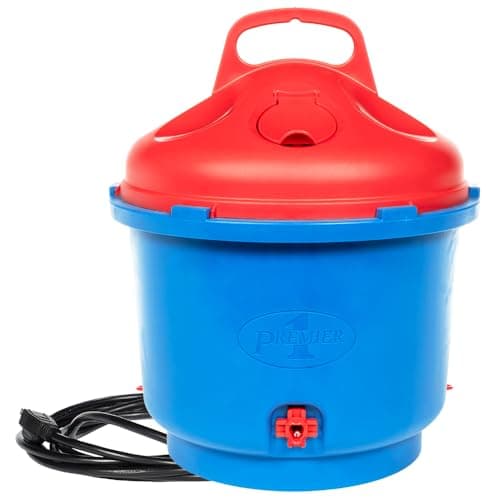
Premier 1 Supplies All-Season Heated Poultry Waterer, 3 Gallon
The only heated waterer here that publishes the temperature it is rated to and the thermostat's actual switching points — 100 watts, on below 40 F, off at 60 F, unfrozen to minus twenty.
Who it is for. Anybody north of a hard-freeze line who wants a published temperature rating rather than a hopeful one.
Published specifications
Capacity
3 gallons
Heater
100 W heating element with a built-in thermostat
Thermostat behavior
Turns on when ambient temperature is below 40 F and off at 60 F
Generally no. Healthy adult standard-breed birds in a dry, well-ventilated coop handle cold well — they are wearing down and they roost together. The winter problem is moisture condensing on combs and wattles rather than the temperature itself, and heat does not fix moisture.
+How much does a chicken coop heater cost to run?
A 200 W panel run continuously for a 90-day winter uses 432 kWh, which is $79.23 at the June 2026 US average residential rate of 18.34 cents per kWh. That is a ceiling — the unit is thermostatic — but its maker does not publish switching points, so the ceiling is the only computable figure.
+Is a heat lamp safe in a chicken coop?
It is the most dangerous thing commonly installed in one. A 250 W bulb runs hot enough to ignite dry bedding, is usually held by a clamp that can loosen, and sits unattended overnight in a wooden building. A flat radiant panel with a published surface temperature around 130 F and a zero-clearance rating is a fundamentally different product.
+What is better than heating a chicken coop?
Ventilation above roost height, which is free and addresses the actual cause of frostbite; a heated waterer, because frozen water is the winter problem that genuinely threatens birds; blocking low drafts while keeping high openings; and changing bedding more often, because damp bedding is a moisture source inside the coop.
Where the numbers came from
Sources
Every figure cited on this page came from one of these documents. If one of them has changed since we read it, the number here is out of date and we would like to know.