A full 21-day hatch costs between about $1.11 and $3.70 in electricity, depending on the machine. A Brinsea Mini II at its published 12 watts typical draws 6.05 kWh over the 504 hours and costs $1.11 at the US average residential rate. A 40-watt machine run at its rating draws 20.16 kWh and costs $3.70. Running cost is therefore a real number and a minor one — it should not decide which incubator you buy.
This page exists because nobody publishes the figure. Incubator makers publish wattage, electricity suppliers publish rates, and the multiplication in between is left to you. It is not a difficult multiplication, but the inputs are scattered across three places and two of the six machines on this site do not supply the first one.
So here is the whole thing, with every input named and sourced. If your electricity costs something different from the national average — and it almost certainly does — you can substitute your own rate and redo it in a line.
The three inputs
Hours. A chicken hatch is 21 days, published by Mississippi State University Extension, and an incubator runs continuously through all of it. That is 21 × 24 = 504 hours. There is no duty cycle to discount for, because although the heater cycles, the published “typical” wattage is already an average figure rather than a peak one.
Watts. From the maker’s own specification page. This is where the category splits in two. Brinsea publishes typical and maximum for every model. Manna Pro publishes no wattage figure at all for the Nurture Right 360, and Farm Innovators publishes a single 40-watt rating for the 4250. For those two, the only defensible calculation is a ceiling.
Run that for every machine on this site and the whole category fits in one table. The right-hand column is the one worth looking at: cost per egg the machine can hold, which is the closest thing to a fair comparison across very different capacities.
Electricity cost of one 21-day hatch, at 504 hours and 18.34 cents/kWh. Figures with a dash have no published typical wattage.
Machine
Typical W
kWh
Cost per hatch
Per egg-slot
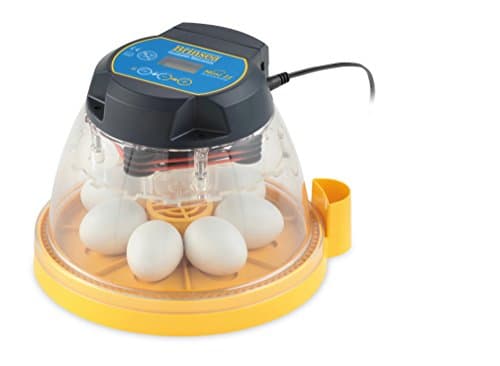
Brinsea Mini II Eco (10 eggs)
12
6.05
$1.11
11 cents
Brinsea Mini II Advance (7 eggs)
12
6.05
$1.11
16 cents
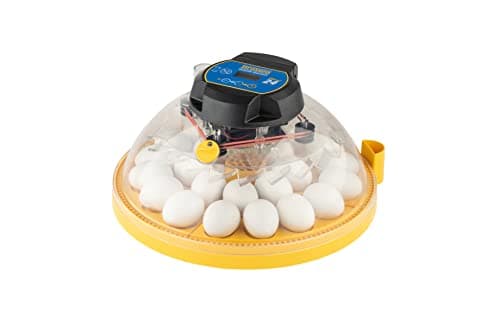
Brinsea Maxi 24 Advance (24 eggs)
24
12.10
$2.22
9 cents
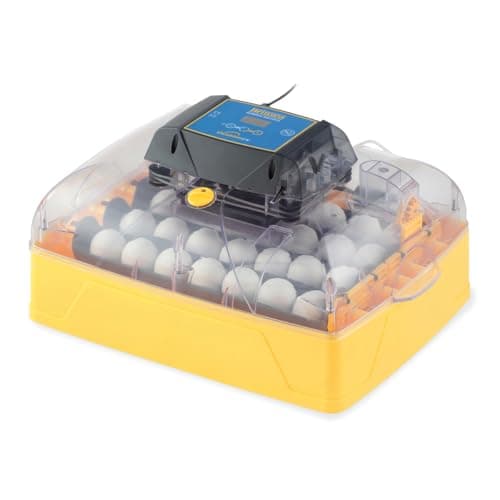
Brinsea Ovation 28 EX (28 eggs)
30
15.12
$2.77
10 cents
Nurture Right 360 (22 eggs)
—
20.16
$3.70 ceiling
17 cents ceiling
Farm Innovators 4250 (41 eggs)
—
20.16
$3.70 ceiling
9 cents ceiling
The last two rows are computed from the published 40-watt rating, held continuously. That is a ceiling and not an estimate: a thermostatically controlled machine does not sit at its rating, so the true figure is lower and we cannot say by how much. Publishing a ceiling and labeling it as one is the honest version of this row. The full incubator comparison goes through what else those two makers do and do not publish.
What the numbers actually tell you
Three things, and only one of them is about money.
First, running cost should not decide your purchase. The spread across this entire table is about two dollars and sixty cents. Any feature that improves your odds of a successful hatch — an alarm, an auto-stop, automatic humidity — is worth multiples of the entire lifetime electricity difference between these machines.
Second, the incubator is the cheap part of the stage. Compare it to what comes next: this site’s brooder arithmetic puts six weeks of brooding on a 12-watt heat plate at $2.22, and on a 250-watt heat lamp at $46.22. Hatching costs about what brooding on a plate costs. Brooding on a lamp costs twenty times either.
Third, a maker that publishes typical wattage has measured its own product. That is the real reason this page ranks Brinsea highly and it has nothing to do with electricity. Two of the six machines on this site cannot appear in the middle four rows of that table, and the reason is not that they draw more power — it is that nobody will say what they draw.
Doing it with your own rate
The national average hides an enormous spread. Substituting your own number takes one multiplication: find the published typical wattage, multiply by 504, divide by 1,000 to get kilowatt-hours, then multiply by your rate per kWh from your own bill.
For a 24-watt machine that is 12.10 kWh regardless of where you live. At 12 cents that is $1.45; at 30 cents it is $3.63. Even at the top of the US range, a full hatch costs less than a bag of chick starter. If somebody tells you incubation is expensive to run, they are describing something other than the electricity — most likely the machine, the eggs, or the brooder that has to be ready on day 21.
Heads up: some links on this page are affiliate links. If you buy through one we may earn a commission at no extra cost to you. It never changes a ranking, and we take no payment for placement. The full version.
The picks
The machines whose running cost can actually be computed
These three publish typical as well as maximum wattage, which is the only reason any of the arithmetic below is possible. The other machines on this site publish a single rating, and a single rating gives you a ceiling rather than a cost.
Brinsea
Mini II Advance
12 W typical
Best for: A first automatic hatch
The same twelve watts as the manual model, with a programmable turning cradle that stops itself two days before hatch — which removes the single most common way a first hatch is lost.
#ad No live price feed yet, so no number is shown rather than a stale one. How this is funded.
Brinsea
Maxi 24 Advance
24 eggs, 24 W typical
Best for: Filling a brooder in one hatch
Twenty-four hen eggs on programmable automatic turning at a published twenty-four watts — the size that actually produces a first flock rather than a demonstration.
#ad No live price feed yet, so no number is shown rather than a stale one. How this is funded.
Brinsea
Ovation 28 EX
Automatic humidity
Best for: The only automatic humidity here
Twenty-eight eggs and the one specification nothing else on this page publishes: automatic humidity control, which removes the daily water-tray judgment call that ruins more hatches than temperature does.
#ad No live price feed yet, so no number is shown rather than a stale one. How this is funded.
FAQ
Questions people actually ask
+How much does it cost to run an egg incubator for 21 days?
Between about $1.11 and $3.70 in electricity, at the US average residential rate of 18.34 cents per kWh. A 12-watt machine draws 6.05 kWh across the 504 hours of a full hatch; a 40-watt machine at its rating draws 20.16 kWh. The whole spread across the incubators on this site is about $2.60, which is why running cost should not decide the purchase.
+How many watts does an egg incubator use?
Published typical figures range from 12 watts on the Brinsea Mini II models to 30 watts on the Ovation 28 EX. Maximum ratings run from 20 to 60 watts. Two makers publish only a single rating with no typical figure, which means their true consumption cannot be computed at all, only bounded from above.
+Is an incubator expensive to run?
No. A full 21-day hatch costs roughly the same in electricity as six weeks of brooding chicks on a 12-watt heat plate, which is about $2.22. The genuinely expensive part of hatching is not power at all: it is feeding the roughly half of the hatch that turns out to be male until you can rehome them.
+How do I calculate my own incubator running cost?
Take the maker's published typical wattage, multiply by 504 hours, divide by 1,000 for kilowatt-hours, then multiply by the rate on your own electricity bill. A 24-watt machine uses 12.10 kWh per hatch wherever you live, which is $1.45 at 12 cents per kWh and $3.63 at 30 cents.
Where the numbers came from
Sources
Every figure cited on this page came from one of these documents. If one of them has changed since we read it, the number here is out of date and we would like to know.
Incubators compared on published watts and egg capacity, the running cost of a 21-day hatch, and the extension figures for temperature, humidity and turning.