Nurture Right 360 review: what the maker actually publishes
This is the incubator most beginners buy, and the one with the worst reputation for documentation. That reputation is half wrong - there is no specification table, but there is a manual, a sixteen-page FAQ with a full species table, and a calibration sheet. Read all three and the machine gets a lot more interesting.
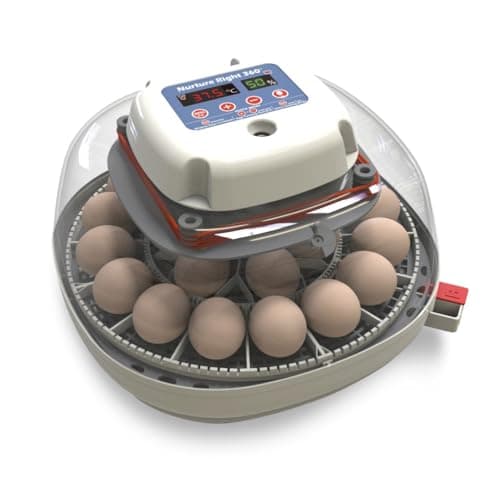
Twenty-two chicken eggs, forced air with a fan, a horizontal rolling turner that “turns for 5 seconds every 60 minutes”, a digital display whose temperature and humidity readings can both be calibrated, and a one-year warranty. The catch is not the hardware, it is a number: Manna Pro’s own species table gives 48 to 55 percent humidity for chicken eggs through incubation, where Mississippi State University Extension publishes 58 to 60 percent. That gap is the single most important thing to know before you set eggs in this machine.
First, a correction to our own pages
This site has previously described the Nurture Right 360 as a machine from a maker that publishes nothing, and has quoted a two-hour turning interval taken from a retailer’s specification listing. Both needed fixing, and we went looking properly before writing a review of it.
Manna Pro publishes three documents: an instruction manual, a sixteen-page FAQ with a species table, and a temperature and humidity calibration sheet. What it does not publish is a specification table — there is no maker’s figure anywhere for dimensions, weight or wattage, which still have to come from a retailer. So the documentation is much better than we said, and still incomplete in a way that matters for running cost.
The species table, which is the best thing Manna Pro publishes
Almost no incubator maker publishes per-species targets. This one does, and it is the reason to keep the FAQ rather than throw it out with the box.
Manna Pro, Nurture Right 360 FAQ, published species table. Three rows shown; the published table also covers pheasant, jumbo duck, turkey, peafowl and goose.
Bird
Incubation
Incubation humidity
Lockdown
Lockdown humidity
Turning
Approx. eggs
Days
Chicken
99.5 F
48 to 55%
99.5 F
65 to 75%
Automatic
22
21
Duck
99.5 F
50 to 60%
98.5 F
65 to 70%
Automatic
12 to 18
28
Quail
99.5 F
40 to 50%
98.5 F
70%
Either
44
17 to 23
Two things stand out. The machine drops the target temperature for lockdown on most species but not on chickens, which stay at 99.5 F throughout. And quail are listed as “Either” on turning, because the FAQ says elsewhere that quail eggs “may be too small for use with the automatic egg turner” — with the turner tray removed entirely, “the incubator can hold about 90 quail eggs.”
The humidity disagreement, stated plainly
Here is the conflict in full. For chicken eggs through the incubation period, Manna Pro publishes 48 to 55 percent. Mississippi State University Extension publishes 58 to 60 percent relative humidity from setting through day 18. Those ranges do not overlap. On lockdown they agree well enough — Manna Pro’s 65 to 75 percent sits neatly around the extension figure of 65 percent or more.
The room requirement is real, and it is the commonest cause of complaints
This is published twice, in two documents, which is usually a sign a maker is tired of answering it. The FAQ: “For best results, we recommend using the incubator in a room that stays between 74F-80F.” And in the troubleshooting section: “Ensure the incubator is located up off the floor, in a room at least 74F and away from drafts and windows.”
Seventy-four Fahrenheit is warmer than a lot of houses, and considerably warmer than the garage or spare room where an incubator usually ends up. A machine that cannot hold temperature or humidity in a 62 F utility room is not necessarily a faulty machine — it is a machine outside its published operating conditions. If your only option is a cool room, that is an argument for a different machine, and it is why the specified operating environment belongs in a review rather than in a footnote.
Water, in quantities the maker actually specifies
The humidity system is two water pots filled from outside the lid, and the published instructions are unusually specific for this price bracket:
“Add about 4 fl. oz. of water into Water Pot A.” Pot A for days 1 to 18; pots A and B together for days 19 to 21 on chicken eggs.
“When making small adjustments to the humidity, add 1 tablespoon at a time.” Then “wait 2-3 hours for the humidity to stabilize before re-adjusting.” Most beginner incubation failures are somebody adjusting again after ten minutes.
Fill to “2/3 or 3/4 of the height of the water pot”, and “to reduce the impact of cold to the eggs, using warm distilled water (80-90F) is recommended.”
“Inspect the water pot(s) every 24 hours and refill as needed. Do not let the incubator run without water during incubation!” The external ports mean this never requires opening the lid, which is the machine’s best feature and the reason it suits a first hatch.
The sliding air vent knob is the other half of the humidity control, and it works the way that always surprises people: “Close the vent to increase humidity or open the vent to decrease humidity.” With a floor under it — the vent must stay “at least 1/3 open for the first 18 days, although 1/2 open is recommended”, and then “the air vent MUST be fully opened for the last 3 days of incubation.” Closing the vent to chase a humidity reading during lockdown is therefore not available to you, which is the correct design decision and worth knowing before you try it.
Calibration, the feature nobody mentions
The third document is the one that changes how you should think about this machine. It publishes a procedure for calibrating both the temperature and the humidity readings against a trusted secondary instrument, in 0.5 F steps, up to a stated limit: “The maximum temperature calibration adjustment is +/- 2.5 F.”
That is a genuinely useful thing on a budget incubator. The standard advice for any cheap incubator is to put your own calibrated thermometer inside it and trust that instead of the display — our incubator roundup says as much. Here you can do one better: measure the offset, then correct the display so the machine’s own thermostat is working from the true figure rather than merely reporting a wrong one to you. A 2.5 F window covers the drift you would plausibly find.
What it will not do
The FAQ is refreshingly willing to say no, and these limits are all published rather than inferred:
Nothing over 21 days on one timer. “The maximum hatch days this incubator is 21 days.” For Muscovy ducks at 35 days the FAQ tells you to split the countdown into two parts, which works but is a workaround.
The turner is fixed. Not programmable, not adjustable, one tray size. “Eggs too large or too small will need to be hand turned”, and “hand turning should be done three times daily minimum.”
The tray range is bantam chicken to large duck, guinea fowl included. Goose, turkey and peacock eggs are too large; with the tray out it holds about 10 to 12 of them, hand-turned.
No ratites and no reptiles. Emu and ostrich eggs are “larger than what the incubator was intended for”; on reptile eggs, “this incubator does not have the appropriate temperature settings.”
An EE in red on the heat indicator means “the system is unable to receive the signal from the temperature sensor within the unit” — a fault code worth recognizing at 3am on day 19.
Lockdown, which this machine handles well
The turner stops itself and then prompts you: the display change is “a reminder to remove the egg turner from incubator base and to increase the humidity.” Usefully, “the eggs do not need to be removed in order to remove the egg turner” — you lift the turner off its shaft and leave the eggs lying on the floor of the machine.
That is the correct behavior and the correct prompt, and it is the part of a first hatch people most often get wrong. It also matters that the manual tells you to wait: some chicks are late, and the guidance runs to day 23 before giving up. Combined with “avoid opening the lid frequently”, that is the whole of lockdown discipline in two instructions.
The built-in LED candler is the other thing that keeps a first-timer honest, because it means candling does not require a separate gadget or a dark cupboard. The manual’s cautions are sensible: dim the room, do not shake the egg, and because “the room temperature is much lower than that of the incubator, candling should be completed within 8 minutes.”
The verdict, and who should buy something else
It earns its place. Twenty-two eggs is a real hatch rather than a demonstration, the external water ports remove the main reason people open a running incubator, hourly turning comfortably clears the published minimum, the turner stops itself and says so, and the display can be calibrated. The dome is not a gimmick either — for a family or a classroom, being able to see in is most of the point.
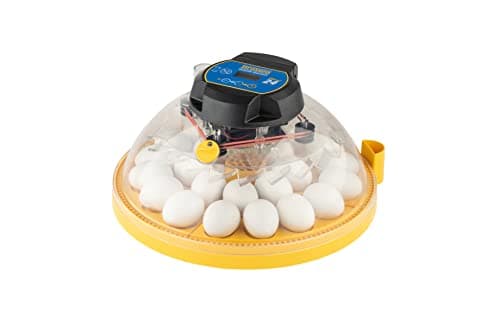
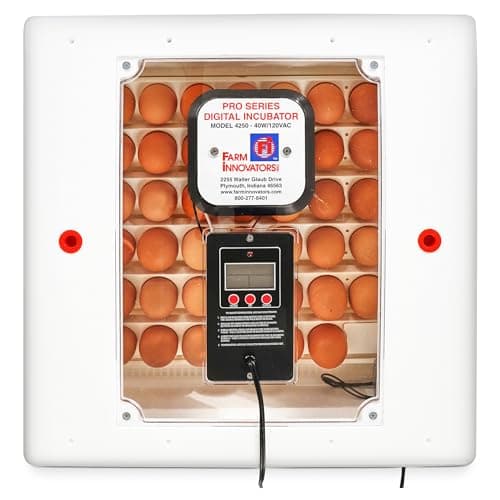
Three reasons to buy something else instead. If you want to compute what a hatch costs before you buy, no maker’s wattage figure exists, so you can only work out a ceiling from a retailer’s 40 watt rating — the running-cost page does that arithmetic for every machine here and this is the one where it is least solid. If you want a warranty proportional to the risk, the Brinsea Maxi 24 Advance publishes three years against one, plus a full specification table, programmable turning and a published 24 watts typical. And if egg count per dollar is the whole objective, the Farm Innovators 4250 takes 41 and includes a candler, at the cost of a polystyrene shell and even thinner documentation.
If the room you plan to put it in is below 74 F, none of the above is the deciding factor — fix the room first, or buy the machine whose published operating conditions you can actually meet.
Heads up: some links on this page are affiliate links. If you buy through one we may earn a commission at no extra cost to you. It never changes a ranking, and we take no payment for placement. The full version.
The picks
The machine reviewed, and the two it sits between
Twenty-two eggs in the middle of the market, against a smaller machine with better documentation and a warranty three times as long, and a bigger one with a candler in the box.
Harris Farms
Nurture Right 360
22 eggs
Twenty-two eggs, a horizontal rolling turner that runs for five seconds every sixty minutes, and a 360-degree dome that is the reason children stay interested for three weeks — from a maker that publishes a manual and a species table but never a specification sheet.
Twenty-four hen eggs on programmable automatic turning at a published twenty-four watts — the size that actually produces a first flock rather than a demonstration.
Forty-one large chicken eggs on an automatic turner with a candler in the box, in a polystyrene shell — the highest capacity here and the shortest list of things the maker will commit to in writing.
For a first or family hatch, yes. Twenty-two chicken eggs, forced air, external water ports so you never open a running machine, a turner that runs hourly and stops itself at lockdown, a built-in LED candler, and a display you can calibrate. The weak points are a one-year warranty, no maker's wattage or dimension figures, and a fixed non-adjustable turner.
+How often does the Nurture Right 360 turn the eggs?
Manna Pro's FAQ says the turner 'turns for 5 seconds every 60 minutes' - 24 turns a day. Mississippi State University Extension publishes a minimum of four to six turns daily, so it clears that comfortably. Retailer listings that say every two hours are wrong; the FAQ also suggests marking an egg with an X to confirm your own unit is turning.
+What humidity should the Nurture Right 360 be set to for chicken eggs?
This is where the sources disagree. Manna Pro's own species table gives 48 to 55 percent through incubation and 65 to 75 percent for lockdown. Mississippi State University Extension publishes 58 to 60 percent through day 18 and 65 percent or more afterwards. The lockdown figures agree; the incubation figures do not overlap. If you follow the lower figure, check egg weight loss rather than trusting the number.
+What room temperature does the Nurture Right 360 need?
The maker publishes it twice: at least 74 F, with 74 to 80 F recommended, kept up off the floor and away from drafts and windows. A unit that cannot hold temperature or humidity in a cool garage is often being run outside its published conditions rather than being faulty.
+Can you calibrate the Nurture Right 360?
Yes, and it is the feature nobody mentions. Manna Pro publishes a calibration sheet for both the temperature and the humidity readings, adjusted in 0.5 F steps against a trusted secondary instrument, with a stated maximum temperature adjustment of plus or minus 2.5 F.
+How many eggs does the Nurture Right 360 hold?
Twenty-two chicken eggs on the published species table. The same table gives 22 to 24 pheasant, 12 to 18 duck and 44 quail. With the turner tray removed it holds about 90 quail eggs, or about 10 to 12 goose, turkey or peacock eggs, all of which have to be hand turned at least three times daily.
+Nurture Right 360 or Brinsea Maxi 24 Advance?
The Brinsea publishes a full specification table, three years of warranty against one, programmable turning with a stated angle and interval, and 24 watts typical with a 40 watt maximum so running cost can be computed properly. The Nurture Right 360 takes fewer eggs at 22 against 24, but costs less, and the 360-degree dome is the reason families and classrooms choose it. Documentation and warranty favor the Brinsea; visibility and price favor the Nurture Right.
Where the numbers came from
Sources
Every figure cited on this page came from one of these documents. If one of them has changed since we read it, the number here is out of date and we would like to know.
Incubators compared on published watts and egg capacity, the running cost of a 21-day hatch, and the extension figures for temperature, humidity and turning.