Automatic egg turners, and what each machine actually does
Every one of these turns the eggs for you. They do it at different intervals, they stop at different points, and only some of them let you change either — which is the whole comparison.
All four turn the eggs without you. The Brinsea machines let you program both the interval and the angle and stop turning two days before hatch. The Nurture Right 360 turns on a fixed 60-minute cycle and stops at lockdown. The Farm Innovators 4250 turns completely every four hours. Every one of these comfortably exceeds the 4 to 6 turns a day Mississippi State University Extension publishes as the minimum, so the interval is not the thing to choose on — the auto-stop and the alarms are.
“Automatic turning” is printed on all four boxes and it describes four different behaviors. One tilts a whole cradle on a schedule you set. One rolls eggs on a fixed 60-minute cycle you cannot change. One turns a tray completely every four hours. They are not interchangeable, and the differences matter most at the two points where a hatch is actually won or lost: the first turn after setting, and the last turn before lockdown.
The published minimum, and why every machine clears it
Mississippi State University Extension publishes the requirement plainly: “eggs must be turned at least 4-6 times daily during the incubation period,” and “do not turn eggs during the last 3 days before hatching.” The extension’s own publication P1182 puts the floor slightly lower, at 2 to 3 times daily through the first 18 days. Either way, the arithmetic is straightforward.
Published turning intervals converted to turns per day, against the published minimum.
Machine
Published interval
Turns per day
Clears the 4-6 minimum?
Harris Farms Nurture Right 360
Every 60 minutes
24
Yes, by 4x
Farm Innovators 4250
Every 4 hours
6
Yes, at the top of the range
Brinsea Maxi 24 Advance
Programmable
Your choice
Yes, if set sensibly
Brinsea Mini II Advance
Programmable
Your choice
Yes, if set sensibly
This is the key finding of the comparison and it is worth stating baldly: the turning interval is not a reason to choose between these machines. All four clear the published requirement, and turning twelve times a day rather than six is not six times better. Any page that ranks incubators primarily on turning frequency is ranking on a specification that has already been satisfied.
The stop is where they actually differ
The turning that matters most is the turning that does not happen. Around day 18 a chick positions itself in the shell to pip. Turning it after that point can kill it, which is why the extension guidance ends turning three days before hatch rather than tapering it.
When each machine stops turning, as published by the maker or its retailer.
Machine
Auto-stop
Effective lockdown day
Published by
Harris Farms Nurture Right 360
3 days before hatch
Day 18
Maker's manual
Brinsea Maxi 24 Advance
2 days before hatch
Day 19
Brinsea
Brinsea Mini II Advance
2 days before hatch
Day 19
Brinsea
Farm Innovators 4250
Not published
You stop it
—
The Nurture Right’s three-day stop lands exactly on the extension figure. The two Brinsea machines stop a day later, on day 19, which is inside the published lockdown window rather than at the start of it. Neither is wrong — a chick that has not begun to position on day 18 is not harmed by a turn on day 18 — but if you want to match the published guidance precisely on a Brinsea, you set the countdown a day early, which the programmable interval lets you do.
The Farm Innovators machine is the one to watch. Its published specification includes an adjustable days-to-hatch countdown but does not state an automatic turning stop, so the safe assumption is that you are responsible for switching the turner off on day 18. Put a reminder in your phone on setting day. The day-by-day guide has the full timeline.
What you are actually buying out of: manual turning
The case for an automatic turner is easier to judge once you know exactly what the manual alternative involves, because it is not difficult work — it is relentless work.
The conventional method is to mark each egg with an X on one side and an O on the other in soft pencil, so a glance tells you which eggs have been turned and which have been missed. It works, and it is genuinely satisfying, and it is also the thing most likely to be skipped on a Wednesday evening in the second week.
There is a second cost that is easy to overlook: each turn means opening the incubator, and each opening is a temperature and humidity excursion. A machine turning a cradle internally never opens at all. That is a real advantage of automatic turning over and above the labor, and it is the reason the machines with an external water port matter — on those, you can go the full eighteen days barely opening the lid.
Programmable turning, and whether it is worth anything
Both Brinsea machines publish programmable interval and angle. That sounds like a feature for specialists, and for chicken eggs it largely is: the factory settings are correct and there is no reason to change them. It earns its keep in two specific cases.
The first is duck and goose eggs, which are larger and are conventionally turned through a wider arc. Brinsea publishes separate capacity figures for those species on every model, which tells you the machines are designed with them in mind. The second is the lockdown adjustment above — being able to end turning on day 18 rather than day 19 if you want to follow the extension figure exactly.
For a first hatch of chicken eggs, treat programmability as a tiebreaker rather than a reason to spend more. What you are actually paying for on the Brinsea machines is the alarm set and the three-year warranty.
What you should be comparing instead: alarms
An incubator runs for 504 consecutive hours. Over that period the failure that costs you a hatch is almost never the turner — it is a temperature excursion nobody noticed.
Published alarm and notification behavior.
Machine
Temperature warning
Room temperature warning
Brinsea Mini II Advance
High and low temperature alarms
Yes — published
Brinsea Maxi 24 Advance
High and low temperature alarms
Not published
Farm Innovators 4250
Light flashes below 97 F or above 103 F
No
Harris Farms Nurture Right 360
Not published
No
The Farm Innovators figure deserves a second look. A notification light that triggers below 97 F or above 103 F is a six-degree dead band around a target of 100 F. An egg sitting at 102.9 F for a day is being damaged and the light stays off. That is not a defect — it is a published specification, and it is exactly the sort of number that is worth reading before you buy rather than after.
The Mini II Advance’s room temperature alarm is the one genuinely differentiated feature in this table. Most first hatches happen in a spare room, a garage or a basement, and the commonest real-world failure is ambient temperature dropping overnight far enough that a small heater cannot keep up. An alarm on the room, not just the machine, is the one that wakes you up in time.
Heads up: some links on this page are affiliate links. If you buy through one we may earn a commission at no extra cost to you. It never changes a ranking, and we take no payment for placement. The full version.
The short answer
The short list
Ranked on the published rubric. Every row jumps to that product's full write-up below; the button goes straight to Amazon.
#
Pick
Best for
Key spec
Score
Price
1
Our pick
Brinsea
Maxi 24 Advance
Twenty-four hen eggs on programmable automatic turning at a published twenty-four watts — the size that actually produces a first flock rather than a demonstration.
Twenty-two eggs, a horizontal rolling turner that runs for five seconds every sixty minutes, and a 360-degree dome that is the reason children stay interested for three weeks — from a maker that publishes a manual and a species table but never a specification sheet.
Forty-one large chicken eggs on an automatic turner with a candler in the box, in a polystyrene shell — the highest capacity here and the shortest list of things the maker will commit to in writing.
The same twelve watts as the manual model, with a programmable turning cradle that stops itself two days before hatch — which removes the single most common way a first hatch is lost.
#ad No live price feed on this build yet, so every button reads “check price” rather than showing a figure we cannot stand behind. Scores are our own published rubric, not customer ratings.
#1 · Filling a brooder in one hatch
Brinsea Maxi 24 Advance
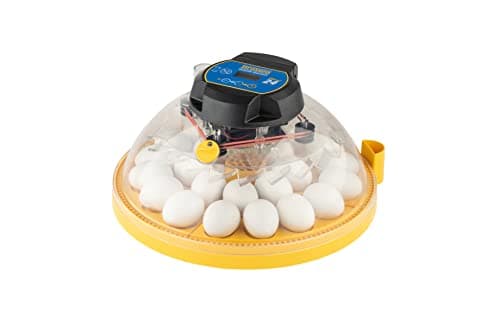
Twenty-four hen eggs on programmable automatic turning at a published twenty-four watts — the size that actually produces a first flock rather than a demonstration.
Who it is for. Somebody deliberately hatching a whole flock at once, with a plan already in place for the cockerels.
Published specifications
Capacity, standard hen
24 eggs
Capacity, large hen / duck / turkey
12 eggs
Capacity, other
Quail 40, pheasant 40, goose 8
Power consumption
24 watts typical, 40 watts maximum
Power supply
100 - 240v, 50/60Hz, 1.3A max
Dimensions
13.9 in x 13.9 in x 6.5 in (354 x 354 x 165 mm)
Weight
3 lb 12 oz (1.7 kg)
Temperature control
Digital, factory preset at 99.5 F and fully adjustable, with high and low temperature alarms
Humidity control
Manual
Egg turning
Automatic, programmable interval and angle; stops automatically 2 days before hatch
Twenty-four standard hen eggs is the first capacity on this page that reliably produces a usable flock after infertile eggs and normal hatch losses
Twenty-four watts typical for more than three times the egg capacity of the Mini — the watts per egg roughly halve as you go up in size
Same programmable turning and automatic stop as the Mini II Advance, in a machine that justifies the price per egg
Only 6.5 inches tall, so it fits on a shelf rather than needing a table
What it costs you
Manual humidity, so the daily water top-up and hygrometer check do not go away at this price
Twelve eggs only for large hen, duck or turkey eggs — the headline 24 is standard hen eggs and nothing else
A 24-egg set produces more chicks than most backyard keepers can legally or sensibly keep, and rehoming cockerels is a genuine problem you should plan for before setting
Nothing here tells you what to do with the roughly half of the hatch that will be male
Skip it if. Your local ordinance caps your flock at four or six birds. Setting 24 eggs is how people end up with birds they cannot keep.
#ad No live price feed yet, so no number is shown rather than a stale one. How this is funded.
#2 · The one most beginners actually buy
Harris Farms Nurture Right 360
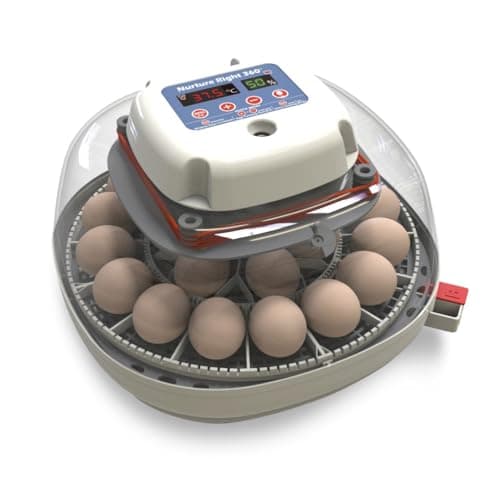
Twenty-two eggs, a horizontal rolling turner that runs for five seconds every sixty minutes, and a 360-degree dome that is the reason children stay interested for three weeks — from a maker that publishes a manual and a species table but never a specification sheet.
Who it is for. A family or classroom hatch where watching matters as much as hatching, and where 22 eggs at a mid-market price is the right trade.
Published specifications
Capacity, chicken eggs
22 (maker's species table)
Capacity, other
Pheasant 22 to 24, duck 12 to 18, quail 44; about 90 quail eggs with the turner tray out
Air type
Forced air with a fan
Power
40 watts, 12v DC low voltage
Dimensions
16.1 in L x 16.1 in W x 9.6 in H
Weight
3.3 lb
Temperature control
Factory 99.5 F, adjustable, digital display; reading calibratable +/- 2.5 F
Humidity control
Digital reading, also calibratable; manual fill via external ports to pots A and B
Egg turning
Horizontal rolling turner, 5 seconds every 60 minutes; not programmable or adjustable; turns off at lockdown and is then removed by hand
Room temperature required
At least 74 F; 74 to 80 F recommended
Maximum hatch-day timer
21 days
Warranty
1-year limited manufacturer's warranty
Manufacturer specification table
None — Manna Pro publishes a manual, a 16-page FAQ and a calibration sheet, but no table of dimensions, weight or wattage
Source: Manna Pro published Nurture Right 360 instruction manual, FAQ document and temperature/humidity calibration sheet (mannapro.com), retrieved 2026-09-27, for capacity, air type, turning, calibration, room temperature and timer. Dimensions, weight and wattage from an Incubator Warehouse published specification listing, retrieved 2026-09-06, because Manna Pro publishes no specification table.
Rubric — 7.4 / 10
Capacity honesty8/10 · weight 26%
Documentation7/10 · weight 24%
Build and weather6/10 · weight 20%
Running cost7/10 · weight 15%
Daily use9/10 · weight 15%
What it gets right
Turning every 60 minutes is 24 turns a day against the 4 to 6 Mississippi State publishes as the minimum, and it stops itself at lockdown
External water ports mean humidity top-ups without opening the lid, which is the single most useful convenience feature in incubation
Both the temperature and the humidity readings can be calibrated against a trusted secondary instrument, up to plus or minus 2.5 F on temperature
A 360-degree clear dome, which sounds like marketing and is genuinely why this is the machine schools and families choose
Low-voltage 12v DC operation rather than mains voltage inside the case
What it costs you
Manna Pro publishes no specification table, so the dimensions, weight and wattage above still come from a retailer's listing rather than the maker
Forty watts for 22 eggs is roughly double the watts per egg of the Brinsea Maxi 24, and no typical-versus-maximum split is published so the real running cost cannot be computed properly
One-year warranty against three years on every Brinsea here, on a machine that runs continuously for three weeks at a time
The turner is fixed: not programmable, not adjustable, one tray size, and quail eggs may be too small for it while goose and turkey eggs are too large
The maker's own incubation humidity figure for chicken eggs is 48 to 55 percent, below the 58 to 60 percent Mississippi State Extension publishes
Skip it if. You want to compute what a hatch costs to run before you buy. Without a published typical-power figure, you cannot — you can only compute a ceiling from the 40 watt rating.
#ad No live price feed yet, so no number is shown rather than a stale one. How this is funded.
#3 · The most eggs per dollar
Farm Innovators Model 4250 Pro Series
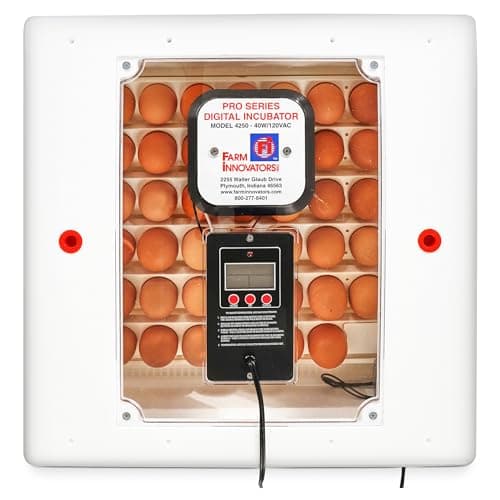
Forty-one large chicken eggs on an automatic turner with a candler in the box, in a polystyrene shell — the highest capacity here and the shortest list of things the maker will commit to in writing.
Who it is for. Somebody hatching a lot of eggs once or twice, who wants capacity and a candler rather than longevity.
Published specifications
Capacity
41 large chicken eggs
Wattage rating
40 watts
Power supply
Standard 120v AC outlet
Temperature rating
99.5 to 100.5 F
Temperature alerts
High/low notification light flashes below 97 F or above 103 F
Humidity rating
50 to 60 percent
Incubation period
21 days
Egg turning
Automatic; turns the eggs completely every 4 hours
Material
Polystyrene
Display
Digital — temperature, humidity and days to hatch
Included
Egg candler
Dimensions and weight
Not published in the maker's specification
Source: Farm Innovators Model 4250 published specification table as listed by IFA Country Stores (ifa.coop), retrieved 2026-09-06. Farm Innovators' own site does not serve a public specification page.
Rubric — 6.6 / 10
Capacity honesty8/10 · weight 26%
Documentation6/10 · weight 24%
Build and weather4/10 · weight 20%
Running cost7/10 · weight 15%
Daily use8/10 · weight 15%
What it gets right
Forty-one eggs is nearly double the Maxi 24 for a fraction of the price, which is the entire argument for it
A candler is included rather than sold separately, and candling on days 4 to 7 is the step that stops you incubating clear eggs for three weeks
The published humidity rating of 50 to 60 percent sits inside the range the extension services publish, and the display shows humidity rather than leaving you to guess
Turning every four hours is comfortably above the 4 to 6 turns a day Mississippi State Extension publishes as the minimum
What it costs you
Polystyrene foam. It insulates well and it is the reason this machine is cheap, but it absorbs moisture, cannot be properly disinfected between hatches, and will not survive many seasons
The high/low light only flashes below 97 F or above 103 F — a 6-degree dead band, which is a very late warning for an egg that is being cooked or chilled
No typical-versus-maximum power split, so the running cost can only be computed as a ceiling from the 40 watt rating
No published dimensions or weight, and the turning interval of every 4 hours is the longest here
Skip it if. You expect to hatch for several years. This is a machine with a short life by design, and three seasons of it costs more than one Brinsea.
#ad No live price feed yet, so no number is shown rather than a stale one. How this is funded.
#4 · A first automatic hatch
Brinsea Mini II Advance
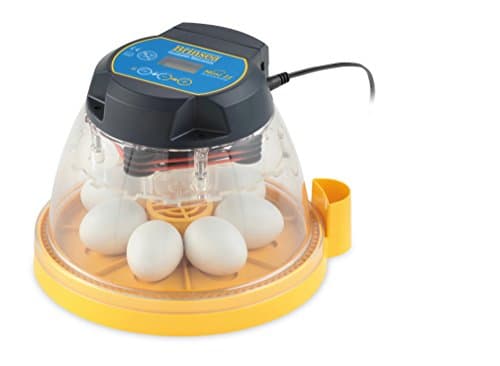
The same twelve watts as the manual model, with a programmable turning cradle that stops itself two days before hatch — which removes the single most common way a first hatch is lost.
Who it is for. A first hatch where the goal is learning the process rather than filling a brooder — a school project, or a keeper adding two or three birds to an existing flock.
Published specifications
Capacity, standard hen
7 eggs
Capacity, large hen / duck / turkey
7 eggs
Capacity, other
Pheasant 12, quail 12
Power consumption
12 watts typical, 20 watts maximum
Power supply
100 - 230v, 50/60Hz, 0.5A max
Dimensions
10 in x 10 in x 6.5 in (245 x 245 x 165 mm)
Weight
2 lb 6 oz (1.07 kg)
Temperature control
Digital, factory preset at 99.5 F and fully adjustable, with high and low temperature alarms plus a room temperature alarm
Humidity control
Manual — water trays with external top-up
Egg turning
Automatic, with programmable interval and angle; turning stops automatically 2 days prior to hatching
Other published features
Countdown to hatch day; periodic egg cooling; Biomaster antimicrobial plastic
Warranty
3 years
Source: Brinsea, Mini II Advance fully digital 7 egg incubator product specification (brinsea.com/p-571), retrieved 2026-09-06
Rubric — 9.4 / 10
Capacity honesty9/10 · weight 26%
Documentation10/10 · weight 24%
Build and weather9/10 · weight 20%
Running cost10/10 · weight 15%
Daily use9/10 · weight 15%
What it gets right
Turning stops automatically two days before hatch, which is the step first-time hatchers most often forget and the one that strands chicks mid-hatch
Room temperature alarm as well as incubator alarms, so you are warned about the garage getting cold rather than only about the machine
Twelve watts typical — the automatic turning costs nothing measurable in electricity
Published countdown to hatch day, so day 18 is not something you have to diary yourself
What it costs you
Seven standard hen eggs, which is three fewer than the cheaper manual model in the same shell — the turning cradle takes the space
Humidity is still manual, so you are topping up water trays and reading a hygrometer through the whole 21 days
Seven eggs will not all hatch, and a small set makes a poor hatch feel worse than it is
The most expensive per-egg machine here by a wide margin
Skip it if. You want more than a handful of chicks. Seven eggs set is realistically a few chicks out, and if you want six pullets this is the wrong size of machine.
#ad No live price feed yet, so no number is shown rather than a stale one. How this is funded.
FAQ
Questions people actually ask
+How often should an automatic egg turner turn the eggs?
At least four to six times a day through day 18, which is the figure Mississippi State University Extension publishes. Published intervals on these machines run from every 60 minutes (24 turns a day) to every four hours (6 turns a day), so all of them clear the minimum. Turning more often than the published requirement does not improve a hatch.
+When does an automatic egg turner stop turning?
It depends on the machine, and it is the specification worth checking. The Harris Farms Nurture Right 360 is published as stopping three days before hatch, which matches the extension guidance exactly. Both Brinsea machines here stop two days before hatch. The Farm Innovators 4250 publishes no automatic stop, so plan to switch the turner off yourself on day 18.
+Is programmable egg turning worth paying for?
Not for a first hatch of chicken eggs — the factory settings are correct and there is no reason to change them. It earns its place if you incubate duck or goose eggs, which are conventionally turned through a wider arc, or if you want to end turning on day 18 rather than day 19 to match the published extension figure precisely.
+What happens if eggs are turned during lockdown?
Around day 18 a chick positions itself in the shell to pip, and turning after that point can leave it unable to break out. This is why Mississippi State University Extension says not to turn eggs during the last three days before hatching, rather than simply turning less often. It is the single reason an automatic stop is worth more than a short turning interval.
Where the numbers came from
Sources
Every figure cited on this page came from one of these documents. If one of them has changed since we read it, the number here is out of date and we would like to know.
Incubators compared on published watts and egg capacity, the running cost of a 21-day hatch, and the extension figures for temperature, humidity and turning.