Candling eggs: the spider, the blood ring, and the air cell nobody reads
Candling is sold as a fertility test, and that is only half of what the published guidance uses it for. The other half is a humidity gauge, and it is the half that decides whether the chicks that are alive on day 14 are still alive on day 21.
Hold a bright, focused light against the shell in a dark room. An infertile egg is clear apart from a faint yolk shadow. A live embryo is spider-shaped — a dark body with blood vessels radiating out like legs. A ring of blood around the embryo means it died. Do it twice: Mississippi State publishes the first check at 4 to 7 days and the second at 14 to 16. Then look at the air cell, because its size is how you check your humidity.
The three things you are looking at
Mississippi State Extension publication P1182 describes all three in one paragraph, and it is worth quoting exactly because the descriptions are better than the ones usually given:
What you see, and what it means. Descriptions quoted from Mississippi State Extension P1182.
What you see
What it is
What to do
Clear, with a slight shadow
An infertile. P1182: “An infertile appears as a clear egg except for a slight shadow cast by the yolk.”
Remove it. It never started.
A spider
A live embryo. P1182: “A live embryo is spider-like in appearance, with the embryo representing a spider’s body and the large blood vessels spreading out much like a spider’s legs.”
Leave it alone.
A ring of blood
A dead germ. P1182: “A dead germ can be distinguished by the presence of a blood ring around the embryo. This is caused by the movement of blood away from the embryo after death.”
Remove it. It started and stopped.
A dark mass, one or two light spaces
A live embryo at the second check. P1182, on days 14 to 16: “you can see only one or two small light spaces filled with blood vessels, and you may see the chick moving.”
Leave it alone.
When to candle, and how many at once
Two published schedules, and they agree closely enough to use either. Mississippi State P1182 puts the first test at 4 to 7 days and a second at 14 to 16 days. University of Illinois Extension gives a wider window: eggs “can be candled anytime after about Day 5 of incubation through Day 17.”
Illinois also publishes the two limits nobody mentions, and both exist to protect the eggs you are not candling:
How many. “Out of 2 dozen eggs in the incubator, probably no more than 5-7 eggs should be candled at one setting.”
How long they are out. “No more than 5 to 10 minutes at a time.”
Both are really the same instruction: the lid is open and the machine is losing heat and humidity the whole time. Candle in short sessions with the door shut in between, and do it somewhere warm. P1182 also notes a shell-color effect worth planning around — “Eggs with white shells are easier to test and can be tested earlier than dark-shelled eggs.” A Marans egg may not read usefully until the second check.
The half of candling nobody does: the air cell
Here is the part that makes candling worth doing properly rather than once. Two Mississippi State publications describe candling as a humidity instrument, not a fertility test.
P1182: “An excellent method of determining proper humidity is to candle the eggs and observe the size of the air cell. As incubation progresses, the size of the air cell increases because of moisture loss. Humidity adjustments can be made after each candling operation.” P1150, the avian embryo publication, says the same thing and prints a figure showing “the normal size of the air cell after 7, 14, and 18 days of incubation.”
So the air cell is a gauge with a published scale. If it is smaller than the reference for that day, the egg is holding too much water and your humidity is too high. If it is bigger, your humidity is too low. And the consequences are published too — P1150: “High humidity will produce a late hatch; low humidity will produce an early hatch. Low humidity will also cause the chick to stick in the shell and die at hatching time.”
Reading the air cell against the published reference. Direction of travel from Mississippi State P1150 and P1182.
Air cell against the reference
What it means
What it causes
What to change
Smaller
The egg has lost too little moisture
A late hatch; chicks that drown in the shell
Reduce humidity
About right
Normal moisture loss
Nothing. This is the target
Leave the water tray alone
Larger
The egg has lost too much moisture
An early hatch; chicks that stick in the shell
Increase humidity
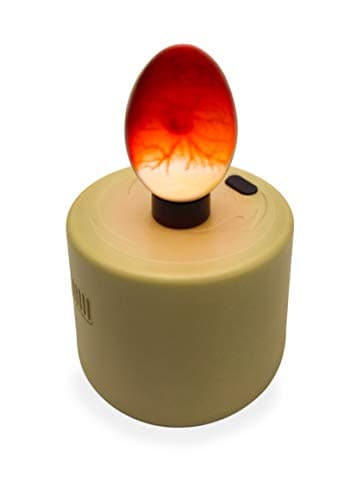
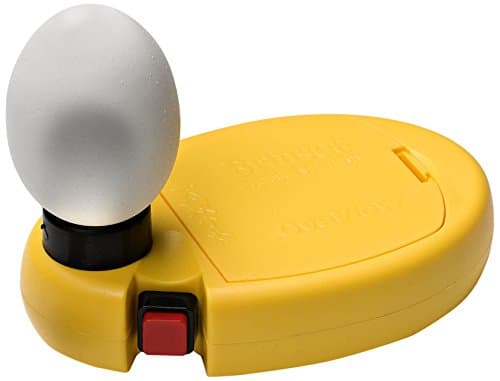
This is also the one function a tool can carry for you. Brinsea prints the reference chart on the OvaView itself, and its instructions give the correction in the same words the extension publications do: “Air space estimation can be made using the chart. If the airspace is too small reduce humidity and vice versa.” A maker and two extension services agreeing on a method is about as settled as poultry guidance gets.
Do you actually need to buy a candler?
Strictly, no — and the publication that tells you so also gives the specification that matters. P1182 describes making your own: “Make a tester or candler by placing a light bulb attached to a drop cord inside a cardboard box. Cut a small, round hole in the top or side of the box, and let a narrow beam of light escape from the box.”
So what are you actually paying for? Three things, in this order: a beam narrow and bright enough to get through a brown shell, a lamp that does not heat the egg it is pressed against, and — on exactly one model — the air-cell chart. P1182 adds the free one: “A darkened room makes testing easier.” Candle at night and you have improved every candler on this page for nothing.
How we judged these
Badly served by the category, is the honest answer. This is the least-documented product type on this site: of the four candlers here, one publishes a brightness figure, one publishes dimensions, and none publishes an aperture diameter — the single specification an extension service actually names. So the ranking rests on what each maker will commit to in writing, and the scores reflect that gap rather than hiding it.
What each maker publishes. NOT PUBLISHED is a finding, not an omission on our part.
Candler
Published output
Aperture
Air-cell chart
Dimensions
Brinsea OvaView
Not published
Not published
Yes, on the tool
128 x 83 x 33 mm
Incu-Bright
250 lumens
Not published
No
Not published
Titan Incubators
Not published
Not published
No
Not published
Magicfly
Not published
Not published
No
Not published
The hygrometer is on this page for a reason that follows directly from the air-cell section: candling tells you your humidity was wrong four days ago. A hygrometer tells you it is wrong now. They are the same measurement at different latencies, and the cheap one is the one you can act on. The incubator roundup covers which machines have a usable readout built in and which do not.
Heads up: some links on this page are affiliate links. If you buy through one we may earn a commission at no extra cost to you. It never changes a ranking, and we take no payment for placement. The full version.
The short answer
The short list
Ranked on the published rubric. Every row jumps to that product's full write-up below; the button goes straight to Amazon.
#
Pick
Best for
Key spec
Score
Price
1
Our pick
Brinsea
OvaView High-Intensity Egg Candling Lamp
The only candler here whose maker publishes the second use of candling: its own instructions carry an air-space chart and tell you to reduce humidity if the air space is too small, which is the same instrument reading two extension publications describe.
The cordless high-intensity option for the shells that defeat a cheap lamp, which Mississippi State flags as a real problem: dark-shelled eggs are harder to read and cannot be candled as early as white ones.
A rechargeable cool-light LED candler at the bottom of the price range, which solves the one practical irritation of the battery models without pretending to be an instrument.
Plus or minus 2 F and a published humidity tolerance that is honest about where it holds — plus or minus 3 percent between 20 and 80 percent RH, and varying outside it.
#adPrices as of October 18, 2026. Scores are our own published rubric, not customer ratings.
#1 · Reading an air cell, not just a clear
Brinsea OvaView High-Intensity Egg Candling Lamp
The only candler here whose maker publishes the second use of candling: its own instructions carry an air-space chart and tell you to reduce humidity if the air space is too small, which is the same instrument reading two extension publications describe.
Who it is for. Anybody running an incubator whose humidity they are not yet confident about — which is most first hatches. The chart is the feedback loop.
Published specifications
Light source
Non-replaceable high power LED, described by the maker as chosen for cool operation
Air-space chart
Printed on the lamp, with hen-egg outlines at days 1, 7, 14 and 19 (58 g egg) and turkey outlines at 1, 10, 15, 20 and 24 (85 g egg)
Published humidity instruction
"Air space estimation can be made using the chart. If the airspace is too small reduce humidity and vice versa."
Published fertility instruction
"Eggs may be examined for fertility after about 7 days. Infertile eggs will appear clear and can be rejected."
Sealing rings
Standard flexible ring plus a smaller ring for small eggs
Power
4 x AA batteries, not supplied; the maker recommends rechargeables for this model specifically
Dimensions
128 x 83 x 33 mm (5 in x 3.3 in x 1.3 in)
Weight
85 g (3 oz)
Published caution
"Never look directly into the light source."
Use
Hand-held, or in a darkened room; the maker's OvaScope is the alternative where the room cannot be darkened
The printed air-space chart is the one feature that turns a candler into a humidity gauge, which is what Mississippi State P1182 and P1150 both describe candling as being for
A published dimension and weight, which no other candler in this comparison provides
The maker states the LED was chosen for cool operation, which matters because the egg is a live embryo and the lamp touches it
Two sealing ring sizes supplied, so bantam and large fowl eggs both seal against the aperture
What it costs you
The LED is explicitly non-replaceable, so the lamp's service life is the LED's service life
Four AA batteries are not supplied, and the maker's own note that rechargeables work best for this model is a polite way of saying it draws hard on alkalines
Brinsea publishes no lumen figure and no aperture diameter, so the two numbers you would actually compare candlers on are missing
The most expensive option here by a wide margin, for a tool used on perhaps six evenings a year
Skip it if. You are candling white-shelled eggs in a room you can make properly dark. A cheaper focused LED does that job, and the air-space chart is the only thing you are paying extra for.
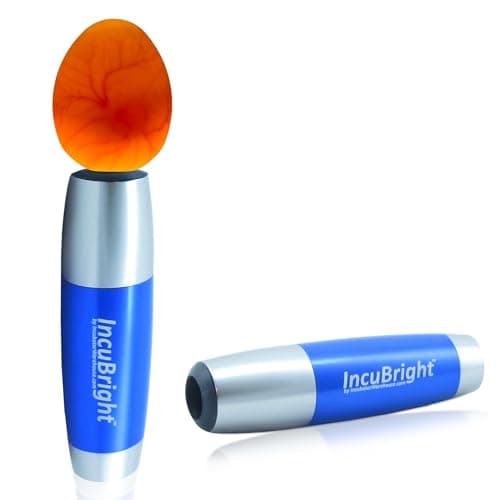
The only candler in this comparison that publishes a brightness figure at all, which is the specification the category otherwise refuses to print.
Who it is for. A first-time hatcher with white or mid-brown eggs who wants to do the two checks properly without buying a laboratory instrument for it.
Published specifications
Published output
250 lumens
Light source
LED
Power
Portable; battery specification NOT PUBLISHED
Egg sizes
Stated as suitable for all egg sizes
Aperture diameter
NOT PUBLISHED
Air-space chart
None
Source: Amazon product listing for the Incu-Bright Ultra Bright LED Egg Candler, retrieved 2026-10-18, which is where the 250 lumen figure is published.
Rubric — 6.0 / 10
Capacity honesty7/10 · weight 26%
Documentation4/10 · weight 24%
Build and weather5/10 · weight 20%
Running cost8/10 · weight 15%
Daily use7/10 · weight 15%
What it gets right
250 lumens is a real published number, and it is the only one in this category — every other maker sells on the word "bright"
Portable and self-contained
Cheap enough that it is not a difficult decision for a tool used a handful of times a year
What it costs you
No published aperture diameter, which is the figure Mississippi State's own homemade candler specifies at one-half to three-quarters of an inch — too wide an opening leaks light around the egg and washes out what you are trying to see
No air-space chart, so the humidity use of candling needs a separate reference
No published dimensions, battery specification or warranty
Skip it if. You want the air-space reference printed on the tool itself. This is a light, not an instrument.
The cordless high-intensity option for the shells that defeat a cheap lamp, which Mississippi State flags as a real problem: dark-shelled eggs are harder to read and cannot be candled as early as white ones.
Who it is for. Anybody hatching Marans, Welsummer, Barnevelder or any other dark-egg breed, where a budget candler simply will not show you the inside of the egg.
Published specifications
Light source
High intensity LED
Power
Battery powered; battery type and count NOT PUBLISHED
Aperture diameter
NOT PUBLISHED
Lumen output
NOT PUBLISHED
Dimensions
NOT PUBLISHED
Supplied accessories
NOT PUBLISHED
Source: Amazon product listing for the Titan Incubators High Intensity LED Chicken Egg Candler/Tester, retrieved 2026-10-18. Titan publishes no specification sheet we could locate.
Rubric — 5.8 / 10
Capacity honesty7/10 · weight 26%
Documentation2/10 · weight 24%
Build and weather6/10 · weight 20%
Running cost7/10 · weight 15%
Daily use8/10 · weight 15%
What it gets right
Cordless, which matters more than it sounds: candling happens over the open incubator, and a mains lead across a warm machine is a nuisance
Sold on light intensity rather than on price, which is the right axis for the dark-shell case
No bulb to replace
What it costs you
Titan publishes no lumen figure, no aperture size, no battery specification and no dimensions, so almost nothing about it can be checked
Priced between the cheap LEDs and the Brinsea without documenting what the extra buys
No air-space chart, so you are judging the air cell against a reference you have to find elsewhere
Skip it if. Your birds lay white or light-brown eggs. The intensity you are paying for is there to get light through a dark shell.
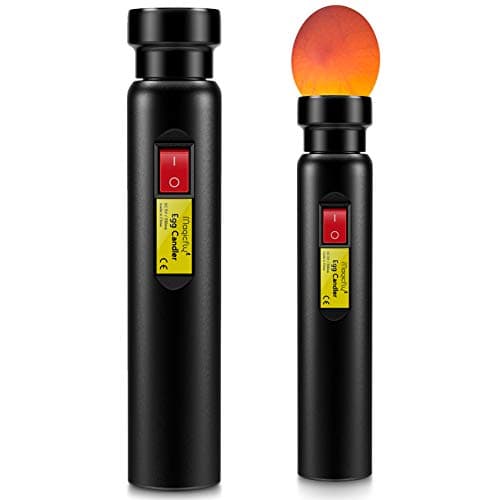
A rechargeable cool-light LED candler at the bottom of the price range, which solves the one practical irritation of the battery models without pretending to be an instrument.
Who it is for. Somebody hatching once, who wants the clears out of the machine on day seven and does not intend to own an incubator for the next decade.
Published specifications
Light source
Cool LED, described by the maker as a bright cool light
Power
Rechargeable internal battery
Battery capacity and run time
NOT PUBLISHED
Lumen output
NOT PUBLISHED
Aperture diameter
NOT PUBLISHED
Air-space chart
None
Source: Amazon product listing for the Magicfly Rechargeable Egg Candler Tester, retrieved 2026-10-18. Magicfly publishes no specification sheet we could locate.
Rubric — 5.4 / 10
Capacity honesty6/10 · weight 26%
Documentation2/10 · weight 24%
Build and weather5/10 · weight 20%
Running cost9/10 · weight 15%
Daily use7/10 · weight 15%
What it gets right
Rechargeable, so it works on the evening you need it rather than the evening after you buy batteries
Cool-running LED, which is the relevant safety property when the lamp is held against a live embryo
The cheapest route to doing both published checks rather than skipping the second one
What it costs you
Magicfly publishes no lumen figure, no run time and no aperture size
Cool LED is a claim rather than a measured temperature; no figure is given
Light output is the thing you are economizing on, and dark shells are where that shows
Skip it if. You keep dark-egg breeds. Economizing on output is exactly the wrong economy for a Marans egg.
AcuRite 00613 Indoor Temperature and Humidity Monitor
Plus or minus 2 F and a published humidity tolerance that is honest about where it holds — plus or minus 3 percent between 20 and 80 percent RH, and varying outside it.
Who it is for. An indoor brooder in a heated room, where the range limit never bites and the humidity reading is the point.
Published specifications
Indoor temperature range
32 F to 122 F (0 C to 50 C)
Temperature accuracy
+/- 2 F
Indoor humidity range
16% to 98% RH
Humidity accuracy
+/- 3% from 20% to 80% RH, with varying accuracy at other humidity ranges
Source: AcuRite, 00613 Indoor Temperature and Humidity Monitor product page (acurite.com), retrieved 2026-09-01
Rubric — 7.5 / 10
Capacity honesty6/10 · weight 26%
Documentation9/10 · weight 24%
Build and weather7/10 · weight 20%
Running cost8/10 · weight 15%
Daily use8/10 · weight 15%
What it gets right
Publishes not just a humidity tolerance but the band it holds within, which is a more honest specification than a single number
32 F to 122 F covers a brooder and a temperate coop comfortably
Small, cheap and widely stocked
What it costs you
The range stops at 32 F, so it is useless for telling you how cold the coop actually got overnight in winter
+/- 2 F is slightly worse than the ThermoPro's published +/- 1.8 F
Same flat-unit problem: no probe, so no reading at chick level
Skip it if. You want to know your coop's overnight low in winter. This device stops reading at freezing, which is precisely where the question starts.
#ad We have no verified Amazon listing for this one, so no number is shown. How this is funded.
FAQ
Questions people actually ask
+How do you candle an egg?
Hold a bright, focused light against the shell at the large end, in a dark room. Mississippi State Extension publishes the first check at 4 to 7 days of incubation and a second at 14 to 16 days. An infertile egg appears clear apart from a slight shadow cast by the yolk; a live embryo looks spider-like, with the body dark and the blood vessels spreading out like legs; a dead embryo shows a ring of blood. Take out no more than 5 to 7 eggs from two dozen at a time and get them back within 5 to 10 minutes.
+What does a fertile egg look like when candled?
Like a spider. Mississippi State Extension P1182 describes a live embryo as spider-like in appearance, with the embryo as the spider's body and the large blood vessels spreading out much like a spider's legs. By days 14 to 16 that has changed - the publication says you can see only one or two small light spaces filled with blood vessels, and you may see the chick moving.
+What does a blood ring mean when candling?
The embryo started developing and then died. Mississippi State Extension describes it as a ring of blood around the embryo, caused by the movement of blood away from the embryo after death. It is distinct from an infertile egg, which never developed at all and simply looks clear. Both come out of the incubator.
+When should you candle eggs?
Twice. Mississippi State Extension publishes the first test at 4 to 7 days and a second at 14 to 16 days. University of Illinois Extension gives a broader window of anytime after about day 5 through day 17. Doing only the first check leaves eggs in the machine that quit after it, which is why the published guidance names two.
+Do I need an egg candler, or will a flashlight work?
A flashlight usually disappoints for a reason that is published. Mississippi State Extension's homemade candler is a bulb in a cardboard box with a hole cut in it, and the publication specifies that hole as one-half to three-quarters of an inch in diameter. The narrow aperture is the whole mechanism - it forces light through the egg instead of letting it spill around the shell into your eye. A broad flashlight beam has no aperture at all.
+Why is my air cell too small?
Because the egg has not lost enough moisture, which means incubator humidity is too high. Mississippi State publishes the normal air cell size at 7, 14 and 18 days and describes candling as an excellent method of determining whether humidity is correct. Too high gives a late hatch; too low gives an early hatch and chicks that stick in the shell.
+Can you candle dark brown eggs?
With difficulty and with more light. Mississippi State Extension states that eggs with white shells are easier to test and can be tested earlier than dark-shelled eggs. For Marans, Welsummer or Barnevelder eggs, expect the first check to be inconclusive and plan on the 14 to 16 day check doing the real work, with the brightest candler you have.
+Can you hatch eggs from the grocery store?
Almost never, and candling is how you find out. Table eggs are generally produced by flocks with no rooster, so there is nothing to develop, and they have usually been refrigerated - Mississippi State notes that hatchability falls rapidly for eggs older than 7 to 10 days. If you set them anyway, the first candling at 4 to 7 days will show clears. Fertile hatching eggs from a breeder are the reliable route.
Where the numbers came from
Sources
Every figure cited on this page came from one of these documents. If one of them has changed since we read it, the number here is out of date and we would like to know.
Incubators compared on published watts and egg capacity, the running cost of a 21-day hatch, and the extension figures for temperature, humidity and turning.
Twenty-two eggs, a turner that runs five seconds every hour, a calibratable display, and a published humidity figure that disagrees with Mississippi State by ten points.