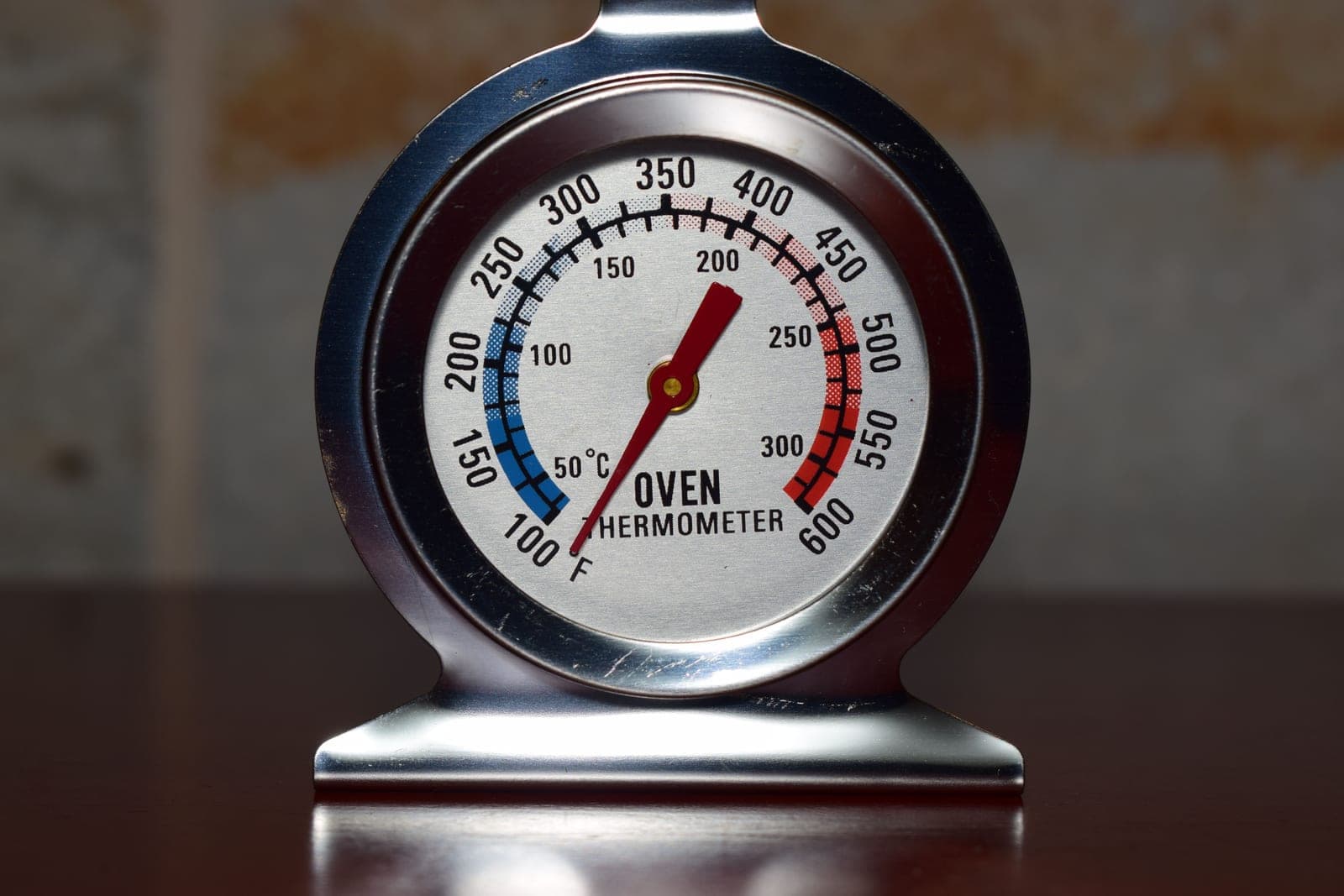
Brooder thermometers, and the specification most of them do not publish
You are trying to hit 95 F at chick level. Two of these instruments publish an accuracy tolerance and two do not, which on a thermometer is a strange thing to leave out.
Buy a thermometer that publishes an accuracy tolerance and can read at chick level. The two purpose-built brooder thermometers here publish neither an accuracy figure nor, in one case, a temperature range, while two general-purpose room units publish both and cost about the same.
This roundup ends somewhere unexpected, so it is worth saying up front. The instruments designed for brooders are better shaped for the job — they hang or mount at chick level, which is where the measurement has to be taken. The instruments not designed for brooders publish far better specifications. Neither group does both, and you should know that before you spend anything.
What you are actually measuring
Penn State Extension’s instruction is precise about location: supply 95 F at chick level under the heat source for the first week, decreasing 5 F per week. Both halves of that matter. A thermometer at chick level three feet away from the plate is reading the room. A thermometer at plate height directly under it is reading the plate. The number you want is the air a chick’s body is actually in, at the edge of the warm zone.
This is why a flat room unit sitting on a brooder wall is the wrong instrument even when it is the more accurate one, and why the adjustable-stem designs exist.
What each one publishes
Published specifications. 'Not published' means the maker does not state it.
Instrument
Temperature range
Accuracy
Humidity
Reads at chick level
ThermoPro TP49
-58 F to 158 F
+/- 1.8 F
10-99% RH, +/- 2-3%
Only if you place it there
AcuRite 00613
32 F to 122 F
+/- 2 F
16-98% RH, +/- 3% (20-80%)
Only if you place it there
Brooder thermometer, 50-120 F
50 F to 120 F
Not published
None
Yes, hangs or mounts
GQF 0485 adjustable
Not published
Not published
None
Yes, 6 to 9 in stem
The GQF unit is the awkward one. Its adjustable 6-to-9-inch stem is genuinely the best idea in this comparison — the sensor follows the chicks as the plate goes up — and the maker publishes neither a temperature range nor an accuracy figure for it. You are buying a mechanism, not an instrument.
Why humidity is worth having
Neither purpose-built brooder thermometer reads humidity, and both room units do. That matters less in the brooder than it does later: humidity is the variable that decides whether a cold coop causes frostbite, because moisture condensing on combs and wattles is the actual mechanism. A thermometer bought for the brooder that also answers the winter question is doing two jobs. Ventilation versus draft explains why that number matters more than the temperature does.
What we would actually do
Use the birds as the primary instrument and the thermometer as the check. Penn State states the behavior plainly: cold chicks huddle under the heat source, and chicks that are too warm move as far from it as possible. That signal is free, continuous, and reads the thing you actually care about, which is whether the chicks are comfortable rather than what a probe says.
Then buy the instrument with a published tolerance, put it at chick level at the edge of the warm zone, and use it to confirm what the birds are telling you.
Heads up: some links on this page are affiliate links. If you buy through one we may earn a commission at no extra cost to you. It never changes a ranking, and we take no payment for placement. The full version.
The short answer
The short list
Ranked on the published rubric. Every row jumps to that product's full write-up below; the button goes straight to Amazon.
#
Pick
Best for
Key spec
Score
Price
1
Score7.8
Our pick
ThermoPro
TP49 Digital Hygrometer Thermometer
The only unit here that publishes an accuracy tolerance — plus or minus 1.8 F — and it reads humidity too, which is the number that actually predicts winter frostbite in a coop.
A dedicated brooder thermometer whose range starts at 50 F and stops at 120 F, which is exactly the band you care about and nothing else — and it hangs at chick level rather than sitting on a shelf.
Plus or minus 2 F and a published humidity tolerance that is honest about where it holds — plus or minus 3 percent between 20 and 80 percent RH, and varying outside it.
An analog probe on a stem that adjusts from six to nine inches, so the sensor can follow the chicks as the heat plate goes up rather than reading whatever height it was installed at in week one.
#adPrices as of October 18, 2026. Scores are our own published rubric, not customer ratings.
Score7.8no photo yet
#1 · A published accuracy figure
ThermoPro TP49 Digital Hygrometer Thermometer
The only unit here that publishes an accuracy tolerance — plus or minus 1.8 F — and it reads humidity too, which is the number that actually predicts winter frostbite in a coop.
Who it is for. Anybody who wants one instrument for the brooder, the coop and the winter humidity question, with a stated tolerance.
Published specifications
Temperature range
-58 F to 158 F (-50 C to 70 C)
Temperature accuracy
+/- 1.8 F (+/- 1 C)
Humidity range
10% to 99% RH
Humidity accuracy
+/- 2 to 3% RH
Refresh rate
Every 10 seconds
Resolution
0.1 degrees
Mounting
Tabletop, wall-mountable or magnet-mountable
Source: ThermoPro TP49 published specifications (buythermopro.com and retailer listings), retrieved 2026-09-01
Rubric — 7.8 / 10
Capacity honesty7/10 · weight 26%
Documentation9/10 · weight 24%
Build and weather7/10 · weight 20%
Running cost8/10 · weight 15%
Daily use8/10 · weight 15%
What it gets right
Publishes an accuracy tolerance, which the purpose-built brooder thermometers do not — on a device whose only job is to be right, that is decisive
Reads humidity, and humidity is what turns a cold coop into a frostbite coop
A range from -58 F to 158 F means the same unit moves from the brooder to the coop and works all winter
Magnet mounting means it goes on the brooder frame without a hole
What it costs you
A general-purpose room unit, not a brooder tool: it has no probe, so it reads air at wherever you stick it rather than at chick level
Battery powered, and a flat battery is a silent failure
0.1 degree resolution reads as more precision than the +/- 1.8 F accuracy actually supports
Skip it if. You need a reading at chick level under a heat plate. A flat unit cannot get there; a stemmed brooder thermometer can.
#ad We have no verified Amazon listing for this one, so no number is shown. How this is funded.
Score7.0no photo yet
#2 · Reading the temperature where it matters
Incubator Warehouse Brooder Thermometer, 50 F to 120 F
A dedicated brooder thermometer whose range starts at 50 F and stops at 120 F, which is exactly the band you care about and nothing else — and it hangs at chick level rather than sitting on a shelf.
Who it is for. A box brooder where the thermometer needs to hang at chick level and survive being knocked about.
Published specifications
Temperature range
50 F to 120 F
Mounting
Fits through a 1 1/8 in hole in the brooder box; can also hang inside
#ad We have no verified Amazon listing for this one, so no number is shown. How this is funded.
Score7.5no photo yet
#3 · Humidity you can trust in the normal band
AcuRite 00613 Indoor Temperature and Humidity Monitor
Plus or minus 2 F and a published humidity tolerance that is honest about where it holds — plus or minus 3 percent between 20 and 80 percent RH, and varying outside it.
Who it is for. An indoor brooder in a heated room, where the range limit never bites and the humidity reading is the point.
Published specifications
Indoor temperature range
32 F to 122 F (0 C to 50 C)
Temperature accuracy
+/- 2 F
Indoor humidity range
16% to 98% RH
Humidity accuracy
+/- 3% from 20% to 80% RH, with varying accuracy at other humidity ranges
Source: AcuRite, 00613 Indoor Temperature and Humidity Monitor product page (acurite.com), retrieved 2026-09-01
Rubric — 7.5 / 10
Capacity honesty6/10 · weight 26%
Documentation9/10 · weight 24%
Build and weather7/10 · weight 20%
Running cost8/10 · weight 15%
Daily use8/10 · weight 15%
What it gets right
Publishes not just a humidity tolerance but the band it holds within, which is a more honest specification than a single number
32 F to 122 F covers a brooder and a temperate coop comfortably
Small, cheap and widely stocked
What it costs you
The range stops at 32 F, so it is useless for telling you how cold the coop actually got overnight in winter
+/- 2 F is slightly worse than the ThermoPro's published +/- 1.8 F
Same flat-unit problem: no probe, so no reading at chick level
Skip it if. You want to know your coop's overnight low in winter. This device stops reading at freezing, which is precisely where the question starts.
#ad We have no verified Amazon listing for this one, so no number is shown. How this is funded.
Score6.5no photo yet
#4 · Following the plate down as it rises
GQF 0485 Adjustable Brooder Thermometer
An analog probe on a stem that adjusts from six to nine inches, so the sensor can follow the chicks as the heat plate goes up rather than reading whatever height it was installed at in week one.
Who it is for. Anybody using a proper box brooder who wants the sensor at chick level all the way through.
#ad We have no verified Amazon listing for this one, so no number is shown. How this is funded.
FAQ
Questions people actually ask
+Where should a brooder thermometer be placed?
At chick level, at the edge of the warm zone under the heat source. Penn State Extension's instruction is 95 F at chick level under the heat source, and both parts matter: a thermometer on the brooder wall reads the room, and one pressed against the plate reads the plate rather than the air the chicks are in.
+How accurate does a brooder thermometer need to be?
Within a couple of degrees is plenty, given the schedule moves in 5 F steps. The problem is that the purpose-built brooder thermometers do not publish an accuracy tolerance at all, while general-purpose room units publish plus or minus 1.8 to 2 F. If you want a stated tolerance, you are buying a room unit.
+Do I need a thermometer if I use a brooder plate?
It is useful but the birds are the better guide. A plate sets its own surface temperature and you adjust the height rather than a dial, so what you are really watching is chick behavior: huddled underneath means too cold, pressed against the far wall means too warm, spread out and moving means right.
+Can I use a regular room thermometer in a brooder?
Yes, and the room units in this comparison publish better specifications than the purpose-built ones do. The limitation is placement — a flat unit has no probe, so you have to physically position it at chick level and it may end up somewhere a chick knocks it over.
Where the numbers came from
Sources
Every figure cited on this page came from one of these documents. If one of them has changed since we read it, the number here is out of date and we would like to know.