Chicken toys, and what the published guidance actually recommends
The extension answer to a bored, pecking flock is four to eight pieces of string and a sheet of plywood leaned against the wall. That is not a joke and it is not a budget option - it is what the literature names. Here is what else is worth buying, and why most of this aisle is for you rather than the hen.
Both University of Maryland Extension and Mississippi State Extension name the same enrichment device for a flock that has started pecking each other: “four to eight pieces of string or twine hung in the pen where the birds can reach them”, plus a sheet of plywood leaned against a wall to break up open space. No published source on this page mentions a swing, a mirror or a xylophone. Buy enrichment that creates foraging work — but fix the published causes first, because boredom is only one of eleven.
The published cause list, which is mostly not boredom
This is the part the toy aisle skips. Feather pecking and cannibalism have a documented cause list, and the great majority of it is management rather than entertainment.
University of Maryland Extension and Mississippi State Extension, Feather Pecking and Cannibalism.
Cause
What is published
Overcrowding
Limited floor space increases competition and makes submissive birds targets
Light
“Light that is extremely bright — larger than 40-watt bulbs — or light for more than 16 hours per day may cause birds to become hostile.” Optimal 0.5 to 1.0 foot-candle
Nutrition
Sodium and phosphorus deficiencies are linked to cannibalism; low protein or an amino acid imbalance, “especially feed lacking adequate amounts of methionine”
Feed form
“The risk of feather pecking is lower if hens are fed a mash diet, which takes longer to consume than a pelleted diet”
Mixing birds
“Never co-mingle birds of different sizes, breeds, colors, or ages unless they were raised together”
Genetics
“Light breeds are more prone to the behavior than heavier breeds”
Learned behavior
“Chickens tend to imitate each other” — it spreads through a flock
Heat
Excessive heat is a stressor and raises pecking incidents
Nesting
A shortage of nest boxes, or brightly lit nests, exposes birds while laying
Injured birds
Failure to remove injured or dead birds promptly; blood draws more pecking
Slow feathering
Birds that feather slowly leave tender immature feathers exposed for longer
Read that list and the shape of the problem changes. A swing does not fix eleven things. It does not fix any of them. What enrichment addresses is the gap between a bird's natural time budget — most of a day spent foraging — and a run where food arrives in a trough and is gone in minutes.
What we judged enrichment on
Does it create foraging work? The published mechanism is occupying birds, which means food that takes time rather than food that arrives fast.
Does it dilute the ration? Anything edible counts against the roughly 10 percent treat ceiling. An enrichment object that is really a bag of corn is a nutrition decision, not a welfare one.
Does it break up open space? The second published recommendation, and the reason a hanging object earns some credit even when it holds no food.
Is it honest about what it is? We have marked down the products whose marketing implies they prevent a behavior the literature attributes to stocking density and diet.
The string, and why it is not a joke
Four to eight pieces of string or twine, hung where birds can reach them. It appears in both extension documents in nearly identical wording, and it works for the same reason a treat ball does: it gives a bird something to direct pecking at that is not another bird. The plywood sheet leaned against a wall does the other half of the job — a big open run gives a bullied hen nowhere to break line of sight, and a leaned board creates somewhere to be out of view.
The finding that conflicts with our own feed page
Both sources publish the same thing about feed form: “the risk of feather pecking is lower if hens are fed a mash diet, which takes longer to consume than a pelleted diet.” That is a real, actionable lever — the same enrichment logic applied to the feeder rather than to a toy.
It also cuts against what our layer feed roundup recommends, where crumble and pellets score well precisely because birds cannot sort them and waste less. Both things are true: pellets waste less feed, mash occupies birds longer. If you have a pecking problem in a confined flock, switching to mash is a published lever worth pulling before buying anything. If you do not, the feed page's reasoning stands.
The irony sitting on the pecking-block shelf
Both extension services name methionine specifically: low protein or an amino acid imbalance, “especially feed lacking adequate amounts of methionine”, is a published cause of feather pecking. It is the same amino acid our molting page is built around, for the same reason — feathers are largely sulfur-containing amino acids.
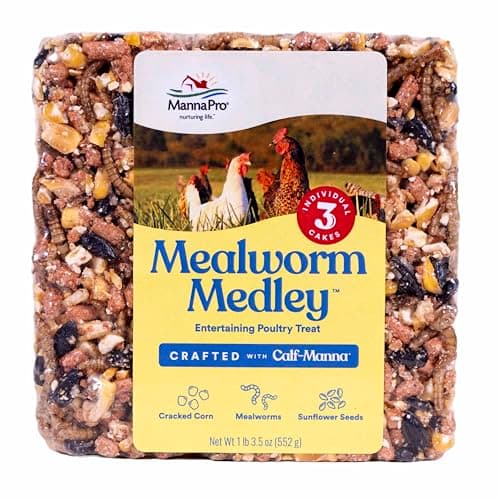
Now read the label on the treat cake sold to stop birds pecking. Manna Pro publishes 0.25 percent methionine for its Mealworm Medley Cake. A standard layer feed publishes 0.30 percent. Every gram of cake a hen eats instead of her ration moves her slightly the wrong way on the one nutrient the literature blames.
Where our own pages disagree
Worth stating plainly rather than leaving for a reader to trip over. Our page on hens that stop laying reports Mississippi State's figure for holding production: at least 16 hours of light a day, 16 to 18 recommended. The feather-pecking guidance from the same service says light “for more than 16 hours per day may cause birds to become hostile.”
Both are published, and they pull against each other above 16 hours. Our reading: 16 hours is the number where both are satisfied, and if you have a flock that is pecking, the laying schedule is the thing to relax rather than the one to defend. On intensity the two are compatible — 1 foot-candle is the laying minimum and 0.5 to 1.0 foot-candle is the pecking-safe band, so aim at one rather than at bright.
What is actually worth buying
In order: something that makes greens take time, then a slow edible object if the flock is shut in for a long winter, then the grit that anything coarse requires. The swing is on this page because it is what people search for, and it is ranked accordingly.
A note on the last pick. Manna Pro's own feeding directions for the treat cake say to offer grit to birds fed it, because of the larger particle size — the same requirement our grit page sets out for any coarse food. It is on this page for the same reason it is on the treats page: it is the condition under which the other products are safe to feed, not an upsell.
Heads up: some links on this page are affiliate links. If you buy through one we may earn a commission at no extra cost to you. It never changes a ranking, and we take no payment for placement. The full version.
The short answer
The short list
Ranked on the published rubric. Every row jumps to that product's full write-up below; the button goes straight to Amazon.
#
Pick
Best for
Key spec
Score
Price
1
Our pick
Ware Manufacturing
Chick-N-Veggie Treat Ball
The only item in this category that does the thing the published guidance actually asks for: it makes a bird work at food for a while, using greens you already have rather than extra grain.
The pecking-block category done by a brand that publishes a guaranteed analysis — which is exactly how you discover that it carries less methionine than the layer feed it displaces, on the one nutrient the feather-pecking literature names.
Cheap, harmless and genuinely used by some birds — but no extension source naming enrichment for feather pecking mentions a swing, and we are not going to pretend otherwise just because it is the thing everyone searches for.
Insoluble crushed granite, which is the actual definition of grit and the reason it is not oyster shell — a bird with no access to stones cannot digest whole grain, scratch or grass.
#adPrices as of September 26, 2026. Scores are our own published rubric, not customer ratings.
#1 · Making greens take time
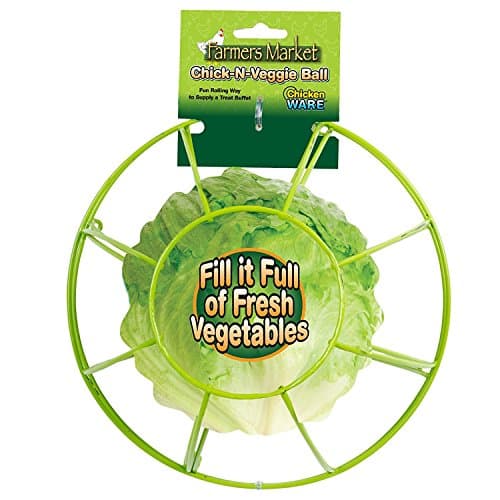
Ware Manufacturing Chick-N-Veggie Treat Ball
The only item in this category that does the thing the published guidance actually asks for: it makes a bird work at food for a while, using greens you already have rather than extra grain.
Who it is for. Anybody whose flock is confined to a run, especially over winter, and who wants to spread greens out over an hour instead of thirty seconds.
Published specifications
Type
Hanging wire treat ball
Fills with
Greens and vegetables
Mounting
Hangs in the coop or run
Adds to the diet
Nothing, if you fill it with greens rather than grain
Published dimensions
NOT PUBLISHED
Source: Ware Manufacturing published product listing (type, use), retrieved 2026-09-26. No dimensions are published.
Rubric — 7.1 / 10
Capacity honesty8/10 · weight 26%
Documentation4/10 · weight 24%
Build and weather7/10 · weight 20%
Running cost10/10 · weight 15%
Daily use8/10 · weight 15%
What it gets right
Turns a handful of greens into a foraging job that lasts, which is the mechanism the published prevention advice is pointing at
Filled with leafy greens it adds effectively no calories, so it does not dilute the complete ration the way a grain-based treat does
Ware Manufacturing is an established pet-products brand rather than an anonymous listing, which is unusual in this category
Hangs at bird height, so it also breaks up open floor space — the second thing the extension guidance recommends
What it costs you
Publishes no dimensions, so how much it holds is a guess until it arrives
Wire hanging toys get fouled and need cleaning, and nobody mentions that when selling them
It is a delivery mechanism, not a fix — if the flock is overcrowded or short on methionine this will not stop feather pecking
Fill it with scratch instead of greens and it becomes a treat dispenser, subject to the same 10 percent ceiling as any other treat
Skip it if. Your birds free range on grass for most of the day. They are already foraging, which is the whole point of this object.
Manna Pro Mealworm Medley Cake Poultry Treat, 19.5 oz
The pecking-block category done by a brand that publishes a guaranteed analysis — which is exactly how you discover that it carries less methionine than the layer feed it displaces, on the one nutrient the feather-pecking literature names.
Who it is for. A confined flock in winter that needs something slow to work at, from a keeper who will count it inside the treat allowance rather than on top of it.
Published specifications
Crude protein (min)
16%
Methionine (min)
0.25%
Lysine (min)
0.75%
Crude fat (min)
7.5%
Crude fiber (max)
7.5%
Calcium
0.2% min, 0.7% max
Ingredients
Cracked corn, mealworms, Calf-Manna and sunflower seeds
Package
19.5 oz, supplied as cakes
Feeding directions
Not recommended for birds under 8 weeks or very small birds, because of the larger particle size; offer grit to birds fed it; provide a complete feed and fresh water
Source: Manna Pro, Mealworm Medley Cake published guaranteed analysis and feeding directions (mannapro.com), retrieved 2026-09-26
Rubric — 7.4 / 10
Capacity honesty6/10 · weight 26%
Documentation9/10 · weight 24%
Build and weather7/10 · weight 20%
Running cost7/10 · weight 15%
Daily use8/10 · weight 15%
What it gets right
Publishes a full guaranteed analysis, which almost nothing sold as a boredom buster does
A compressed cake takes real time to eat, which is the only property that makes it enrichment rather than a snack
Manna Pro's own directions tell you to offer grit alongside it and to keep feeding a complete ration — instructions the category usually omits
Protected from the elements it lasts, so a cake is a slow-release object rather than a daily chore
What it costs you
0.25 percent methionine is below the 0.30 percent a layer feed publishes, and methionine deficiency is named by two extension services as a cause of feather pecking — so a bird eating this instead of feed moves the wrong way on the one nutrient that matters here
7.5 percent crude fat is high, and calcium is effectively absent at 0.2 to 0.7 percent against a layer feed's 3.25 to 4.25
It is a treat and counts against the published ceiling of about 10 percent of daily intake, whatever it is marketed as
Explicitly not for birds under 8 weeks or very small birds, which rules it out of a brooder
Skip it if. You are buying it to stop feather pecking. The published causes are density, light, mixing and nutrition, and this product is slightly negative on the nutrition one.
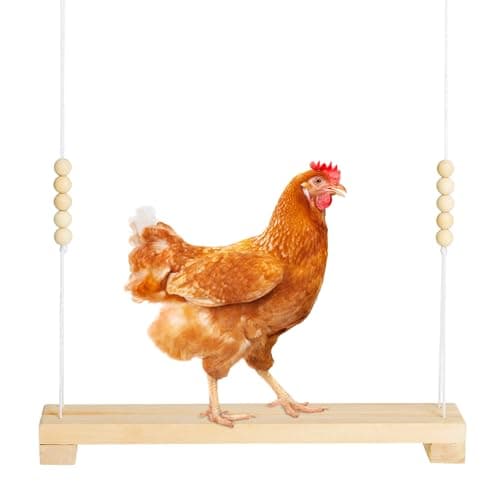
Cheap, harmless and genuinely used by some birds — but no extension source naming enrichment for feather pecking mentions a swing, and we are not going to pretend otherwise just because it is the thing everyone searches for.
Who it is for. Keepers who want to add something to a bare run, understand it is for interest rather than treatment, and will rotate it with other objects.
Published specifications
Length
40 cm (about 15.7 in)
Material
Natural wood bar on rope
Mounting
Hangs from the coop or run frame
Published load rating
NOT PUBLISHED
Source: Published product listing (length, material, mounting), retrieved 2026-09-26. No load rating is published.
Rubric — 5.8 / 10
Capacity honesty5/10 · weight 26%
Documentation3/10 · weight 24%
Build and weather6/10 · weight 20%
Running cost10/10 · weight 15%
Daily use7/10 · weight 15%
What it gets right
Cheapest item on this page, and a hanging object does break up open space, which the published guidance does recommend
A wooden bar is the right material for feet, and some birds genuinely do use it
Easy to move, so it satisfies the published advice to rotate enrichment items occasionally
Does not add a single calorie to the diet, unlike every edible boredom product
What it costs you
No published extension guidance on feather pecking names a swing — the devices named are string, twine and a leaned sheet of plywood
Publishes no load rating, on an object a heavy breed is meant to stand on
Many flocks ignore it completely, and there is no way to know in advance whether yours will
It is the product most likely to be bought instead of fixing space, light or feed, which are the things the literature actually blames
Skip it if. You are buying it to solve a pecking problem. Spend the money on a bale of straw to scatter, and read the cause list first.
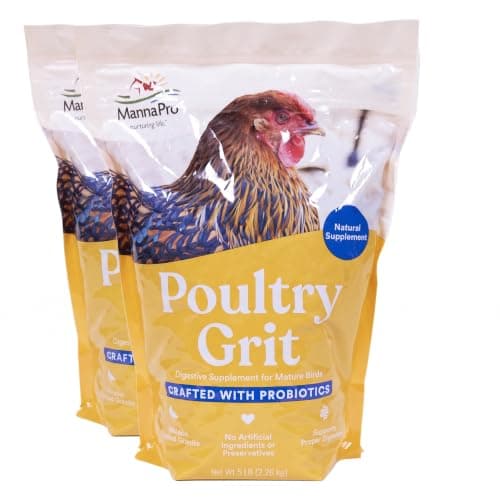
Insoluble crushed granite, which is the actual definition of grit and the reason it is not oyster shell — a bird with no access to stones cannot digest whole grain, scratch or grass.
Who it is for. Any confined flock that gets scratch, treats or greens, which is very nearly every backyard flock.
Published specifications
Material
Insoluble crushed granite
Added
Probiotics
Purpose
Aids proper digestion of coarse grains for all classes of poultry
Guaranteed analysis
Not published for the grit itself
Source: Manna Pro, Poultry Grit product listings, retrieved 2026-09-01
Rubric — 7.6 / 10
Capacity honesty8/10 · weight 26%
Documentation5/10 · weight 24%
Build and weather8/10 · weight 20%
Running cost9/10 · weight 15%
Daily use9/10 · weight 15%
What it gets right
Insoluble is the operative word and it is stated plainly: this stays in the gizzard and grinds, where oyster shell dissolves
Suitable for all classes of poultry, so one bag covers pullets and hens
Necessary the moment a bird eats anything that is not a complete crumble or pellet — treats, scratch, grass, kitchen scraps
What it costs you
Manna Pro publishes no guaranteed analysis or particle size for the grit itself, so you cannot check it is sized for your birds' age
The added probiotics have no published inclusion rate, which makes them hard to value
Birds with free range over stony ground find their own grit and do not need this at all
Skip it if. Your birds free-range over gravel or coarse soil and eat nothing but complete feed. They are already sorted.
They need something to do, which is not quite the same thing. Both University of Maryland and Mississippi State Extension recommend hanging four to eight pieces of string or twine where birds can reach them, and leaning a sheet of plywood against a wall to break up open space. Neither names a swing, mirror or xylophone. A confined flock benefits from foraging work; a flock on grass most of the day is already getting it.
+What stops chickens from pecking each other?
Working down the published cause list, which is mostly management. Overcrowding, light that is too bright or longer than 16 hours a day, nutritional gaps - especially methionine - mixing birds of different sizes or ages, heat, too few or too-bright nest boxes, and failing to remove injured birds. Enrichment helps with the boredom component. It does not substitute for the other ten.
+Are chicken swings worth it?
As entertainment, maybe; as treatment, no. No extension source cited here names a swing among enrichment for feather pecking - the devices named are string, twine and a leaned plywood sheet. A swing is cheap and harmless, a hanging object does break up open space, and plenty of flocks ignore it entirely. Buy one knowing what it is.
+Does a boredom block stop feather pecking?
Nothing published says so. A compressed treat block does take time to eat, which is the useful property. But the Manna Pro cake publishes 0.25% methionine against a layer feed's 0.30%, and methionine deficiency is one of the named causes of feather pecking - so it dilutes the nutrient the literature blames. Feed it inside the roughly 10 percent treat ceiling and treat it as occupation, not medicine.
+Does mash really reduce feather pecking compared to pellets?
That is what both extension sources publish: the risk is lower on a mash diet because it takes longer to consume than a pelleted one. It is the same enrichment logic applied to the feeder. It does cut against the usual advice to buy crumble or pellets for lower waste, and both things are true - if you have a pecking problem in a confined flock, mash is a published lever worth trying.
+How much light should a chicken coop have?
For limiting pecking, 0.5 to 1.0 foot-candle, and nothing brighter than a 40-watt bulb or longer than 16 hours a day. Note this pulls against the laying guidance, which calls for at least 16 hours to hold production. Sixteen hours is the figure that satisfies both, and a pecking flock is a reason to relax the laying schedule rather than defend it.
Where the numbers came from
Sources
Every figure cited on this page came from one of these documents. If one of them has changed since we read it, the number here is out of date and we would like to know.
The published 10% ceiling, the dilution arithmetic that shows where a ration actually breaks, and the treats worth buying - with the grit their makers say to provide alongside.