Keeping hawks off your chickens: cover the run, because nothing else is published
Every deterrent sold for this has the same problem — a hawk learns. The extension guidance does not suggest scaring the bird off; it says to put something solid between the hawk and the hen, and it names what.
Cover the run. University of Maryland Extension gives one recommendation for aerial predators and it is physical: “If you have serious problems with hawks and owls, consider covering the chicken run with hawk netting,” and more generally “Cover outside runs with mesh wire or netting to prevent problems from flying predators.” There is no published deterrent. If you also want wild birds out — which is a biosecurity question as much as a predation one — the same source calls for fine mesh, which means half-inch rather than one-inch.
First, confirm it was a hawk
Worth thirty seconds, because the fix is completely different for a ground predator and building a roof over the run solves nothing if a raccoon is working the walls. University of Maryland Extension publishes a diagnostic list, and the overlap is the trap:
What was taken, and what takes it that way. University of Maryland Extension, Prevention of Predation.
What you find
What it points to
Bird simply missing
Birds of prey, coyotes, dogs or foxes. Dogs are distinguishable because they will not eat the birds, and the carcass is often found near the attack site
Head missing
Birds of prey or raccoons. Raccoons reach through mesh and rip the head off through the wire, so check whether the body is at a fence line
Limbs missing
Raccoons, reaching through mesh and pulling legs off
Eggs or chicks missing
Opossums, skunks, rats, cats, snakes or birds of prey
Lacerations near the vent
Weasels and their relatives, which bite at the vent region
Scattered feathers
Not diagnostic on its own. The publication notes this may also be a sign of panic-stricken birds
Two things narrow it fast. Time of day: the same publication notes hawks hunt during the day and owls at night, so a daylight loss from an open run is the hawk case and an overnight loss from inside a closed coop is not. Location: a raptor takes a bird in the open; a raccoon works at a barrier. The predator-proofing page covers the ground side properly — hardware cloth, the apron, and the openings people forget.
What the law actually allows, briefly
Hawks, owls and eagles are federally protected in the United States under the Migratory Bird Treaty Act. You cannot shoot, trap or relocate one, and University of Maryland Extension’s advice when a predator problem is serious is to “Ask for assistance from local authorities responsible for wildlife for suggestions” rather than to handle it yourself.
That is not a side note, it is the reason this page is about netting. Exclusion is not merely the best option for aerial predators; for most keepers it is the only lawful one.The predator-proofing page carries the full legal position with the federal sources.
Why the shiny things are not on this page
Reflective tape, scare-eye balloons, plastic owls, old CDs on strings, a radio left on. We looked for an extension service that publishes any of these as effective against raptors and did not find one. What the publications recommend, consistently, is a physical barrier.
The mechanism is not mysterious. A hawk hunting a known food source returns to it, and a stationary object that never does anything stops being frightening. A net does not habituate.
The mesh decision, which is the only real decision
Netting is sold by mesh size and almost nothing else, and the published guidance pushes in two directions at once. For raptors, any mesh small enough to stop the bird reaching through will do, and that is a wide range. For wild birds, University of Maryland Extension is specific: “Open poultry houses should be enclosed by fine meshing to prevent entry by wild birds.”
What each mesh actually excludes. The wild-bird column is what the published biosecurity instruction is about.
Mesh
Stops a raptor
Stops small wild birds
Debris and snow load
1/2 in
Yes
Yes
Catches the most
1 in
Yes
No
Moderate
2 in
Yes
No
Sheds well
2.4 in
Yes
No
Sheds best
So the honest framing is: every mesh here answers the hawk. The mesh size is really choosing whether you are also solving the sparrows-in-the-feeder problem, and paying for it in coverage per dollar and in how much leaf litter and snow the net carries each winter.
How we judged these
On mesh size, panel area, construction and what each seller will commit to in writing — which, as with candlers, turns out to be almost nothing. Not one netting in this category publishes a breaking strain, a UV rating or a polymer grade, so service life cannot be compared and we have not pretended otherwise. What is checkable is mesh, area and whether the net is knotted or woven, and that is what the ranking rests on.
Hardware cloth sits at the bottom of the list on purpose. It is not a run roof in any practical sense — it is heavy, expensive by the square foot and needs a frame — but it is on the page because it is what the published guidance calls for on the coop itself, and because a reader who arrives here after losing a bird often has a structure problem as well as an airspace one.
If you are buying the run rather than roofing one you own, the run roundup ranks walk-in runs on the one figure their makers publish, and several arrive with a cover already fitted.
Fitting it so it stays up
The failure modes are consistent and none of them is the netting giving way in the middle.
Tension it, then tension it again a month later. A sagging net that touches the top of the run is a net something can work against from above and a support the birds can roost on from below.
Overlap the seams generously. A gap at a join is a gap, and this is why the roll size matters more than it looks on the listing.
Spread the load at every fixing. Netting tears from a point. A batten or a length of wire along the edge turns point loads into line loads.
Think about snow. A loaded net is heavy and a flat net holds everything that lands on it. A slight pitch, or a wire ridge down the middle, keeps it shedding.
Close the gap between net and fence. The commonest miss is a few inches of daylight along the top of the run wall, which is exactly where a ground-climbing predator comes in and where a panicking bird gets out.
Heads up: some links on this page are affiliate links. If you buy through one we may earn a commission at no extra cost to you. It never changes a ranking, and we take no payment for placement. The full version.
The short answer
The short list
Ranked on the published rubric. Every row jumps to that product's full write-up below; the button goes straight to Amazon.
#
Pick
Best for
Key spec
Score
Price
1
Our pick
Vocray
Woven Aviary Netting, 25 x 50 ft, 1 in mesh
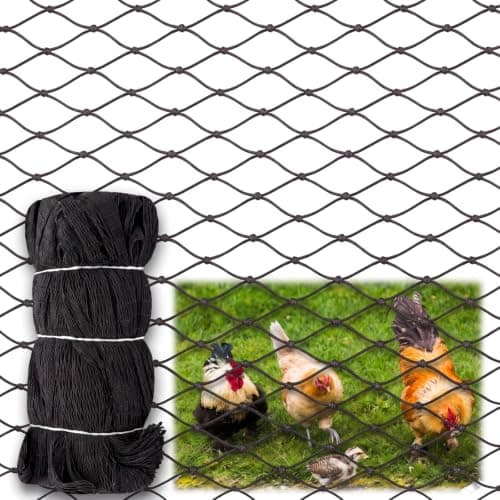
A one-inch woven mesh in the size that actually covers a backyard run, which is the physical exclusion University of Maryland Extension names when it says to cover the run rather than to deter the bird.
The half-inch version, and the one to buy if you read the published guidance carefully: Maryland calls for fine meshing to keep wild birds out of open poultry housing, and one-inch mesh does not do that.
Knotted construction rather than woven, which is the one durability distinction in this category that is a structural fact rather than an adjective: a knotted net does not unravel from a single broken strand.
The cheapest way to get something over an open run today, and included here with its limitation stated plainly rather than left for you to discover: at 2.4 inches this is the loosest mesh that still physically blocks a stoop.
Half-inch welded mesh in 19 gauge steel — not chicken wire, which keeps chickens in and keeps nothing out, and is the single most expensive mistake a first-time keeper makes.
#adPrices as of October 18, 2026. Scores are our own published rubric, not customer ratings.
#1 · Roofing a run you already own
Vocray Woven Aviary Netting, 25 x 50 ft, 1 in mesh
A one-inch woven mesh in the size that actually covers a backyard run, which is the physical exclusion University of Maryland Extension names when it says to cover the run rather than to deter the bird.
Who it is for. Anybody who has lost a bird to a hawk and owns a run with no roof, which is the commonest version of this problem.
Published specifications
Mesh
1 in
Panel size
25 ft x 50 ft, 1,250 sq ft
Construction
Woven
Material
Polyethylene; grade NOT PUBLISHED
Breaking strain
NOT PUBLISHED
UV rating
NOT PUBLISHED
Fixings
Not supplied
Source: Amazon product listing for the Vocray Bird Netting for Chicken Coop 25 x 50 ft, 1 in mesh, retrieved 2026-10-18. No maker specification sheet exists.
Rubric — 6.6 / 10
Capacity honesty8/10 · weight 26%
Documentation3/10 · weight 24%
Build and weather6/10 · weight 20%
Running cost10/10 · weight 15%
Daily use7/10 · weight 15%
What it gets right
A one-inch mesh is small enough to stop a hawk physically reaching the birds, which is the only mechanism with published support behind it
1,250 sq ft covers a large run with enough left to overlap the seams, and overlap is where a cheap netting job fails
Woven rather than extruded, which resists the tearing that starts at a single fixing point and runs
Light enough to be supported on wire or conduit rather than needing a framed roof
What it costs you
A one-inch mesh does NOT exclude small wild birds, and University of Maryland Extension specifically calls for fine meshing to keep wild birds out of open poultry houses — for that you need the half-inch
No published breaking strain, UV rating or polymer grade, so service life is unknowable in advance
Netting sags, and a sagging net touching the ground is a net a raccoon can work on; it needs tensioning and re-tensioning
No fixings supplied, and the fixing method is most of the work
Skip it if. Wild birds landing in the run are your actual concern rather than raptors. Go to the half-inch mesh, which is the version that excludes them.
Vocray Woven Aviary Netting, 25 x 25 ft, 1/2 in mesh
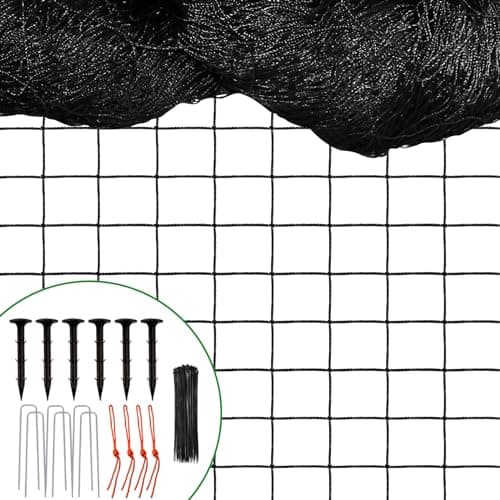
The half-inch version, and the one to buy if you read the published guidance carefully: Maryland calls for fine meshing to keep wild birds out of open poultry housing, and one-inch mesh does not do that.
Who it is for. Anybody whose run shares airspace with a lot of wild birds, or anybody acting on biosecurity advice rather than only on a hawk.
Published specifications
Mesh
1/2 in
Panel size
25 ft x 25 ft, 625 sq ft
Construction
Woven
Material
Polyethylene; grade NOT PUBLISHED
Breaking strain
NOT PUBLISHED
UV rating
NOT PUBLISHED
Fixings
Not supplied
Source: Amazon product listing for the Vocray Bird Netting for Chicken Coop 25 x 25 ft, 1/2 in mesh, retrieved 2026-10-18. No maker specification sheet exists.
Rubric — 6.1 / 10
Capacity honesty7/10 · weight 26%
Documentation3/10 · weight 24%
Build and weather6/10 · weight 20%
Running cost10/10 · weight 15%
Daily use6/10 · weight 15%
What it gets right
Half-inch mesh is the only netting here that meets the published instruction to exclude wild birds, not just raptors — which is a biosecurity question as much as a predation one
Stops the sparrow and starling traffic that empties a feeder and shares the water
Woven construction, same as the one-inch
625 sq ft suits the run most backyard keepers actually have
What it costs you
Half the coverage of the one-inch roll at a similar price, so the cost per square foot is roughly double
A finer mesh catches more leaf litter, snow and feather down, and a loaded net is a heavy net
Same missing documentation as the one-inch: no breaking strain, no UV rating, no polymer grade
Finer mesh is more visible overhead, which some keepers mind and some do not
Skip it if. Your run is large and raptors are the only concern. You will cover twice the area for the same money with the one-inch.
Yoojahow Knotted Aviary Netting, 25 x 25 ft, 2 in mesh
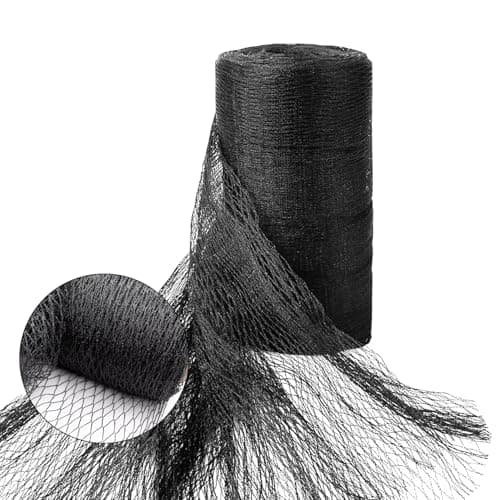
Knotted construction rather than woven, which is the one durability distinction in this category that is a structural fact rather than an adjective: a knotted net does not unravel from a single broken strand.
Who it is for. Somebody putting up a permanent run roof once and not wanting to do it again in three years.
Published specifications
Mesh
2 in
Panel size
25 ft x 25 ft, 625 sq ft
Construction
Knotted, described by the seller as commercial grade
Material
Polymer NOT PUBLISHED
Breaking strain
NOT PUBLISHED
UV rating
NOT PUBLISHED
Fixings
Not supplied
Source: Amazon product listing for the Yoojahow 25 x 25 ft Aviary Bird Netting, commercial grade knotted 2 in mesh, retrieved 2026-10-18. No maker specification sheet exists.
Rubric — 6.3 / 10
Capacity honesty6/10 · weight 26%
Documentation3/10 · weight 24%
Build and weather8/10 · weight 20%
Running cost9/10 · weight 15%
Daily use7/10 · weight 15%
What it gets right
Knotted netting is genuinely more durable than woven or extruded: damage stays local instead of running along the strand
Two-inch mesh is lighter and sheds leaf litter and snow better than a fine mesh, so it loads up less over a winter
The construction claim is checkable by eye on arrival, unlike the brightness and UV claims in this category
What it costs you
A two-inch mesh is the loosest here. It will stop a hawk from reaching a bird, but it excludes nothing smaller and a determined raptor has more to work with
Most expensive of the four by area
"Commercial grade" is published as a phrase with no figure attached — no breaking strain, no denier, no UV rating
Heavier than the woven nets, so it needs more support across a wide span
Skip it if. Small wild birds in the run matter to you. Two-inch mesh is an open door to every one of them.
The cheapest way to get something over an open run today, and included here with its limitation stated plainly rather than left for you to discover: at 2.4 inches this is the loosest mesh that still physically blocks a stoop.
Who it is for. Somebody who lost a bird yesterday and needs the run covered before dusk, with a better net ordered for next month.
Published specifications
Mesh
2.4 in
Panel size
25 ft x 25 ft, 625 sq ft
Material
Nylon
Construction
NOT PUBLISHED
Breaking strain
NOT PUBLISHED
UV rating
NOT PUBLISHED
Fixings
Not supplied
Source: Amazon product listing for the DQS Bird Netting 25 ft x 25 ft with 2.4 in mesh, retrieved 2026-10-18. No maker specification sheet exists.
Rubric — 5.1 / 10
Capacity honesty5/10 · weight 26%
Documentation2/10 · weight 24%
Build and weather4/10 · weight 20%
Running cost10/10 · weight 15%
Daily use7/10 · weight 15%
What it gets right
Cheap enough that an uncovered run has no excuse, and an uncovered run is the actual risk factor
Light, so it goes up over wire or batten with no structural work
Large mesh sheds debris and snow load better than anything finer
What it costs you
A 2.4 in mesh is wide enough to admit every small wild bird, so it does nothing for the biosecurity half of the published advice
Nylon degrades in sunlight and no UV rating is published; treat it as a season or two rather than a decade
Sold as garden netting, so the sizing and strength are set for fruit cages rather than for a bird that weighs two pounds landing hard
Nothing about the construction is published at all
Skip it if. You want this done once. Buy the knotted net, or the one-inch woven, and fix it properly.
#5 · The only mesh that actually excludes predators
Galvanized hardware cloth 1/2 in mesh, 19 gauge
Half-inch welded mesh in 19 gauge steel — not chicken wire, which keeps chickens in and keeps nothing out, and is the single most expensive mistake a first-time keeper makes.
Who it is for. Every coop and every run, and specifically an 18 to 24 inch skirt laid flat on the ground around the perimeter rather than buried, which stops diggers without trenching.
Published specifications
Mesh size
0.5 in x 0.5 in (12.7 x 12.7 mm)
Gauge
19 gauge steel wire
Finish
Galvanized; galvanized-after-weld (GAW) versions seal the welds too
Common roll sizes
24 in x 25 ft, 48 in x 100 ft, 4 ft x 100 ft
Typical uses
Chicken coops, run walls, vent covers, buried predator aprons
Source: Retailer and manufacturer listings for 19-gauge 1/2 in galvanized hardware cloth (Home Depot, Louis Page, Vevor), retrieved 2026-09-01
Rubric — 8.1 / 10
Capacity honesty9/10 · weight 26%
Documentation6/10 · weight 24%
Build and weather9/10 · weight 20%
Running cost9/10 · weight 15%
Daily use8/10 · weight 15%
What it gets right
Half-inch openings exclude a weasel and a rat; chicken wire's two-inch hexagons exclude neither, and a raccoon can reach straight through them
Welded rather than twisted, so a raccoon cannot work the joints apart the way it can with poultry netting
Galvanized-after-weld dips the finished mesh in zinc so the welds are sealed too, which is where untreated mesh rusts first
The same roll does run walls, window vents and a buried apron, so there is one material to buy
What it costs you
Meaningfully more expensive per square foot than chicken wire, which is exactly why people buy the wrong thing
19 gauge is thin enough to cut with snips, which also means it is thin enough to be cut by something determined over a long night
Cut edges are genuinely sharp and need to be turned under or covered
Retailers list roll sizes rather than a published breaking strength, so predator resistance is a design argument, not a spec sheet
Skip it if. Nothing. If you have a run, this is the mesh, and half-inch is the size. Substituting chicken wire is how flocks are lost.
#ad We have no verified Amazon listing for this one, so no number is shown. How this is funded.
FAQ
Questions people actually ask
+How do you keep hawks away from chickens?
Cover the run. University of Maryland Extension's published recommendation for serious hawk and owl problems is to cover the chicken run with hawk netting, and more broadly to cover outside runs with mesh wire or netting to prevent problems from flying predators. No extension service we found publishes a deterrent that works, because a hawk returning to a known food source habituates to anything stationary.
+What size netting keeps hawks out of a chicken run?
Any mesh fine enough to stop the bird reaching through, which in practice means anything from half an inch to about two and a half inches. The more useful question is whether you also want small wild birds excluded - Maryland Extension calls for fine meshing for that, which means half-inch. One-inch and wider will stop a hawk and let a sparrow straight through.
+Is it legal to shoot a hawk that is killing my chickens?
No. Hawks, owls and eagles are federally protected in the United States under the Migratory Bird Treaty Act, and you cannot shoot, trap or relocate one. University of Maryland Extension's advice for a serious predator problem is to ask local authorities responsible for wildlife for suggestions. Exclusion is for most keepers the only lawful route.
+Do fake owls or reflective tape keep hawks away?
We could not find an extension publication that supports any of them, which is why none appears on this page. The mechanism is the problem: a hawk that has found a reliable food source comes back, and a stationary object that never does anything stops being frightening. Netting does not habituate.
+Was it a hawk or a raccoon?
Time and place narrow it. Hawks hunt in daylight and owls at night, so a daylight loss from an open run is the raptor case. University of Maryland Extension lists a missing head as pointing to either a bird of prey or a raccoon, but raccoons reach through mesh and rip the head off through the wire, so a body at a fence line is a raccoon and a bird simply gone from open ground is not.
+Can I use bird netting instead of hardware cloth?
Only on the run roof, and not on the coop. Netting excludes a bird in flight. It does nothing against a raccoon, which has hands and all night, so where the flock sleeps the answer is still half-inch hardware cloth. Swapping one for the other is a common and expensive mistake.
+Will a rooster protect hens from hawks?
A cockerel does watch and does give an alarm call, and that is genuinely worth something. He is not armor - he is frequently the bird taken - and many local ordinances prohibit keeping one at all. We would not advise buying a bird as a security measure when a net is cheaper, lawful everywhere and does not habituate.
+Do chickens need a covered run?
If raptors hunt where you live, yes, and it is the only intervention with published support. The secondary benefits are real too: a covered run keeps wild birds off the feed and water, keeps the run surface drier, and stops the flock free-ranging into a garden. The cost is that netting loads up with leaf litter and snow and needs re-tensioning.
Where the numbers came from
Sources
Every figure cited on this page came from one of these documents. If one of them has changed since we read it, the number here is out of date and we would like to know.
Electric netting compared on published strand count and post spacing, with the joule rule for sizing an energizer and what netting does not protect against.