Electric poultry netting, and how to size the energizer
A run keeps chickens in. Netting keeps foxes and loose dogs out, and moves to fresh ground when the old ground is bare. It is also the one purchase here that does nothing at all if you get the energizer wrong.
Electric netting is a different tool from a run. A run is a static enclosure that contains birds; netting is a movable, energized perimeter that deters ground predators while the flock is out. Premier 1 publishes the numbers that matter for both jobs: 12 horizontal strands, 11 of them conductive, verticals every 3 inches, and line posts every 6 ft 8 in on the Plus version. It also publishes the sizing rule almost nobody else does — a pulse-style 0.6 joule energizer or larger for up to three rolls.
What netting does that a run does not
This site's run roundup ranks static enclosures on published area per bird, and its predator-proofing page is about hardware cloth and aprons. Netting sits between them and solves a problem neither does: ground that runs out. A fixed run on grass becomes a fixed run on bare dirt within weeks. Netting is unrolled somewhere else and the birds get new ground.
The second job is active deterrence. Hardware cloth is a passive barrier — a predator can work at it for as long as it likes. An energized fence teaches instead: the animal touches it once and leaves. That is a genuinely different kind of protection, and it is why netting is the standard answer for free-ranging where foxes and loose dogs are the problem.
How to judge a roll of netting
Post spacing, because sag is the failure mode. A sagging net touches grass and shorts out. Premier's Plus spec puts posts every 6 ft 8 in against 10 ft on the standard roll, and that is the single most useful difference between them.
Strand count and vertical spacing. Twelve horizontals with verticals every 3 inches is a fine enough grid that a chicken does not walk through it and a fox does not push between strands.
Whether the maker publishes an energizer rule. Joules per roll is the number that decides whether the fence works at all, and most sellers leave you to guess.
Height against what you are excluding. 48 in is the common poultry height; the same range exists at 42 in, which is easier to step over and lower against a jumping dog.
Sizing the energizer, with the published rule
This is where first-time buyers go wrong, usually by buying netting and a cheap energizer separately and finding the fence dead a week later. Premier's published guidance is a pulse-style 0.6 joule unit or larger for up to three rolls of PoultryNet. That converts directly into a length.
The practical reading: one roll of netting and a 0.8 joule solar energizer is a coherent starter setup. Two or three rolls still works on the same unit. Beyond that, you are into a larger energizer and the arithmetic should be done again before buying, not after.
The strand that is deliberately not live
Eleven of the twelve horizontal strands are conductive. The bottom one is not, and that is a design decision rather than a defect: a live strand lying in wet grass would short the whole fence continuously. It has a consequence worth stating plainly, because sellers rarely do.
Keeping it working
Keep the line clear. Grass growing into the strands is the commonest cause of a weak fence. Strim the line before you set the net, not after.
Test it, do not assume it. A fence tester is a small purchase against a flock. Starter kits from the same maker include one for exactly this reason.
Train the birds. Chickens learn a fence quickly, but they learn it by touching it. Expect a startled bird in the first day or two.
Mind the tangle risk. Netting is a hazard to a bird that gets caught in it, which is another reason to keep it taut and properly posted.
Heads up: some links on this page are affiliate links. If you buy through one we may earn a commission at no extra cost to you. It never changes a ranking, and we take no payment for placement. The full version.
The short answer
The short list
Ranked on the published rubric. Every row jumps to that product's full write-up below; the button goes straight to Amazon.
#
Pick
Best for
Key spec
Score
Price
1
Our pick
Premier 1 Supplies
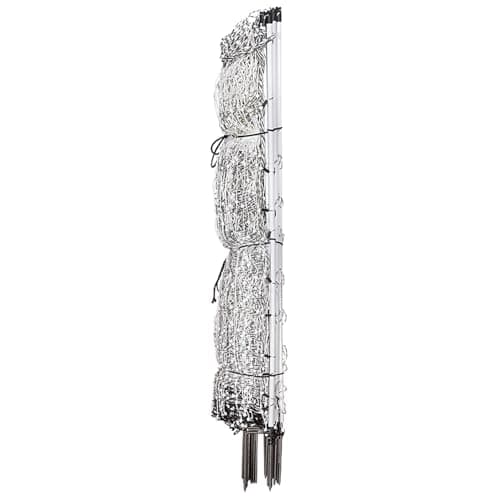
PoultryNet Plus 12/48/3, 48 in x 100 ft
Twelve horizontal strands, eleven of them live, on posts already built into the roll — the only containment product on this site that both holds chickens in and actively deters what wants to get at them.
Above the 0.6 joule minimum Premier publishes for up to three rolls of netting, with the solar panel and battery built into one unit — which is the only practical way to electrify a fence at the bottom of a field.
Half-inch welded mesh in 19 gauge steel — not chicken wire, which keeps chickens in and keeps nothing out, and is the single most expensive mistake a first-time keeper makes.
#adPrices as of September 21, 2026. Scores are our own published rubric, not customer ratings.
#1 · Moving the flock, and keeping foxes out
Premier 1 Supplies PoultryNet Plus 12/48/3, 48 in x 100 ft
Twelve horizontal strands, eleven of them live, on posts already built into the roll — the only containment product on this site that both holds chickens in and actively deters what wants to get at them.
Who it is for. Anybody free-ranging over a paddock or yard who wants to move the flock to fresh ground and keep ground predators honest while the birds are out.
Published specifications
Height
48 in
Roll length
100 ft
Horizontal strands
12, of which 11 are conductive
Vertical strings
Every 3 in
Line posts
Built in, every 6 ft 8 in on the Plus version (every 10 ft on standard PoultryNet)
Post spikes
Double spike, for stability
Energizer
Sold separately; Premier recommends a pulse-style 0.6 joule unit or larger for up to 3 rolls
Intended stock
Chickens and ducks
Source: Premier 1 Supplies, PoultryNet and PoultryNet Plus 12/48/3 published specifications and energizer guidance, retrieved 2026-09-21
Rubric — 8.4 / 10
Capacity honesty9/10 · weight 26%
Documentation9/10 · weight 24%
Build and weather9/10 · weight 20%
Running cost7/10 · weight 15%
Daily use7/10 · weight 15%
What it gets right
Eleven live strands with verticals every 3 inches is a genuine barrier to a fox or a loose dog, which no static run fence is
The Plus spacing puts a post every 6 ft 8 in rather than every 10 ft, and sag is the single biggest cause of a netting fence shorting out
Posts are built into the roll, so setting it up is unrolling and stepping posts in rather than assembling a fence
Premier publishes an energizer sizing rule — 0.6 joules or more for up to three rolls — which almost nothing else in electric fencing does
What it costs you
The bottom strand is not electrified, which is deliberate for grounding safety but means the fence does not stop a determined digger
It only works if it is energized: an unpowered net is a trip hazard that chickens walk through, and grass growing into the strands drains it
The energizer is a separate and substantial purchase, so the real entry cost is roughly double the netting price
Electric netting is a hazard to small children and to birds that get tangled; it needs a considered site, not just a spare corner
Skip it if. Your birds live in a fixed, roofed run and never leave it. This is a tool for rotating birds over ground, not a substitute for a predator-proof enclosure at night.
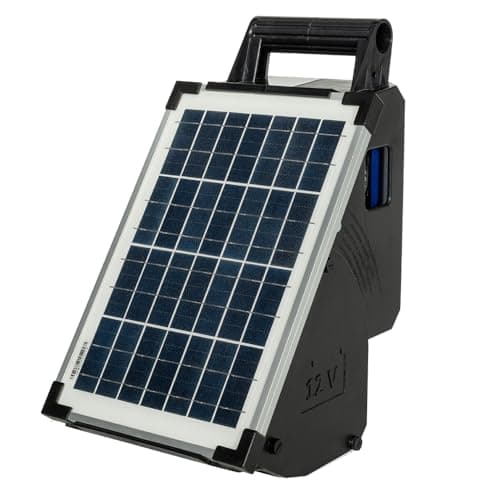
Premier 1 Supplies SolarStop 80 Fence Energizer, 0.8 J
Above the 0.6 joule minimum Premier publishes for up to three rolls of netting, with the solar panel and battery built into one unit — which is the only practical way to electrify a fence at the bottom of a field.
Who it is for. Anybody running netting away from the house, which is most of the people who buy netting in the first place.
Published specifications
Output
0.8 joule
Solar panel
10 W, integrated
Published fence guidance
Premier recommends 0.6 J or larger for up to 3 rolls of PoultryNet
Type
Self-contained solar energizer with battery
Source: Premier 1 Supplies, SolarStop 80 published output and PoultryNet energizer guidance, retrieved 2026-09-21
Rubric — 8.1 / 10
Capacity honesty8/10 · weight 26%
Documentation8/10 · weight 24%
Build and weather8/10 · weight 20%
Running cost9/10 · weight 15%
Daily use8/10 · weight 15%
What it gets right
0.8 joules clears Premier's own published 0.6 joule threshold for up to three rolls, with headroom for grass load
Self-contained: panel, battery and energizer in one housing, so there is no outlet, no cable run and no separate leisure battery
From the same maker as the netting, so the sizing guidance and the hardware come from one source rather than two
Solar is the right answer for the use case — netting exists to be moved, and a mains energizer anchors it
What it costs you
Costs substantially more than the roll of netting it powers, which surprises people pricing a first setup
Solar output falls exactly when you need the fence most reliably — short, overcast winter days
0.8 J is sized for up to about three rolls; a larger perimeter needs a bigger unit and the cost climbs steeply
One more thing to steal from an open field, and it is not a cheap thing
Skip it if. You have mains power within reach of the fence line. A plug-in energizer of the same output costs considerably less and never has a flat-battery week.
#3 · The only mesh that actually excludes predators
Galvanized hardware cloth 1/2 in mesh, 19 gauge
Half-inch welded mesh in 19 gauge steel — not chicken wire, which keeps chickens in and keeps nothing out, and is the single most expensive mistake a first-time keeper makes.
Who it is for. Every coop and every run, and specifically an 18 to 24 inch skirt laid flat on the ground around the perimeter rather than buried, which stops diggers without trenching.
Published specifications
Mesh size
0.5 in x 0.5 in (12.7 x 12.7 mm)
Gauge
19 gauge steel wire
Finish
Galvanized; galvanized-after-weld (GAW) versions seal the welds too
Common roll sizes
24 in x 25 ft, 48 in x 100 ft, 4 ft x 100 ft
Typical uses
Chicken coops, run walls, vent covers, buried predator aprons
Source: Retailer and manufacturer listings for 19-gauge 1/2 in galvanized hardware cloth (Home Depot, Louis Page, Vevor), retrieved 2026-09-01
Rubric — 8.1 / 10
Capacity honesty9/10 · weight 26%
Documentation6/10 · weight 24%
Build and weather9/10 · weight 20%
Running cost9/10 · weight 15%
Daily use8/10 · weight 15%
What it gets right
Half-inch openings exclude a weasel and a rat; chicken wire's two-inch hexagons exclude neither, and a raccoon can reach straight through them
Welded rather than twisted, so a raccoon cannot work the joints apart the way it can with poultry netting
Galvanized-after-weld dips the finished mesh in zinc so the welds are sealed too, which is where untreated mesh rusts first
The same roll does run walls, window vents and a buried apron, so there is one material to buy
What it costs you
Meaningfully more expensive per square foot than chicken wire, which is exactly why people buy the wrong thing
19 gauge is thin enough to cut with snips, which also means it is thin enough to be cut by something determined over a long night
Cut edges are genuinely sharp and need to be turned under or covered
Retailers list roll sizes rather than a published breaking strength, so predator resistance is a design argument, not a spec sheet
Skip it if. Nothing. If you have a run, this is the mesh, and half-inch is the size. Substituting chicken wire is how flocks are lost.
#ad We have no verified Amazon listing for this one, so no number is shown. How this is funded.
FAQ
Questions people actually ask
+Does electric netting keep foxes away from chickens?
It is the standard tool for it while birds are out, because an energized fence actively deters rather than passively resists. Premier 1's PoultryNet has 12 horizontal strands with 11 conductive and verticals every 3 inches. The important limitation is that the bottom strand is not electrified, so an animal that digs under never touches a live wire - netting is not a substitute for a predator-proof coop at night.
+What size energizer do I need for poultry netting?
Premier 1 publishes the rule: a pulse-style 0.6 joule unit or larger for up to three rolls of PoultryNet. Three 100 ft rolls is 300 ft of fence. Buy some headroom above the minimum, because vegetation touching the strands drains the charge as grass grows.
+Will chickens go through electric netting?
Not once they have learned it, and the 3-inch vertical spacing is fine enough that they do not walk through it in the meantime. Expect a startled bird in the first day or two while the flock works out where the boundary is.
+Is electric poultry netting worth it?
If you free range over ground that gets bare, or you have lost birds to foxes or loose dogs in daylight, yes - it is the only product here that both moves and deters. If your birds live permanently in a fixed roofed run and never leave it, it solves a problem you do not have.
+Do I need solar or mains for an electric fence energizer?
Mains is cheaper for the same output and never has a flat-battery week, so use it if the fence line is within reach of power. Solar exists because netting is meant to be moved, and most people who buy netting are fencing somewhere with no outlet. A self-contained solar unit above the published joule minimum is the usual answer.
Where the numbers came from
Sources
Every figure cited on this page came from one of these documents. If one of them has changed since we read it, the number here is out of date and we would like to know.