The best chicken runs, ranked on the only figure their makers publish
Walk-in runs are listed as chicken coops, arrive without a henhouse, and state no bird count at all. What they do publish is a footprint — and that is the one number the decision actually needs.
poultry.extension.org publishes 10 square feet of outdoor space per hen, so a run’s published footprint divided by ten is its honest bird count. On that arithmetic the VAGGER 10 by 10 is the pick for most backyard flocks at 100 square feet, or ten birds. The 9.9-by-13.2-foot enclosure is the largest here at 130.7 square feet. None of these four publishes a mesh gauge, which is the specification that decides whether a run excludes a raccoon — budget for hardware cloth on top of whichever you buy.
The run is the half of a chicken setup that gets bought last, sized by eye, and then blamed for problems it caused. It is also the half where the market is strangest: these products are listed as “chicken coops,” contain no henhouse, and — unusually — make no capacity claim at all.
That last part is to their credit. Every coop on this site states a bird count that its own published dimensions contradict. These runs state nothing, publish a footprint, and leave the division to you. So here is the division.
What decides a run, in order
Published footprint, divided by ten.poultry.extension.org publishes 10 square feet of outdoor space per laying hen. It is the least-disputed figure in this whole category and it turns a listing title into a bird count.
Headroom, because you go in every day. A run you stoop in is a run you clean badly. Three of these four publish a height; one does not, and that omission is scored against it.
Mesh gauge and aperture — the specification none of them publishes. This is the gap that matters most and the one every maker here leaves blank. Covered below.
A cover, and what a cover is not. All four publish one. A cover is weather protection and a deterrent to a hawk in flight; it is not a predator-proof roof, and neither the listings nor this page will claim it is.
Shape against your yard. A hundred square feet as a 10-by-10 square and as a long rectangle fit completely different gardens. This is the criterion a spec sheet cannot decide for you.
Four runs, divided by ten
Published footprints and the bird count they support at the extension figure of 10 sq ft per hen. Dimensions from each maker's product listing; areas computed. Retrieved 2026-09-13.
Run
Published footprint
Area
Birds at 10 sq ft
Headroom
9.9 x 13.2 ft enclosure
9.9 x 13.2 ft
130.7 sq ft
13
Not published
VAGGER 10 x 10
10 x 10 ft
100.0 sq ft
10
6.5 ft
CHIKENCOOP 9.8 x 6.5
9.8 x 6.5 ft
63.7 sq ft
6
6.5 ft
VEVOR 6.56 ft square
6.56 x 6.56 ft
43.0 sq ft
4
6.56 ft
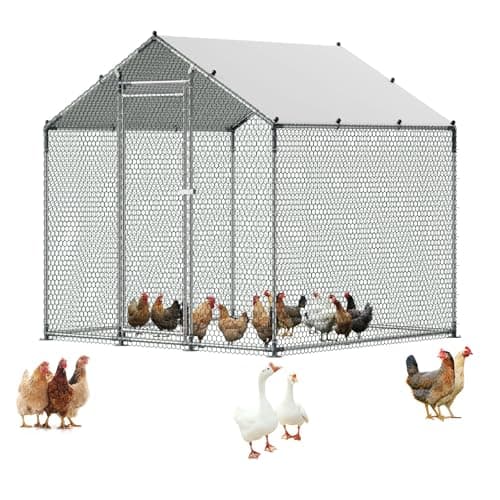
VAGGER 10 x 10 — the one most backyard flocks should buy
A flat hundred square feet, which is exactly ten birds at the published allowance, with 6.5 feet of headroom and a cover. For the common backyard case — four to eight birds — this is the run that lets you exceed the published minimum rather than sit on it, and exceeding it is the whole point: outdoor space is the cheapest prevention there is for the feather picking and bullying that get blamed on breed.
The honest downside: no published mesh gauge or aperture, which is the gap shared by everything on this page. A hundred square feet also needs genuinely level ground, which is more site preparation than the listing implies. And the ten-bird figure is only useful if your coop houses ten — most do not, as the ten-bird coop page works through.
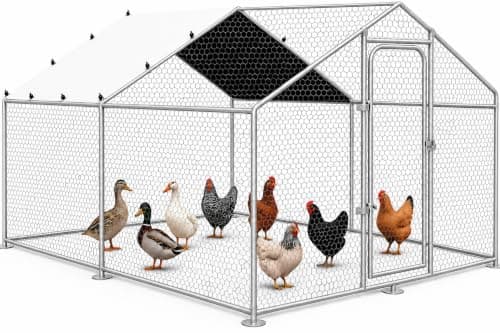
CHIKENCOOP 9.8 x 6.5 — six birds, exactly
63.7 square feet lands almost precisely on six birds at the published figure, which is the flock size most first-time keepers actually end up with. The rectangle sits along a fence line better than a square does, and it publishes the same 6.5 feet of headroom.
The honest downside: six and a half feet of width is narrow once you put a coop inside it, and at six birds you are on the published minimum with nothing spare. Same missing mesh specification. And like everything here it is sold as a “chicken coop” while containing no henhouse at all — you still need the coop.
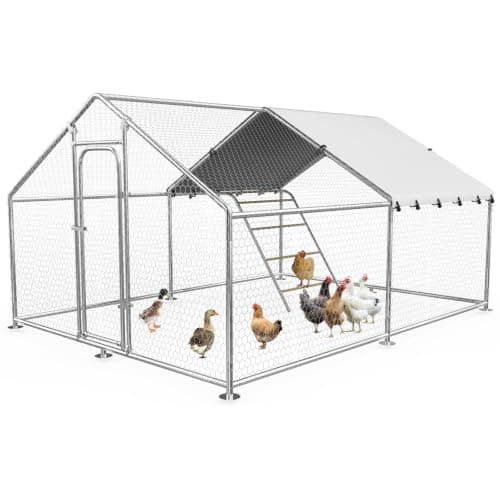
9.9 x 13.2 ft enclosure — the most area, the least documentation
130.7 square feet is the largest published footprint here and the only one that gives a ten-bird flock real margin — 13.07 square feet a bird rather than the bare 10. If your flock is at the top of what a backyard holds, this is the area you want.
The honest downside: the height is not published anywhere in the listing, which for a product sold as walk-in is the single specification you most need. There is also no brand attached to hold accountable, and our rubric scores that down hard. Over 130 square feet is a substantial permanent structure — level ground, and worth a look at local setback rules first.
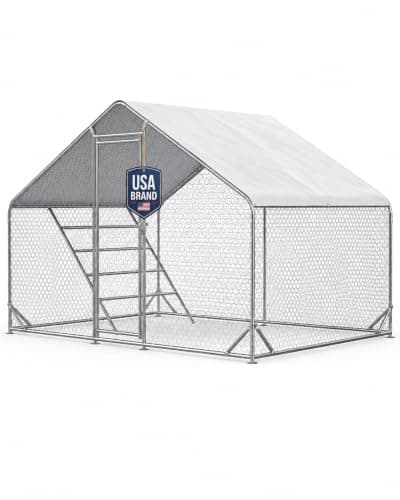
VEVOR 6.56 ft square — the one that fits a small yard
Forty-three square feet is four birds at the published allowance, with 6.56 feet of headroom — the tallest here — a spire roof, a cover and a locking door. For a genuinely small garden it is the only one of these four that will physically fit alongside a coop.
The honest downside: four birds is the answer and it does not stretch. Most people who start at four are at six within a year, and this run has no capacity to absorb that. It is also the smallest area for a price the live buttons will let you compare against the VAGGER’s hundred square feet — do that comparison before buying.
The specification none of them publishes
Every run on this page publishes a footprint and a cover. Not one publishes a mesh gauge or an aperture size, and that is the pair of numbers that decides whether the structure is a predator barrier or a fence that contains chickens.
The distinction is not academic. Predator-proofing covers it in full: a raccoon reaches through a two-inch hexagon and a weasel passes through it entirely, which is why half-inch hardware cloth in 19 gauge is the material and chicken wire is not. Assume any run in this price class ships with something closer to the latter, and budget for lining the bottom two feet and laying an apron.
That is not a reason to avoid these runs. It is a reason to price them honestly: the run plus a roll of hardware cloth is the real cost, and it is still cheaper than building the same footprint from scratch.
Heads up: some links on this page are affiliate links. If you buy through one we may earn a commission at no extra cost to you. It never changes a ranking, and we take no payment for placement. The full version.
The short answer
The short list
Ranked on the published rubric. Every row jumps to that product's full write-up below; the button goes straight to Amazon.
#
Pick
Best for
Key spec
Score
Price
1
Our pick
VAGGER
Walk-In Chicken Run, 10 x 10 ft
A flat hundred square feet, which is ten birds at the published outdoor allowance and more than twice the area of the smallest run on this page for a modest step up in price.
Nine-point-eight by six-and-a-half feet is 63.7 square feet, which lands almost exactly on six birds at the published outdoor figure — the flock size most backyard keepers actually end up with.
The largest published footprint here at 130.7 square feet — thirteen birds at the published allowance, and the only one on this page that gives a ten-bird flock genuine headroom rather than the bare minimum.
A 6.56-foot square walk-in with a spire roof and a cover, which is 43 square feet — four birds at the published outdoor allowance, and the only one here small enough for a genuinely small yard.
#adPrices as of September 13, 2026. Scores are our own published rubric, not customer ratings.
#1 · The most area per dollar here
VAGGER Walk-In Chicken Run, 10 x 10 ft
A flat hundred square feet, which is ten birds at the published outdoor allowance and more than twice the area of the smallest run on this page for a modest step up in price.
Who it is for. Somebody with eight to ten birds, or somebody with six who would rather overbuild the run once than rebuild it later.
Published specifications
Published dimensions
10 ft L x 10 ft W x 6.5 ft H
Run area
100.00 sq ft, computed from the published 10 ft x 10 ft
Birds at the published outdoor allowance
10, at 10 sq ft per bird
Headroom
6.5 ft
Roof
Cover included
Stated bird capacity
None stated by the maker
Mesh gauge and aperture
Not published
Source: VAGGER manufacturer listing, published dimensions in the product title; retrieved 2026-09-13. No maker specification page is published. Area figures computed from those dimensions.
Rubric — 6.9 / 10
Capacity honesty9/10 · weight 26%
Documentation4/10 · weight 24%
Build and weather5/10 · weight 20%
Running cost9/10 · weight 15%
Daily use8/10 · weight 15%
What it gets right
A hundred square feet is the published outdoor allowance for ten birds, and it is the only run here that clears a double-figure flock
More than double the area of the 6.56 ft run for a step up in price that the live buttons above will show you is small
A square 10-by-10 is a standard yard footprint and easy to plan a coop into
Enough area that you can overbuild relative to your flock, which is the cheapest behavioral insurance there is
What it costs you
No published mesh gauge or aperture — the same gap as every run on this page, and the one that decides predator exclusion
A hundred square feet needs level ground, which is more site preparation than people expect
No maker specification page; dimensions come from the listing title
Ten-bird capacity is only meaningful if your coop also houses ten, and most do not
Skip it if. Your yard cannot take a 10-by-10 permanent structure, or your flock is four birds and will stay that way.
Nine-point-eight by six-and-a-half feet is 63.7 square feet, which lands almost exactly on six birds at the published outdoor figure — the flock size most backyard keepers actually end up with.
Who it is for. A six-bird flock that already has a coop and needs the run the coop's own capacity claim quietly assumed.
Published specifications
Published dimensions
9.8 ft L x 6.5 ft W x 6.5 ft H
Run area
63.70 sq ft, computed from the published 9.8 ft x 6.5 ft
Birds at the published outdoor allowance
6, at 10 sq ft per bird
Headroom
6.5 ft
Roof
Cover included
Stated bird capacity
None stated by the maker
Mesh gauge and aperture
Not published
Source: CHIKENCOOP manufacturer listing, published dimensions in the product title; retrieved 2026-09-13. No maker specification page is published. Area figures computed from those dimensions.
Rubric — 6.4 / 10
Capacity honesty8/10 · weight 26%
Documentation4/10 · weight 24%
Build and weather5/10 · weight 20%
Running cost9/10 · weight 15%
Daily use7/10 · weight 15%
What it gets right
63.7 sq ft is six birds at the published allowance, which is the size most first flocks settle at
A rectangle rather than a square, which sits along a fence line better than a 10-by-10 does
Six and a half feet of headroom for cleaning and catching birds
No stated bird count to argue with — you do the division yourself from a published footprint
What it costs you
No published mesh specification, so predator exclusion is unverifiable and you should plan on adding hardware cloth
Six and a half feet of width is narrow for a run you also want to put a coop inside
No maker specification page; the figures are the listing's own title
Sold as a 'chicken coop' when it is a run — there is no henhouse here, and you still need one
Skip it if. You want one purchase that houses and runs the birds. This is the outdoor half only.
Walk-in poultry run 9.9 x 13.2 ft Metal Run Enclosure
The largest published footprint here at 130.7 square feet — thirteen birds at the published allowance, and the only one on this page that gives a ten-bird flock genuine headroom rather than the bare minimum.
Who it is for. Ten or more birds, a yard that can take it, and a keeper who values published area over a published brand.
Published specifications
Published dimensions
9.9 ft L x 13.2 ft W
Run area
130.68 sq ft, computed from the published 9.9 ft x 13.2 ft
Birds at the published outdoor allowance
13, at 10 sq ft per bird
Birds with real margin
10, at 13.07 sq ft each
Headroom
Not published in the listing
Type
Walk-in poultry run enclosure
Stated bird capacity
None stated by the maker
Mesh gauge and aperture
Not published
Source: Manufacturer listing, published dimensions in the product title; retrieved 2026-09-13. No maker specification page and no published height. Area figures computed from the published footprint.
Rubric — 6.3 / 10
Capacity honesty9/10 · weight 26%
Documentation3/10 · weight 24%
Build and weather4/10 · weight 20%
Running cost9/10 · weight 15%
Daily use7/10 · weight 15%
What it gets right
130.7 sq ft is the largest published area on this page, and it is the only one that lets a ten-bird flock have more than the published minimum
Run area is the cheapest thing you can overbuild — feather picking and bullying are space problems long before they are temperament problems
No stated bird count, so nothing to argue with: the footprint is published and the division is yours
A long rectangle suits a fence-line siting better than a square
What it costs you
Height is not published at all, which for a 'walk-in' is the specification you most want. Assume nothing until it arrives
No published mesh gauge or aperture, and no maker specification page
Over 130 sq ft is a significant permanent structure — level ground, and worth checking local setback rules
The listing gives no brand to hold accountable, which is itself a mark against it on our rubric
Skip it if. You need to know the headroom before you buy. It is not published, and for a walk-in that is a real gap.
A 6.56-foot square walk-in with a spire roof and a cover, which is 43 square feet — four birds at the published outdoor allowance, and the only one here small enough for a genuinely small yard.
Who it is for. A four-bird flock in a yard where a 10-by-10 structure will not fit, and a keeper who will add hardware cloth to the bottom two feet themselves.
Published specifications
Published dimensions
6.56 ft L x 6.56 ft W x 6.56 ft H
Run area
43.03 sq ft, computed from the published 6.56 ft x 6.56 ft
Birds at the published outdoor allowance
4, at 10 sq ft per bird
Headroom
6.56 ft — walk-in without stooping
Roof
Spire roof with cover
Security
Security lock on the door
Stated bird capacity
None stated by the maker
Mesh gauge and aperture
Not published
Source: VEVOR manufacturer listing, published dimensions in the product title; retrieved 2026-09-13. No maker specification page is published for this product. Area figures computed from those dimensions.
Rubric — 6.4 / 10
Capacity honesty8/10 · weight 26%
Documentation4/10 · weight 24%
Build and weather5/10 · weight 20%
Running cost9/10 · weight 15%
Daily use7/10 · weight 15%
What it gets right
Six and a half feet of headroom, so it is a walk-in by the only measure that counts — you stand up in it
43 sq ft is a real four-bird run at the 10 sq ft per bird poultry.extension.org publishes, and the maker does not pretend otherwise by claiming a bird count
The smallest footprint here, which is the one that fits a suburban yard alongside a coop
A published cover and a locking door, both of which a bare panel run leaves you to solve
What it costs you
No published mesh gauge or aperture, which is the specification that decides whether it excludes a raccoon or merely contains a chicken. Assume you are adding half-inch hardware cloth at ground level
43 sq ft is four birds. Most keepers end up with six, and this run does not grow
No maker specification page at all — the dimensions come from the product listing
A cover is not a predator-proof roof; it is weather protection
Skip it if. You have more than four birds, or you expect to. The area is published and it does not stretch.
10 square feet per hen, which is the outdoor allowance poultry.extension.org publishes. For six birds that is 60 square feet and for ten it is 100. Dividing a run's published footprint by ten is the fastest honest check you can run on any product in this category, because almost none of them states a bird count.
+What is the best chicken run?
On published area against the extension figure, the VAGGER 10 by 10 for most backyard flocks — 100 square feet, or ten birds, with 6.5 feet of headroom. The 9.9 by 13.2 foot enclosure publishes more area at 130.7 square feet but does not publish its height, which for a walk-in is a significant gap.
+Are metal chicken runs predator proof?
Not on their published specifications. None of the runs covered here publishes a mesh gauge or aperture size, which are the figures that decide predator exclusion. Assume you are lining the bottom two feet with half-inch hardware cloth in 19 gauge and laying a ground apron, and treat the cover as weather protection rather than a predator-proof roof.
+Do chicken runs come with a coop?
These do not, despite being listed as chicken coops. They are enclosures with a cover and no henhouse, so you still need somewhere for the birds to roost and lay. Budget for both, and size the coop from the 3 to 4 square feet per hen indoors figure rather than assuming the run covers it.
+Should I spend more on the coop or the run?
The run, if you have to choose. The published figures are 3 to 4 square feet per bird indoors against 10 square feet outdoors, so the run is where the birds spend their time and where crowding shows up first as feather picking and bullying. Outdoor space is the cheapest behavioral intervention available.
Where the numbers came from
Sources
Every figure cited on this page came from one of these documents. If one of them has changed since we read it, the number here is out of date and we would like to know.