The best chicken coops for winter, ranked on ventilation rather than insulation
Every coop marketed for cold weather talks about insulation, and no maker on this page publishes an R-value or a temperature rating. What some of them do publish is how the air moves — which is the specification the extension research actually points at.
Buy the coop that publishes how its air moves, not the one that claims to be insulated. The OverEZ Large publishes two screened windows that open and close plus a vent at the upper point of each gable end, and wooden roosts — which is the closest match on this page to what University of Minnesota Extension publishes for cold weather. Not one of the five coops here publishes an R-value or a temperature rating, and that absence is the honest headline.
There is a specific reason this page ranks on airflow. Every extension source that addresses winter says the same thing, and it is not what coop marketing says. University of Minnesota Extension puts it in six words: “the main causes of frostbite are high moisture and cold temperatures.” University of Maryland Extension is blunter still — “birds can handle cold temperatures only if kept dry.”
A flock breathes and produces droppings all night in a closed box. That water has to leave the building or it condenses on combs, wattles and feet, and wet tissue below freezing is frostbite. So the question “which coop is best for winter?” is really “which coop gets moisture out without blowing air across the birds?” — and that is a question a maker can answer in a specification, if it chooses to.
The five things that actually decide a winter coop
Published ventilation, and whether you can adjust it.Dr. Jacquie Jacob of the University of Kentucky writes that a ventilation system’s main function is “to maintain adequate oxygen levels while removing carbon dioxide, moisture, dust, and odors,” and that in winter “the amount of fresh air brought in should be just sufficient to allow for adequate air exchange.” Just sufficient is the operative phrase: a coop with fixed openings cannot be dialed down, and one with no openings cannot be dialed up.
Where the air comes in. The same article describes the winter pattern: “the incoming air enters through the roof of the building and warms as it drops toward the floor.” That is an argument for gable and ridge openings above the birds rather than wall vents at roost height, which is the distinction ventilation is not draft works through in full.
Floor area on the days the run is shut. Oregon State University Extension EC 1644 publishes at least 3 square feet a bird with run access and 8 to 10 square feet a bird without it. Winter is precisely when a run gets shut, so the confinement figure is the one to stress-test a coop against.
Roost material and space. University of Minnesota Extension publishes 9 inches of roost per bird for cold weather, roosts starting at least 12 inches above the floor, and — the detail almost nobody quotes — to use wooden boards rather than metal or plastic. That figure sits inside the 6-to-10-inch range University of Maryland Extension publishes generally, so the two sources agree.
Whether you can keep it dry when everything is frozen. UMN publishes a deep-litter approach of “4 to 6 inches of straw or shavings” with periodic stirring and a deep clean in spring. A coop you cannot get into, or cannot scrape out when the bedding is frozen to the floor, makes that harder than it needs to be.
Five coops, on what their makers put in writing
Published winter-relevant specifications. Omlet publishes interior floor area; OverEZ and Producer's Pride publish exterior footprints only. Retrieved 2026-09-07.
Coop
Published ventilation
Roost material
Birds at 8 sq ft
OverEZ Large
2 opening screened windows; 2 gable vents
Wood
3 to 4
OverEZ Medium
1 opening screened window; 2 gable vents
Wood
2
Omlet Eglu Pro
Adjustable (only Eglu listed with it)
Plastic
1 to 2
Omlet Eglu Cube
Not published
Plastic
1
Producer's Pride Sentinel
Not published
Not published
1
OverEZ Large — the most published airflow here
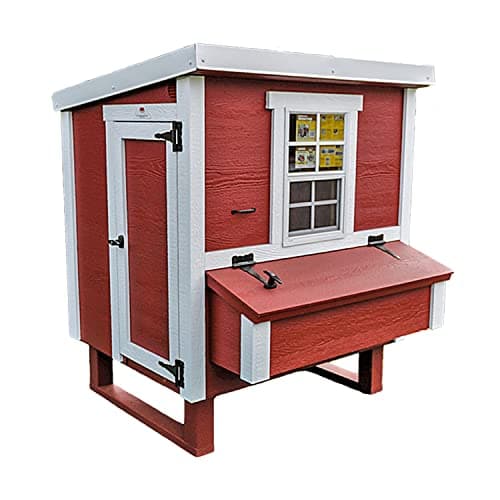
Two screened windows that open and close, a vent at the upper point of each gable end, and two wooden roosts. That combination is the closest thing on this page to the extension guidance: high openings for the air to enter and warm as it falls, adjustable openings so you can run them nearly closed in January, and the roost material UMN names specifically. The maker also describes the resin-treated flooring and siding as helping with “the moisture levels that chickens naturally produce,” which is at least a claim aimed at the right problem.
The honest downside: the ceiling’s radiant barrier sheathing is described by the maker as a summer measure to keep the coop cooler, so it is not a winter feature and we have not counted it as one. No published interior floor area, no published roost length, no R-value, no temperature rating. And the fifteen-bird claim gives 2.06 square feet a bird on the exterior footprint — read it as ten birds in summer and three or four on a snowed-in day.
OverEZ Medium — the same airflow, one window fewer
One opening screened window instead of two, the same vent at the upper point of each gable end, the same two wooden roosts and the same resin-treated floor. For a flock of four to six birds this is the more sensible size and it loses nothing structural against the Large.
The honest downside: one adjustable opening gives you less to work with when you are trying to hit “just sufficient” air exchange in a cold snap — you are choosing between one window open and one window shut. The ten-bird claim is 1.83 square feet a bird on the exterior footprint and about two birds under the confinement figure. Same missing numbers as the Large: no interior area, no roost length, no thermal rating.
Omlet Eglu Pro — the only Eglu with published adjustable venting
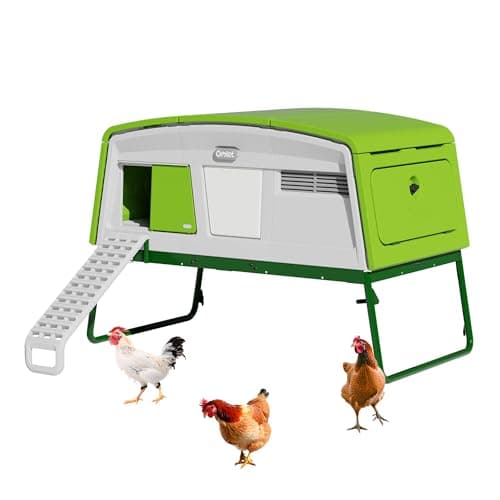
Omlet’s own comparison table lists adjustable ventilation on the Pro and on no other model in the range, and it publishes a real interior floor area of 13.29 square feet, which nearly no coop maker does. It hoses out, which matters more in winter than it sounds — damp bedding is the thing you are fighting, and a plastic shell with removable droppings trays is far easier to keep dry in February than a wooden floor.
The honest downside: the roosting bars are integrated plastic, measuring a published 2.3 by 7.3 cm — about 1 inch by 2.8 inches. UMN’s cold-weather guidance is to use wooden boards rather than metal or plastic, so this is a published preference the coop does not meet. Omlet publishes no insulation value and no temperature rating. And 1.33 square feet a hen at the stated ten birds is the tightest figure here at exactly the moment tightness matters.
Omlet Eglu Cube — checkable everywhere except on air
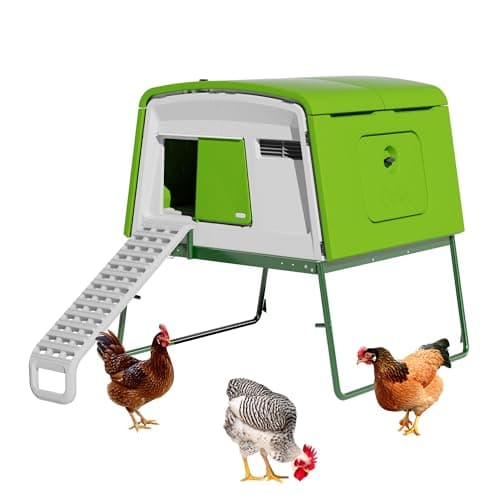
The most transparent coop on this site for dimensions — 34 by 33 inches of published interior, 7.79 square feet — and the easiest of any of these to keep clean and dry, with a slide-out droppings tray and a shell you can wipe down when it is too cold to do anything else properly.
The honest downside: Omlet publishes ventilation as an adjustable feature on the Pro and lists nothing for the Cube, so the one specification this page ranks on is simply absent. Plastic roosting bars again. And 7.79 square feet is about one bird at the published confinement figure, which makes the always-open-run assumption baked into the Eglu design harder to satisfy in exactly the week you most need it satisfied.
Producer’s Pride Sentinel — nothing published to judge
The coop most people can go and look at before buying, with a powder-coated steel frame, three large nest boxes and a published external footprint of 11.70 square feet. As a first coop bought in person it has real advantages, and this site has said so elsewhere.
The honest downside: on this page’s criteria there is nothing to assess. No published ventilation, no published interior floor area, no published roost length, no roost material, no thermal rating. That is not a claim it performs badly in winter — it is that the maker has published nothing that would let anybody say either way, and on a page about a specification that decides frostbite, an absence is a finding.
The heat question, and what the extension actually publishes
This site’s standing position is that adult birds in a dry, ventilated coop generally do not need supplemental heat, and that a heated coop becomes a dependency the night the power fails. That position has not changed. But it would be dishonest to leave out that University of Minnesota Extension publishes a specific threshold: “when temperatures fall below 35 degrees Fahrenheit, provide supplemental heat at the height of the nest boxes or lower rung of the roost,” with radiant sources recommended over heat lamps where possible.
Both things can be true, and the detail that reconciles them is placement rather than existence. UMN is describing heat low down, near the birds, from a radiant source — not a warmed coop. That is the same argument this site makes for plates over lamps in the brooder: warm the bird, not the air. If you do decide to heat, the coop heater page has the published wattages and the running-cost arithmetic, and winter care puts it in order against everything cheaper that works better.
One figure worth holding onto from the same UMN page: most poultry maintain body temperature when the environment is between 60 and 75 F, and a chicken’s own body temperature averages 106 F. A hen is carrying a great deal of insulation already. What she cannot do is dry herself out.
What to add to whichever coop you already have
Most readers are not buying a new coop for winter, and the honest answer is that they probably should not. Three additions do more than a new building would.
Deep bedding, stirred. UMN publishes 4 to 6 inches of straw or shavings with periodic stirring and a deep clean in spring. The bedding comparison ranks materials on moisture absorption and ammonia rather than on how they look.
Water that does not freeze. This is the one that actually threatens a flock: a hen that cannot drink stops laying within about a day. Heated waterers publish cold ratings from 10 F down to -20 F depending on the unit.
A high opening you can leave open, and a blocked draft at roost height. That is the whole of the ventilation argument in one sentence, it costs nothing, and it is more effective than anything you can buy. The frostbite article on poultry.extension.org notes that frostbite is most likely “during the nighttime hours in a cold, poorly ventilated coop with damp bedding,” and that condensation is the sign your ventilation is not keeping up. Go out on a cold morning and look at the inside of the roof.
Heads up: some links on this page are affiliate links. If you buy through one we may earn a commission at no extra cost to you. It never changes a ranking, and we take no payment for placement. The full version.
The short answer
The short list
Ranked on the published rubric. Every row jumps to that product's full write-up below; the button goes straight to Amazon.
#
Pick
Best for
Key spec
Score
Price
1
Score7.3
Our pick
OverEZ
Large Chicken Coop
The same shed at 74 by 60 inches with five nest boxes — stated for fifteen chickens, and the only coop here whose published footprint gets within reach of the extension figure at a real backyard flock size.
A pre-assembled wooden shed with a man door, three nest boxes and two roosts, stated for ten chickens on a published external footprint of 18.3 square feet — which is the number to argue with.
The large plastic coop, and the only model in Omlet's own comparison table that lists adjustable ventilation — which is the spec that matters most in a coop you cannot see inside on a January night.
A plastic coop that hoses out, with published interior dimensions you can actually check — and once you check them, a six-hen claim that only works because the run is permanently attached.
A steel-framed wooden coop with three nest boxes and a published external footprint — and no published interior floor area or roost length, which is the pair of numbers the six-chicken claim rests on.
#ad No live price feed on this build yet, so every button reads “check price” rather than showing a figure we cannot stand behind. Scores are our own published rubric, not customer ratings.
Score7.3no photo yet
#1 · Eight to ten birds, honestly
OverEZ Large Chicken Coop
The same shed at 74 by 60 inches with five nest boxes — stated for fifteen chickens, and the only coop here whose published footprint gets within reach of the extension figure at a real backyard flock size.
Who it is for. Somebody committed to eight to ten birds who wants a walk-in wooden coop, and who reads the fifteen-bird figure as ten.
Published specifications
Stated capacity
Houses up to 15 chickens
Exterior dimensions
74 in L x 60 in W x 72-1/2 in H, including the nesting box
Exterior footprint
30.83 sq ft, computed from the published 74 in x 60 in
Exterior footprint per hen at stated capacity
2.06 sq ft, computed from 30.83 sq ft divided by 15 hens
Exterior footprint per hen at 10 birds
3.08 sq ft, computed from 30.83 sq ft divided by 10 hens
Interior henhouse floor area
Not published by the maker
Nest boxes
5, with lockable lid
Roosts
2; length not published
Ventilation
2 screened windows that open and close; 2 vents, at the upper point of each gable end
Ceiling
Radiant barrier sheathing, which the maker describes as a summer heat measure
Man door
20-3/8 in W x 43 in H
Materials
Wood; flooring and siding have a treated resin, which the maker describes as helping with the moisture levels chickens naturally produce
Assembly
Assembles in under 60 minutes with a screw gun
Weight and warranty
Not published
Source: OverEZ Chicken Coop, Large Chicken Coop product page (overezchickencoop.com), retrieved 2026-09-06. Footprint figures computed from the published exterior dimensions.
Rubric — 7.3 / 10
Capacity honesty6/10 · weight 26%
Documentation6/10 · weight 24%
Build and weather8/10 · weight 20%
Running cost9/10 · weight 15%
Daily use9/10 · weight 15%
What it gets right
At ten birds rather than the stated fifteen, the published exterior footprint works out at 3.08 sq ft a hen — the only coop on this site that reaches the bottom of the published extension range at a plausible backyard flock size
Five nest boxes covers twenty to twenty-five hens at the published one-per-four-to-five ratio, so you will never be short
A 20-inch by 43-inch man door is the largest OverEZ publishes, and the 6-foot ridge means there is room to work once you are through it — though 43 inches is a stoop, not a walk-in
Resin-treated flooring and siding, and panels that arrive pre-assembled
What it costs you
The fifteen-chicken claim gives 2.06 sq ft a bird on the EXTERIOR footprint, before walls and the nest box bump-out are subtracted — below the 3 to 4 sq ft per hen poultry.extension.org publishes
No published interior floor area, no published roost length, no published weight and no published warranty term
This is a building, not a coop you move. A 74 by 60 inch footprint needs a prepared, level base and probably a check of your local setback rules
Comfortably the most expensive way to house ten birds covered on this site
Skip it if. You have four or six birds. This is roughly twice the coop you need and it will not be moved once it is up.
#ad No live price feed yet, so no number is shown rather than a stale one. How this is funded.
#2 · Standing up inside it
OverEZ Medium Chicken Coop
A pre-assembled wooden shed with a man door, three nest boxes and two roosts, stated for ten chickens on a published external footprint of 18.3 square feet — which is the number to argue with.
Who it is for. Somebody with six to eight birds who wants a coop they can walk into, and who is prepared to treat the stated capacity as a ceiling rather than a target.
Published specifications
Stated capacity
Houses up to 10 chickens
Exterior dimensions
50-1/4 in L x 52-1/2 in W x 62-1/4 in H, including the nesting box
Exterior footprint
18.32 sq ft, computed from the published 50.25 in x 52.5 in
Exterior footprint per hen at stated capacity
1.83 sq ft, computed from 18.32 sq ft divided by 10 hens
Interior henhouse floor area
Not published by the maker
Nest boxes
3, with lockable lid
Roosts
2; length not published
Ventilation
1 screened window that opens and closes; 2 vents, at the upper point of each gable end
Man door
17 in W x 38 in H, lockable
Chicken door
12.5 in H x 11 in W, lockable, with a treated wood ramp
Materials
Wood; flooring and siding have a treated resin for moisture resistance
Assembly
Assembles in under 60 minutes with a screw gun; panels arrive pre-painted and pre-assembled
Origin
Made in the USA
Source: OverEZ Chicken Coop, Medium Chicken Coop product page (overezchickencoop.com), retrieved 2026-09-06. Footprint figures computed from the published exterior dimensions.
Rubric — 6.8 / 10
Capacity honesty4/10 · weight 26%
Documentation6/10 · weight 24%
Build and weather8/10 · weight 20%
Running cost9/10 · weight 15%
Daily use9/10 · weight 15%
What it gets right
Published gable vents at both ends plus an opening screened window, which is the ventilation disclosure almost no coop maker provides and the one that decides winter frostbite
A 17 by 38 inch man door is small for a person, but it is still full-body access rather than a hatch, so cleaning happens from the doorway rather than on your knees
Three nest boxes covers twelve to fifteen birds at the one-per-four-to-five figure University of Maryland Extension publishes, so the boxes are not the limiting factor
Pre-assembled panels and a stated under-an-hour build, on a coop this size, is a genuine difference from flat-pack
What it costs you
The ten-chicken claim does not survive the published numbers. 18.32 sq ft is the EXTERIOR footprint including the nest box bump-out, so interior floor is less — and even the exterior figure is 1.83 sq ft a bird against the 3 to 4 sq ft poultry.extension.org publishes for laying hens indoors
The maker publishes no interior floor area and no roost length, so neither the bird count nor the perch space can actually be checked
Wood and resin-treated siding need annual attention that a plastic coop does not
No published weight, and no published warranty terms beyond a general quality guarantee
Skip it if. You are taking the ten-bird figure at face value. Read it as six, or as ten only with a permanently open run, and the coop makes sense; read it as ten shut-in birds and it does not.
#ad No live price feed yet, so no number is shown rather than a stale one. How this is funded.
#3 · The only one here with adjustable ventilation
Omlet Eglu Pro
The large plastic coop, and the only model in Omlet's own comparison table that lists adjustable ventilation — which is the spec that matters most in a coop you cannot see inside on a January night.
Who it is for. Somebody committed to a larger flock long-term who wants adjustable ventilation and does not want to build.
Published specifications
Stated capacity
10 large hens or 15 small hens
Interior dimensions
H 1 ft 9 in x W 4 ft 10 in x D 2 ft 9 in
Interior floor area
13.29 sq ft, computed from the published 58 in x 33 in footprint
Floor area per hen at stated capacity
1.33 sq ft, computed from 13.29 sq ft divided by 10 hens
Ventilation
Adjustable (the only Eglu model listed with this)
Droppings trays
Two removable
Runs
Detachable
Source: Omlet, Eglu chicken coop comparison table (omlet.us/misc/eglu_comparison), retrieved 2026-09-01. Floor-area figures computed from those published dimensions.
Rubric — 8.0 / 10
Capacity honesty6/10 · weight 26%
Documentation9/10 · weight 24%
Build and weather8/10 · weight 20%
Running cost9/10 · weight 15%
Daily use9/10 · weight 15%
What it gets right
Adjustable ventilation is a published feature here and on no other model in the range, and ventilation is the thing that prevents winter frostbite
Two droppings trays across a 58 inch span, which keeps the daily clean genuinely quick at ten birds
The largest published interior in the range, so the same arithmetic supports four to five hens rather than two to three
What it costs you
1.33 sq ft per hen at the stated ten-bird capacity — the same shortfall as the rest of the range, just at a larger scale
The most expensive way to house a backyard flock, and the price is not published in a way we can quote
Only sold in green, per Omlet's own comparison table
Skip it if. You are housing four birds. You are paying for a ten-bird shell you will use at half capacity.
#ad No live price feed yet, so no number is shown rather than a stale one. How this is funded.
#4 · Cleaning in ten minutes, not an hour
Omlet Eglu Cube
A plastic coop that hoses out, with published interior dimensions you can actually check — and once you check them, a six-hen claim that only works because the run is permanently attached.
Who it is for. Somebody in a suburban yard with a permanently attached run, who values a coop that cleans in minutes and is prepared to read the six-hen figure as four.
Published specifications
Stated capacity
6 large hens or 10 small hens
Interior dimensions
H 1 ft 7 in x W 2 ft 10 in x D 2 ft 9 in
Interior floor area
7.79 sq ft, computed from the published 34 in x 33 in footprint
Floor area per hen at stated capacity
1.30 sq ft, computed from 7.79 sq ft divided by 6 hens
Nest box
Integrated; accommodates up to 3 hens laying at a time
Roosting bars
Integrated into the floor; bars measure 2.3 x 7.3 cm (about 1 in x 2.8 in)
Droppings tray
One removable slide-out tray
Runs
Detachable
Source: Omlet, Eglu chicken coop comparison table (omlet.us/misc/eglu_comparison), retrieved 2026-09-01. Floor-area figures computed from those published dimensions.
Rubric — 7.9 / 10
Capacity honesty5/10 · weight 26%
Documentation9/10 · weight 24%
Build and weather8/10 · weight 20%
Running cost9/10 · weight 15%
Daily use10/10 · weight 15%
What it gets right
Omlet publishes interior dimensions, which most coop makers do not, so the capacity claim can be checked rather than trusted
A wipe-clean plastic shell with a slide-out droppings tray, which changes coop cleaning from a weekend job to a ten-minute one
Integrated roosting bars and nest box, so there is nothing to build and nothing to buy separately
Detachable runs mean the coop is not locked to one footprint
What it costs you
1.30 sq ft of interior floor per hen at the stated six-bird capacity, against the 3 to 4 sq ft per hen that poultry.extension.org publishes for laying hens indoors
That gap only closes if the attached run is genuinely always open — a Cube used as a lockable overnight coop in a snowbound week is badly overstocked
Omlet publishes no insulation value and no temperature rating, so cold-climate performance is a claim you cannot check
Skip it if. Your birds will be shut in for whole days in winter, or you cannot commit to leaving the run open. The interior arithmetic does not support six hens under confinement.
#ad No live price feed yet, so no number is shown rather than a stale one. How this is funded.
Score5.7no photo yet
#5 · A first coop from a farm store shelf
Producer's Pride Sentinel Chicken Coop
A steel-framed wooden coop with three nest boxes and a published external footprint — and no published interior floor area or roost length, which is the pair of numbers the six-chicken claim rests on.
Who it is for. A first-time keeper who wants a conventional wooden coop from a store they can drive to, and who plans on three or four birds rather than six.
Published specifications
Stated capacity
Up to 6 chickens
External dimensions
41.74 in L x 40.35 in W x 48.23 in H
External footprint
11.70 sq ft, computed from the published 41.74 in x 40.35 in
Nest boxes
3 large nest boxes
Roost
Extended roosting bar; length not published
Interior henhouse floor area
Not published by the maker
Frame
Powder-coat steel frame with wooden panels
Roof
Asphalt
Door opening
12 in H x 12 in W
Weight
170 lb
Source: Producer's Pride Sentinel Chicken Coop product listing at Tractor Supply, retrieved 2026-09-01. Footprint computed from the published external dimensions.
Rubric — 5.7 / 10
Capacity honesty4/10 · weight 26%
Documentation4/10 · weight 24%
Build and weather7/10 · weight 20%
Running cost8/10 · weight 15%
Daily use7/10 · weight 15%
What it gets right
A steel frame rather than staples and thin ply, which is a genuine difference from the cheapest flat-pack coops
Three nest boxes is generous — University of Maryland Extension publishes one nest per four to five birds, so three covers twelve
Slide-out tray and a solid wood ramp are both published features
You can look at it in a store before buying, which is worth something on a 170 lb flat-pack
What it costs you
The maker publishes no interior floor area and no roost-bar length, so the six-chicken claim cannot be checked against the 6 to 10 inches of perch per bird that University of Maryland Extension publishes
11.70 sq ft is the whole external footprint including the run underneath, not henhouse floor — treat it as an upper bound and nothing more
Asphalt roof and wooden panels need annual attention that plastic coops do not
170 lb of flat pack, and assembly is required
Skip it if. You want to verify capacity before you buy. Nothing published here lets you. If that matters, buy a coop whose maker prints interior dimensions.
#ad No live price feed yet, so no number is shown rather than a stale one. How this is funded.
FAQ
Questions people actually ask
+What is the best chicken coop for winter?
The one that publishes how its air moves. On this page that is the OverEZ Large: two screened windows that open and close, a vent at the upper point of each gable end, and wooden roosts, which is what University of Minnesota Extension publishes for cold weather. No coop here publishes an R-value or a temperature rating, so insulation claims cannot be compared at all.
+Do chicken coops need ventilation in winter?
Yes, and closing them up is the most common winter mistake. Poultry extension guidance is that ventilation maintains oxygen while removing carbon dioxide, moisture, dust and odors, and that in winter the amount of fresh air should be just sufficient for adequate air exchange. Moisture that cannot leave condenses on combs and wattles, and that is what causes frostbite.
+Should a winter chicken coop be insulated?
Insulation is much less useful than ventilation and no coop covered here publishes an R-value or temperature rating for its own. Insulation slows heat loss from a space nothing is heating, so it delays the coop reaching outdoor temperature rather than preventing it, and if it blocks high openings it makes the moisture problem worse.
+How much space do chickens need in a coop in winter?
More than in summer, because the run gets shut. Oregon State University Extension EC 1644 publishes at least 3 square feet per bird where there is run access and 8 to 10 square feet per bird where there is not. At 8 square feet a bird, none of the coops on this page houses anything close to its stated capacity.
+What kind of roost is best for cold weather?
Wooden boards. University of Minnesota Extension publishes 9 inches of roost per chicken in cold weather, starting at least 12 inches above the floor, and specifies wooden boards rather than metal or plastic. That is a published preference the plastic integrated bars on the Omlet Eglu range do not meet.
+Do chickens need a heated coop in winter?
This site's position is that adult birds in a dry, ventilated coop generally do not, and that a heated coop becomes a dependency the night the power fails. University of Minnesota Extension does publish a threshold — below 35 degrees Fahrenheit, supplemental heat at nest box height or the lower rung of the roost, radiant rather than a heat lamp. Note that this describes warming the birds low down, not warming the coop.
Where the numbers came from
Sources
Every figure cited on this page came from one of these documents. If one of them has changed since we read it, the number here is out of date and we would like to know.