Roosting bars, and the figure nobody prints on the box
University of Maryland publishes 6 to 10 inches of perch per bird. Every roosting bar on sale is advertised as suiting 8 to 10 chickens. Almost none of them tells you how many inches of bar you are getting.
Chickens sleep on a perch, and the amount they need is published in inches, not birds. University of Maryland Extension publishes 6 to 10 inches of perch per bird — the figure this site uses on every coop page. Six hens therefore need 36 to 60 inches of bar. Convert any “suits 8-10 chickens” claim into inches before you buy it, because that is the only way to check it.
Converting a bird-count claim into inches
Now compare that with what gets published. The perch on this page states a 55 by 40 inch frame and a capacity of 8 to 10 chickens, and does not publish total linear perch length at all. A tiered frame plainly provides more bar than its longest side, but without the figure the capacity claim cannot be checked — and this site's position throughout is that an unverifiable capacity claim should be treated as marketing.
Flat beats round, and it matters most in winter
A chicken does not grip a perch the way a songbird does. She squats over it, and in cold weather she covers her own toes with her breast feathers. That is the mechanism that keeps toes from freezing, and it only works on a bar wide enough to sit down on.
A narrow round dowel forces the foot to curl around it and leaves the toes exposed at the front and sides. A flat or square-section bar of roughly two by four inches, laid with the wide face up, lets her cover them. This is also why the integrated roosting bars in the Eglu Cube are published as 2.3 by 7.3 cm — about 1 by 2.8 inches — a flat section rather than a dowel. It is one of the few coops that publishes the figure.
The frostbite connection is not ours: the winter care page covers the published guidance, where moisture and ventilation do most of the work and a bird that can cover her feet does the rest.
Height, and the order things go in
Three published constraints fix where a perch goes, and they interact:
Above the nest boxes. Hens roost on the highest thing available. A perch level with or below the nest boxes means they sleep in the boxes, and a nest box slept in is a nest box fouled. The nest box page has the mounting heights.
Below the ventilation. Air needs to move above roost height so moisture leaves without blowing across the birds. The ventilation page is the whole argument, and it is the single most important thing in a winter coop.
With droppings in mind. Birds produce most of their manure overnight, directly under the perch. That is the case for a droppings board, and it is why perch placement decides how unpleasant your bedding management is.
Build or buy
We are going to be blunt, because the arithmetic makes it obvious: a flat length of untreated lumber on two brackets is the same product as most of what is sold as a roosting bar, at a fraction of the cost, and you get to pick the length straight off the extension figure. If you can cut a 2x4 to 60 inches, you have just built the right perch for six hens.
The case for buying is narrower but real: a free-standing frame adds perch space to a run or to a coop you do not want to drill into, it needs no tools, and it is the only option if you are renting or your coop is plastic. That is what the pick below is for — not because it is better than lumber, but because it is the answer when lumber is not an option.
Heads up: some links on this page are affiliate links. If you buy through one we may earn a commission at no extra cost to you. It never changes a ranking, and we take no payment for placement. The full version.
The short answer
The short list
Ranked on the published rubric. Every row jumps to that product's full write-up below; the button goes straight to Amazon.
#
Pick
Best for
Key spec
Score
Price
1
Our pick
PETSFIT
Square Chicken Roosting Perch, 55 x 40 in
Solid fir with a flat, widened bar rather than a dowel, which is the right shape for a chicken's foot — but like everything in this category it is sold by bird count and never publishes the one figure the extension allowance is written in.
A plastic coop that hoses out, with published interior dimensions you can actually check — and once you check them, a six-hen claim that only works because the run is permanently attached.
Half-inch welded mesh in 19 gauge steel — not chicken wire, which keeps chickens in and keeps nothing out, and is the single most expensive mistake a first-time keeper makes.
#adPrices as of September 21, 2026. Scores are our own published rubric, not customer ratings.
#1 · A free-standing perch in a run
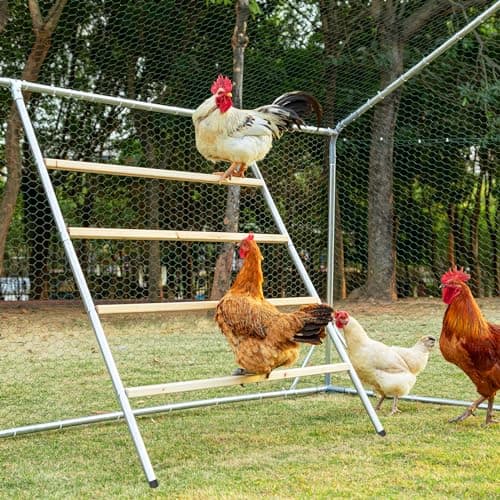
PETSFIT Square Chicken Roosting Perch, 55 x 40 in
Solid fir with a flat, widened bar rather than a dowel, which is the right shape for a chicken's foot — but like everything in this category it is sold by bird count and never publishes the one figure the extension allowance is written in.
Who it is for. Keepers who do not want to build, whose coop came with an inadequate round dowel, or who need extra perch space in a run.
Published specifications
Frame
55 in L x 40 in W
Material
Solid fir wood
Bar shape
Square, widened flat perch rather than a round dowel
A flat, widened bar lets a bird sit down over her own toes, which is what matters in a frost and what a round dowel does badly
Solid fir rather than the plastic-coated wire sold at the same price
Free-standing, so it adds perch space to a run or a coop with no roost without drilling into the structure
Square section resists rotating under a bird, which is a real failure mode on round bars mounted in brackets
What it costs you
Does not publish total linear perch length, which is the only figure the published 6-to-10-inches-per-bird allowance can be checked against — so the 8-to-10-chicken claim is unverifiable
Fir is a soft wood; outdoors and unfinished it will weather and it is not a decade-long purchase
A free-standing frame in a run collects droppings underneath it on ground you then have to manage
Assembly required on a product whose whole appeal is that it saves you building one
Skip it if. You are happy cutting a 2x4. A flat length of lumber on two brackets is the same product for a fraction of the money, and you get to choose the length from the extension figure.
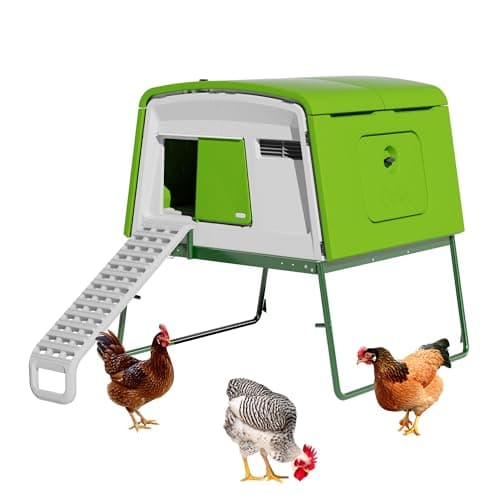
A plastic coop that hoses out, with published interior dimensions you can actually check — and once you check them, a six-hen claim that only works because the run is permanently attached.
Who it is for. Somebody in a suburban yard with a permanently attached run, who values a coop that cleans in minutes and is prepared to read the six-hen figure as four.
Published specifications
Stated capacity
6 large hens or 10 small hens
Interior dimensions
H 1 ft 7 in x W 2 ft 10 in x D 2 ft 9 in
Interior floor area
7.79 sq ft, computed from the published 34 in x 33 in footprint
Floor area per hen at stated capacity
1.30 sq ft, computed from 7.79 sq ft divided by 6 hens
Nest box
Integrated; accommodates up to 3 hens laying at a time
Roosting bars
Integrated into the floor; bars measure 2.3 x 7.3 cm (about 1 in x 2.8 in)
Droppings tray
One removable slide-out tray
Runs
Detachable
Source: Omlet, Eglu chicken coop comparison table (omlet.us/misc/eglu_comparison), retrieved 2026-09-01. Floor-area figures computed from those published dimensions.
Rubric — 7.9 / 10
Capacity honesty5/10 · weight 26%
Documentation9/10 · weight 24%
Build and weather8/10 · weight 20%
Running cost9/10 · weight 15%
Daily use10/10 · weight 15%
What it gets right
Omlet publishes interior dimensions, which most coop makers do not, so the capacity claim can be checked rather than trusted
A wipe-clean plastic shell with a slide-out droppings tray, which changes coop cleaning from a weekend job to a ten-minute one
Integrated roosting bars and nest box, so there is nothing to build and nothing to buy separately
Detachable runs mean the coop is not locked to one footprint
What it costs you
1.30 sq ft of interior floor per hen at the stated six-bird capacity, against the 3 to 4 sq ft per hen that poultry.extension.org publishes for laying hens indoors
That gap only closes if the attached run is genuinely always open — a Cube used as a lockable overnight coop in a snowbound week is badly overstocked
Omlet publishes no insulation value and no temperature rating, so cold-climate performance is a claim you cannot check
Skip it if. Your birds will be shut in for whole days in winter, or you cannot commit to leaving the run open. The interior arithmetic does not support six hens under confinement.
#3 · The only mesh that actually excludes predators
Galvanized hardware cloth 1/2 in mesh, 19 gauge
Half-inch welded mesh in 19 gauge steel — not chicken wire, which keeps chickens in and keeps nothing out, and is the single most expensive mistake a first-time keeper makes.
Who it is for. Every coop and every run, and specifically an 18 to 24 inch skirt laid flat on the ground around the perimeter rather than buried, which stops diggers without trenching.
Published specifications
Mesh size
0.5 in x 0.5 in (12.7 x 12.7 mm)
Gauge
19 gauge steel wire
Finish
Galvanized; galvanized-after-weld (GAW) versions seal the welds too
Common roll sizes
24 in x 25 ft, 48 in x 100 ft, 4 ft x 100 ft
Typical uses
Chicken coops, run walls, vent covers, buried predator aprons
Source: Retailer and manufacturer listings for 19-gauge 1/2 in galvanized hardware cloth (Home Depot, Louis Page, Vevor), retrieved 2026-09-01
Rubric — 8.1 / 10
Capacity honesty9/10 · weight 26%
Documentation6/10 · weight 24%
Build and weather9/10 · weight 20%
Running cost9/10 · weight 15%
Daily use8/10 · weight 15%
What it gets right
Half-inch openings exclude a weasel and a rat; chicken wire's two-inch hexagons exclude neither, and a raccoon can reach straight through them
Welded rather than twisted, so a raccoon cannot work the joints apart the way it can with poultry netting
Galvanized-after-weld dips the finished mesh in zinc so the welds are sealed too, which is where untreated mesh rusts first
The same roll does run walls, window vents and a buried apron, so there is one material to buy
What it costs you
Meaningfully more expensive per square foot than chicken wire, which is exactly why people buy the wrong thing
19 gauge is thin enough to cut with snips, which also means it is thin enough to be cut by something determined over a long night
Cut edges are genuinely sharp and need to be turned under or covered
Retailers list roll sizes rather than a published breaking strength, so predator resistance is a design argument, not a spec sheet
Skip it if. Nothing. If you have a run, this is the mesh, and half-inch is the size. Substituting chicken wire is how flocks are lost.
#ad We have no verified Amazon listing for this one, so no number is shown. How this is funded.
FAQ
Questions people actually ask
+How much roosting bar space does a chicken need?
University of Maryland Extension publishes 6 to 10 inches of perch per bird. Four hens need 24 to 40 inches, six need 36 to 60, and ten need 60 to 100. Use the upper end for heavy breeds or cold winters, because birds crowd in the cold and spread out in heat.
+What shape should a chicken roosting bar be?
Flat or square section, wide face up - roughly a 2x4. A chicken squats over a perch rather than gripping it, and in cold weather she covers her toes with her breast feathers. A narrow round dowel leaves the toes exposed, which is the wrong shape going into a frost.
+How high should a roosting bar be?
Higher than the nest boxes, and below the ventilation. Hens roost on the highest thing in the coop, so a perch level with the boxes means they sleep in the boxes and foul them. Air should move above roost height so moisture leaves the coop without blowing across the birds.
+Do chickens need a roosting bar?
Yes. Roosting off the floor is normal behavior, it keeps birds out of their own droppings overnight, and it is how they settle a pecking order at dusk. A coop with no perch means birds sleeping on the floor or in the nest boxes.
+Should I buy a roosting bar or build one?
Build, if you can fix lumber to the coop - a 2x4 cut to the length the extension figure gives you is the same product most sellers offer with a markup. Buy a free-standing frame when you cannot drill into the coop, when you are renting, or when you need extra perch space in a run.
Where the numbers came from
Sources
Every figure cited on this page came from one of these documents. If one of them has changed since we read it, the number here is out of date and we would like to know.