Omlet Eglu Cube review: the six-hen claim, checked
Omlet publishes interior dimensions, which almost no coop maker does. That honesty is the best thing about the product and the reason this review can be specific: run the arithmetic and the six-hen Cube is a four-hen coop with a very good cleaning story.
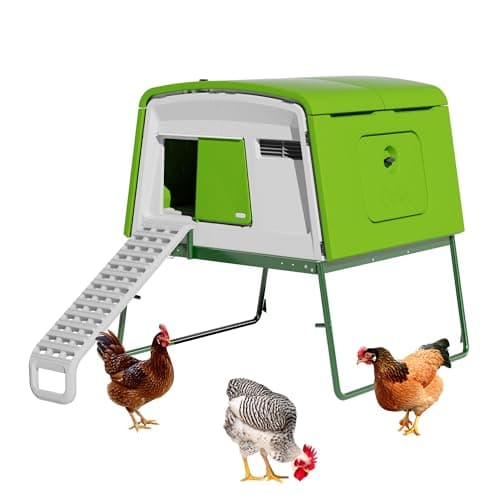
The Eglu Cube is a plastic coop that hoses out in minutes and publishes its interior dimensions — H 1 ft 7 in x W 2 ft 10 in x D 2 ft 9 in, a 34 by 33 inch footprint. That works out at 7.79 square feet of floor, or 1.30 square feet per hen at the stated capacity of six, against the 3 to 4 square feet per hen poultry.extension.org publishes for laying hens indoors. That gap is the whole review: it is defensible if the run is genuinely always open, and indefensible if it is not.
We have not owned one. What follows is Omlet's published figures, checked against the extension allowances this site uses on every coop page, plus the things Omlet does not publish.
The capacity claim, worked
This is not Omlet being uniquely dishonest — it is the standard assumption across the category, and our space-per-chicken page works through why “fits six hens” almost always means “six hens with the run permanently open”. What distinguishes Omlet is that it publishes the numbers that let you catch it. Most makers do not, which is precisely why they cannot be checked.
What you are actually paying for
The Cube sits in a premium price bracket, well above a wooden coop of similar footprint, and the honest case for it is not capacity. It is maintenance. A wipe-clean plastic shell with a slide-out droppings tray turns coop cleaning from a scraping job into a hose-down, and there is no timber for red mite to colonize — which is a genuine advantage that the mites and lice page makes clear is harder to win in a wooden coop.
Judged as “a coop that takes ten minutes a week instead of an hour”, the Cube is excellent and the price makes sense over years. Judged as “a house for six hens”, it is expensive for the floor area you get. Both statements are true and which one matters depends on whether your constraint is time or money.
The fittings, and one figure worth borrowing
Omlet publishes its integrated roosting bars as 2.3 by 7.3 cm — about 1 by 2.8 inches. That is a flat, wide bar rather than a round dowel, and it is the right shape: a hen squats over a perch and covers her toes with her breast feathers, which she can only do on something flat. The roosting bar page covers why that matters in a frost, and it is notable that almost no coop maker publishes the dimension at all.
The nest box is integrated and Omlet states it accommodates up to three hens laying at a time. Set against University of Maryland Extension's one nest per four to five birds, that is comfortably adequate for the realistic four-bird reading and still fine at six.
What Omlet does not publish
Any insulation value or temperature rating. The twin-wall plastic is marketed on insulation, and there is no figure to check that against. For a coop sold into cold climates at this price, that is the gap we would most like closed.
Ventilation area. Our ventilation page argues that airflow above roost height decides winter health more than insulation does, and no maker in this category publishes vent area.
Total linear roost length. The bar cross-section is published; how many inches of it there are is not, so the 6-to-10-inches-per-bird check cannot be run.
What plastic is actually like to live with
The durability argument cuts both ways and it is worth being specific rather than loyal. In favor: there is no timber to rot at the base, nothing to repaint, no felt roof to replace, and no seams for red mite to breed in. A wooden coop at the same price is usually approaching the end of its useful life at the point a plastic one has barely started.
Against: plastic panels are not repairable in the way a timber panel is. A cracked board on a wooden coop is a twenty-minute job with a saw; a cracked Eglu panel is a part order. The Cube also depends on its fittings — the droppings tray, the door runners, the run clips — and those are the components that wear. Omlet sells replacements, which is a genuine mark in its favor, but it does make the coop a product you stay in a relationship with rather than a shed you own outright.
The secondhand market is the strongest evidence for the design. Eglus hold value unusually well for garden equipment, which is what you would expect of a product whose main failure mode is cosmetic. If the price is the obstacle, a used Cube is a far more sensible purchase than a new budget coop — and unlike a used wooden coop, a used plastic one can be disinfected properly before your birds go anywhere near it. That matters more than it sounds: buying somebody else's timber coop is how mites arrive.
Cube, Go or Pro
Omlet's own comparison table is the most useful thing on its website, because all three coops share the cleaning story and differ only in capacity and price. Run the same arithmetic across the range and the decision gets simple.
Omlet published capacities, with this site's reading at the extension allowance.
Coop
Omlet's stated capacity
Our reading, confined
Eglu Go
Up to 3 large hens
Two, or a broody and chicks
Eglu Cube
6 large hens or 10 small
Four, comfortably
Eglu Pro
Up to 10 large hens or 15 bantams
Six to seven
The practical advice that falls out of it: buy the Cube if you want four hens and a coop you can clean in minutes. Buy the Go only for a very small flock or as a second coop for a broody. Buy the Pro if you genuinely want six or more birds housed to the published allowance and the budget survives it — it is a large step up in price.
Is it worth it?
On a pure cost-per-square-foot basis, no: a wooden coop or a walk-in build gives more floor for less money, and the walk-in page covers that end of the market. On maintenance, mite resistance and how long the thing will still be serviceable, the Cube is the strongest product this site covers in the coop category, and Omlet's willingness to publish checkable dimensions is worth something in a market where most makers publish nothing.
The recommendation is therefore conditional and specific: it is worth it for a keeper with four hens, a permanently attached run, a suburban garden and limited time. It is not worth it as a way to house six hens cheaply, because it does not do that — and the maker's own published figures are what tell you so.
Heads up: some links on this page are affiliate links. If you buy through one we may earn a commission at no extra cost to you. It never changes a ranking, and we take no payment for placement. The full version.
The picks
The Cube, and the two sizes either side of it
Same plastic, same cleaning story, three capacities - and the published interior figures that decide which one your flock actually fits in.
Omlet
Eglu Cube
7.8 sq ft interior
A plastic coop that hoses out, with published interior dimensions you can actually check — and once you check them, a six-hen claim that only works because the run is permanently attached.
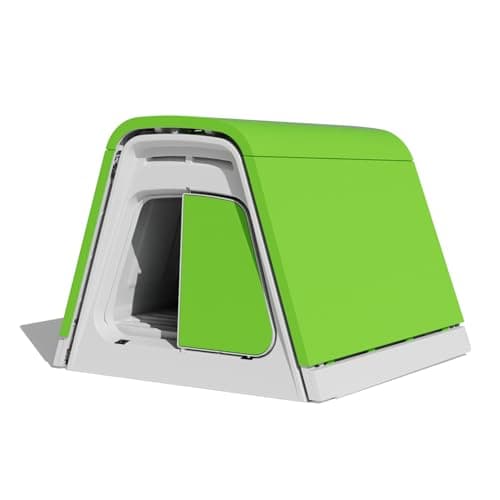
The small plastic coop, published at three large hens across 4.3 square feet of interior — the same 1.4 square feet a bird as the rest of the range, and the same caveat.
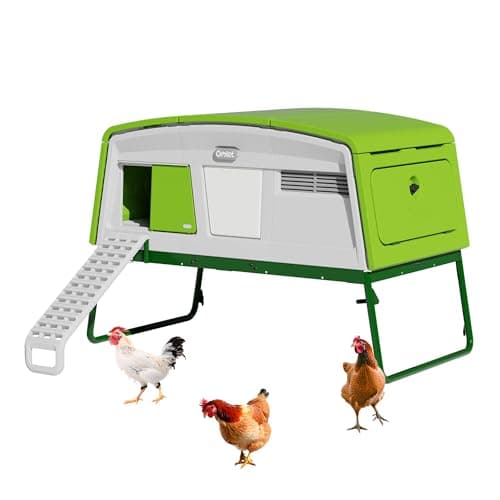
The large plastic coop, and the only model in Omlet's own comparison table that lists adjustable ventilation — which is the spec that matters most in a coop you cannot see inside on a January night.
Conditionally. What the premium buys is maintenance - a plastic shell that hoses out with a slide-out droppings tray, and no timber for red mite to live in. It does not buy floor area: at Omlet's published interior of 7.79 sq ft, six hens works out at 1.30 sq ft each against a published allowance of 3 to 4. It is worth it for four hens and limited time; it is poor value as a way to house six.
+How many chickens fit in an Eglu Cube?
Omlet states 6 large hens or 10 small. On its own published interior footprint of 34 by 33 inches - 7.79 sq ft - six hens is 1.30 sq ft each, about 43% of the 3 sq ft per hen poultry.extension.org publishes for indoors. The stated figure assumes the attached run is always open. If birds are ever shut in, treat it as a four-hen coop.
+Is the Eglu Cube good in winter?
Omlet markets the twin-wall plastic on insulation but publishes no insulation value and no temperature rating, so that claim cannot be checked. The bigger winter issue is that confinement is exactly when the capacity arithmetic bites - a snowed-in week puts six hens in 7.79 square feet. Ventilation above roost height matters more than insulation either way.
+Eglu Cube or Eglu Go?
The Go is stated for up to 3 large hens, which reads as two under the published allowance - it suits a very small flock or works as a second coop for a broody hen. The Cube is the four-hen answer. If you want six or more birds housed to the published allowance, neither is right and the Pro is the one to price up.
+Does the Eglu Cube stop red mite?
Plastic gives mites far fewer places to live than timber, which is a real advantage of the design. It is not immunity - mites live on the birds and in any crevice - so the usual confirm-then-treat routine still applies.
Where the numbers came from
Sources
Every figure cited on this page came from one of these documents. If one of them has changed since we read it, the number here is out of date and we would like to know.
6 to 10 inches of perch per bird is the published figure. How to convert a bird-count claim into inches, why flat beats round, and how high to mount it.