Coops for eight chickens, where the flat-pack market runs out
At eight birds the constraint quietly changes. Floor area stops being the thing that fails first and roost bar takes over — and roost bar is the number almost nobody publishes.
Eight hens need 24 to 32 square feet of coop floor, 80 square feet of run, 48 to 80 inches of roost bar and two nest boxes. The OverEZ Large publishes a 30.83 square foot exterior footprint, which is 3.85 square feet a bird at eight — the only coop on this site with genuine margin at this flock size. The Omlet Eglu Pro, the largest coop that publishes a real interior figure, gives 1.66 square feet a bird at eight.
Somewhere between six and eight birds the backyard coop market stops having products for you. The flat-pack coops from farm stores top out at a stated six, the plastic range tops out at a stated ten that does not survive division, and what is left is sheds. That is the real finding of this page, and it is better to meet it before ordering birds than after.
The target for eight birds
What eight hens need, at published extension figures.
Requirement
Eight birds
Published by
Coop floor, minimum
24 sq ft (at 3 sq ft/hen)
poultry.extension.org
Coop floor, comfortable
32 sq ft (at 4 sq ft/hen)
poultry.extension.org
Run
80 sq ft (at 10 sq ft/hen)
poultry.extension.org
Roost bar
48 to 80 in (at 6 to 10 in/bird)
University of Maryland Extension
Nest boxes
2 (at one per 4 to 5 birds)
University of Maryland Extension
Twenty-four square feet is a coop four feet by six. Eighty square feet of run is eight by ten. Together that is a structure occupying a meaningful part of a suburban yard, and it is worth measuring the space with a tape before deciding on eight birds rather than six.
Why roost length starts failing before floor area
This is the thing that changes at eight and it is worth working through, because it explains why coops that look big enough are not.
Floor area scales with two dimensions. Roost bar scales with one. Make a coop 20 percent deeper and you gain 20 percent more floor and no extra roost, because the bar runs across the width. So as flock size rises, the floor requirement is met by a coop that is still nowhere near having enough bar.
Which is why the roost count matters at eight birds in a way it does not at four. Both OverEZ coops publish two roosts. Omlet publishes integrated roosting bars on the Eglu range and gives their cross-section — 2.3 by 7.3 cm, about 1 inch by 2.8 inches — but not their length. The Producer’s Pride Sentinel publishes an “extended roosting bar” with no figure at all, which is why it does not appear in this roundup: at eight birds an unpublished roost length is not a minor gap.
What the coops give eight birds
Published area divided by eight birds. Omlet publishes interior floor; OverEZ publishes exterior footprints only.
Coop
Published area
Sq ft per hen at 8
Measure
OverEZ Large
30.83 sq ft
3.85
External footprint
OverEZ Medium
18.32 sq ft
2.29
External footprint
Omlet Eglu Pro
13.29 sq ft
1.66
Interior floor
OverEZ Large — the first coop with real margin
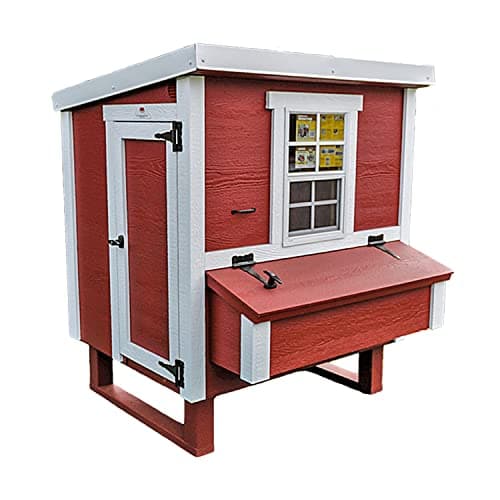
Seventy-four by sixty inches of exterior, stated for fifteen chickens. At eight birds that works out to 3.85 square feet each of exterior footprint, which sits above the published 3 to 4 square feet per hen range even before you argue about walls. Five lockable nest boxes, two roosts, a 20-inch by 43-inch man door and a roughly six-foot ridge. Note the door figure: 43 inches is 3 ft 7 in, so you stoop through it rather than walk through it, and then there is genuine room to work inside. Walk-in coops and the door height nobody checks goes through what that actually means for cleaning.
The honest downside: the fifteen-bird claim it is sold on gives 2.06 square feet a bird and does not hold. No published interior floor area, no published roost length, no published weight and no published warranty term — so the margin above is inferred from an exterior measurement rather than confirmed from an interior one. And this is a building: it needs a level prepared base, and it is worth checking your local setback rules before siting a 74 by 60 inch structure.
Omlet Eglu Pro — the checkable one, and it does not clear it
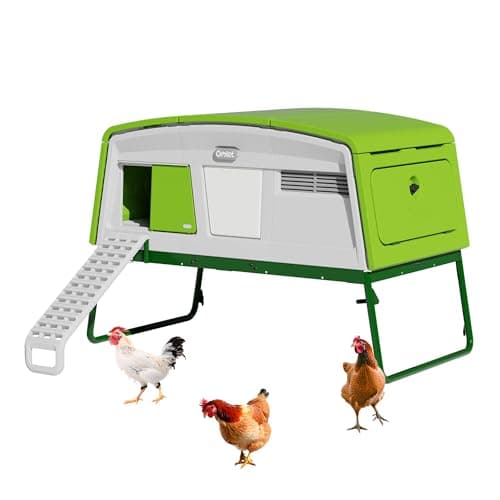
The Eglu Pro is the only coop in this comparison that publishes an interior floor area you can hold the maker to: 58 by 33 inches, 13.29 square feet. It is also the only model in Omlet’s own published range listed with adjustable ventilation, which is the specification that matters most in a coop you cannot see inside on a January night, and it has two removable droppings trays across that 58-inch span.
The honest downside: 1.66 square feet a bird at eight, against a published minimum of three. Omlet designs around a permanently open attached run and the coop is a place to sleep rather than to live, which is a coherent position — but it means eight birds shut in for a snowbound week are badly overstocked, and it is the most expensive way to reach that number. No published insulation value or temperature rating either.
OverEZ Medium — the one to stop at six
Fifty by fifty-two inches of exterior, stated for ten chickens, three nest boxes, two roosts, a screened opening window and two vents at each gable end. That published ventilation detail is unusual and genuinely useful — most coop makers publish nothing at all about airflow, and ventilation rather than insulation is what prevents winter frostbite.
The honest downside: 2.29 square feet a bird of exterior footprint at eight, which is below the published minimum before any deduction for walls or the nest box bump-out. It is a good coop for six birds and an optimistic one for eight. The stated ten-bird capacity gives 1.83 and should be read as marketing.
Eighty square feet of run, and why it is the real cost
Eight birds need 80 square feet of run at the published figure. That is an eight-by-ten structure, which is bigger than most people picture, and it has to be roofed or netted if you have hawks — which the predator-proofing page covers, including the federal law that makes overhead cover the only legal answer to a hawk.
Building that in half-inch hardware cloth rather than chicken wire is not optional and it is the single largest materials cost in an eight-bird setup. It is also the one people economize on and then regret, because chicken wire contains chickens and excludes nothing.
The arithmetic worth doing before committing to eight birds is simple: 24 to 32 square feet of coop plus 80 square feet of run is more than 100 square feet of yard, permanently. If that does not fit, six birds is the honest answer and the six-bird page covers it.
Two roosts, and the four-foot ceiling on the fix
The obvious answer to needing 48 to 80 inches of bar in a coop that is only five feet wide is to fit two bars. Both OverEZ coops here publish exactly that. But there is a published constraint on how you arrange them, and it is easy to run into.
University of Maryland Extension publishes that perches should be no higher than 4 feet above the floor. That is a landing-injury figure: a heavy hen coming off a high bar onto a hard floor is a bumblefoot risk. So you cannot simply stack bars vertically up the back wall to accumulate length.
The two arrangements that work are bars at the same height, spaced far enough apart that birds are not sitting over each other, or a shallow ladder with the whole run of it under four feet. The arrangement that does not work is a tall ladder, and the reason is not only the height — chickens compete for the highest bar, so a stepped arrangement concentrates the flock at the top and leaves the lower bars empty while the birds on them get fouled from above.
This is another argument for a walk-in coop at eight birds, and it is a practical one rather than an aesthetic one: a coop you can stand in has room to place two bars side by side at a sensible height. A four-foot-tall flat-pack does not.
Heads up: some links on this page are affiliate links. If you buy through one we may earn a commission at no extra cost to you. It never changes a ranking, and we take no payment for placement. The full version.
The short answer
The short list
Ranked on the published rubric. Every row jumps to that product's full write-up below; the button goes straight to Amazon.
#
Pick
Best for
Key spec
Score
Price
1
Score7.3
Our pick
OverEZ
Large Chicken Coop
The same shed at 74 by 60 inches with five nest boxes — stated for fifteen chickens, and the only coop here whose published footprint gets within reach of the extension figure at a real backyard flock size.
The large plastic coop, and the only model in Omlet's own comparison table that lists adjustable ventilation — which is the spec that matters most in a coop you cannot see inside on a January night.
A pre-assembled wooden shed with a man door, three nest boxes and two roosts, stated for ten chickens on a published external footprint of 18.3 square feet — which is the number to argue with.
#ad No live price feed on this build yet, so every button reads “check price” rather than showing a figure we cannot stand behind. Scores are our own published rubric, not customer ratings.
Score7.3no photo yet
#1 · Eight to ten birds, honestly
OverEZ Large Chicken Coop
The same shed at 74 by 60 inches with five nest boxes — stated for fifteen chickens, and the only coop here whose published footprint gets within reach of the extension figure at a real backyard flock size.
Who it is for. Somebody committed to eight to ten birds who wants a walk-in wooden coop, and who reads the fifteen-bird figure as ten.
Published specifications
Stated capacity
Houses up to 15 chickens
Exterior dimensions
74 in L x 60 in W x 72-1/2 in H, including the nesting box
Exterior footprint
30.83 sq ft, computed from the published 74 in x 60 in
Exterior footprint per hen at stated capacity
2.06 sq ft, computed from 30.83 sq ft divided by 15 hens
Exterior footprint per hen at 10 birds
3.08 sq ft, computed from 30.83 sq ft divided by 10 hens
Interior henhouse floor area
Not published by the maker
Nest boxes
5, with lockable lid
Roosts
2; length not published
Ventilation
2 screened windows that open and close; 2 vents, at the upper point of each gable end
Ceiling
Radiant barrier sheathing, which the maker describes as a summer heat measure
Man door
20-3/8 in W x 43 in H
Materials
Wood; flooring and siding have a treated resin, which the maker describes as helping with the moisture levels chickens naturally produce
Assembly
Assembles in under 60 minutes with a screw gun
Weight and warranty
Not published
Source: OverEZ Chicken Coop, Large Chicken Coop product page (overezchickencoop.com), retrieved 2026-09-06. Footprint figures computed from the published exterior dimensions.
Rubric — 7.3 / 10
Capacity honesty6/10 · weight 26%
Documentation6/10 · weight 24%
Build and weather8/10 · weight 20%
Running cost9/10 · weight 15%
Daily use9/10 · weight 15%
What it gets right
At ten birds rather than the stated fifteen, the published exterior footprint works out at 3.08 sq ft a hen — the only coop on this site that reaches the bottom of the published extension range at a plausible backyard flock size
Five nest boxes covers twenty to twenty-five hens at the published one-per-four-to-five ratio, so you will never be short
A 20-inch by 43-inch man door is the largest OverEZ publishes, and the 6-foot ridge means there is room to work once you are through it — though 43 inches is a stoop, not a walk-in
Resin-treated flooring and siding, and panels that arrive pre-assembled
What it costs you
The fifteen-chicken claim gives 2.06 sq ft a bird on the EXTERIOR footprint, before walls and the nest box bump-out are subtracted — below the 3 to 4 sq ft per hen poultry.extension.org publishes
No published interior floor area, no published roost length, no published weight and no published warranty term
This is a building, not a coop you move. A 74 by 60 inch footprint needs a prepared, level base and probably a check of your local setback rules
Comfortably the most expensive way to house ten birds covered on this site
Skip it if. You have four or six birds. This is roughly twice the coop you need and it will not be moved once it is up.
#ad No live price feed yet, so no number is shown rather than a stale one. How this is funded.
#2 · The only one here with adjustable ventilation
Omlet Eglu Pro
The large plastic coop, and the only model in Omlet's own comparison table that lists adjustable ventilation — which is the spec that matters most in a coop you cannot see inside on a January night.
Who it is for. Somebody committed to a larger flock long-term who wants adjustable ventilation and does not want to build.
Published specifications
Stated capacity
10 large hens or 15 small hens
Interior dimensions
H 1 ft 9 in x W 4 ft 10 in x D 2 ft 9 in
Interior floor area
13.29 sq ft, computed from the published 58 in x 33 in footprint
Floor area per hen at stated capacity
1.33 sq ft, computed from 13.29 sq ft divided by 10 hens
Ventilation
Adjustable (the only Eglu model listed with this)
Droppings trays
Two removable
Runs
Detachable
Source: Omlet, Eglu chicken coop comparison table (omlet.us/misc/eglu_comparison), retrieved 2026-09-01. Floor-area figures computed from those published dimensions.
Rubric — 8.0 / 10
Capacity honesty6/10 · weight 26%
Documentation9/10 · weight 24%
Build and weather8/10 · weight 20%
Running cost9/10 · weight 15%
Daily use9/10 · weight 15%
What it gets right
Adjustable ventilation is a published feature here and on no other model in the range, and ventilation is the thing that prevents winter frostbite
Two droppings trays across a 58 inch span, which keeps the daily clean genuinely quick at ten birds
The largest published interior in the range, so the same arithmetic supports four to five hens rather than two to three
What it costs you
1.33 sq ft per hen at the stated ten-bird capacity — the same shortfall as the rest of the range, just at a larger scale
The most expensive way to house a backyard flock, and the price is not published in a way we can quote
Only sold in green, per Omlet's own comparison table
Skip it if. You are housing four birds. You are paying for a ten-bird shell you will use at half capacity.
#ad No live price feed yet, so no number is shown rather than a stale one. How this is funded.
#3 · Standing up inside it
OverEZ Medium Chicken Coop
A pre-assembled wooden shed with a man door, three nest boxes and two roosts, stated for ten chickens on a published external footprint of 18.3 square feet — which is the number to argue with.
Who it is for. Somebody with six to eight birds who wants a coop they can walk into, and who is prepared to treat the stated capacity as a ceiling rather than a target.
Published specifications
Stated capacity
Houses up to 10 chickens
Exterior dimensions
50-1/4 in L x 52-1/2 in W x 62-1/4 in H, including the nesting box
Exterior footprint
18.32 sq ft, computed from the published 50.25 in x 52.5 in
Exterior footprint per hen at stated capacity
1.83 sq ft, computed from 18.32 sq ft divided by 10 hens
Interior henhouse floor area
Not published by the maker
Nest boxes
3, with lockable lid
Roosts
2; length not published
Ventilation
1 screened window that opens and closes; 2 vents, at the upper point of each gable end
Man door
17 in W x 38 in H, lockable
Chicken door
12.5 in H x 11 in W, lockable, with a treated wood ramp
Materials
Wood; flooring and siding have a treated resin for moisture resistance
Assembly
Assembles in under 60 minutes with a screw gun; panels arrive pre-painted and pre-assembled
Origin
Made in the USA
Source: OverEZ Chicken Coop, Medium Chicken Coop product page (overezchickencoop.com), retrieved 2026-09-06. Footprint figures computed from the published exterior dimensions.
Rubric — 6.8 / 10
Capacity honesty4/10 · weight 26%
Documentation6/10 · weight 24%
Build and weather8/10 · weight 20%
Running cost9/10 · weight 15%
Daily use9/10 · weight 15%
What it gets right
Published gable vents at both ends plus an opening screened window, which is the ventilation disclosure almost no coop maker provides and the one that decides winter frostbite
A 17 by 38 inch man door is small for a person, but it is still full-body access rather than a hatch, so cleaning happens from the doorway rather than on your knees
Three nest boxes covers twelve to fifteen birds at the one-per-four-to-five figure University of Maryland Extension publishes, so the boxes are not the limiting factor
Pre-assembled panels and a stated under-an-hour build, on a coop this size, is a genuine difference from flat-pack
What it costs you
The ten-chicken claim does not survive the published numbers. 18.32 sq ft is the EXTERIOR footprint including the nest box bump-out, so interior floor is less — and even the exterior figure is 1.83 sq ft a bird against the 3 to 4 sq ft poultry.extension.org publishes for laying hens indoors
The maker publishes no interior floor area and no roost length, so neither the bird count nor the perch space can actually be checked
Wood and resin-treated siding need annual attention that a plastic coop does not
No published weight, and no published warranty terms beyond a general quality guarantee
Skip it if. You are taking the ten-bird figure at face value. Read it as six, or as ten only with a permanently open run, and the coop makes sense; read it as ten shut-in birds and it does not.
#ad No live price feed yet, so no number is shown rather than a stale one. How this is funded.
FAQ
Questions people actually ask
+How big should a coop be for 8 chickens?
24 to 32 square feet of coop floor, at the 3 to 4 square feet per hen published by poultry.extension.org, plus 80 square feet of run at 10 square feet a bird. Twenty-four square feet is a coop about four feet by six; the run is roughly eight by ten.
+How much roost bar do 8 chickens need?
48 to 80 inches, at the 6 to 10 inches per bird University of Maryland Extension publishes. This is the specification that fails first at eight birds, because roost length is set by the coop's width while floor area grows with both dimensions. A single four-foot bar meets only the bare minimum, so two bars or a wider coop is effectively required.
+How many nest boxes for 8 chickens?
Two, at the published one nest per four to five birds. More rarely helps: hens converge on one preferred box and queue for it whatever you provide, so spare boxes end up as storage, and low-mounted boxes get slept in and produce dirty eggs.
+Can 8 chickens live in an Eglu Pro?
Omlet publishes an interior of 58 by 33 inches, which is 13.29 square feet, or 1.66 square feet a hen at eight birds — around half the published extension minimum for laying hens indoors. It works under Omlet's own design assumption of a permanently open attached run, and it does not work for birds shut in through a snowbound week.
+Do I need a walk-in coop for 8 chickens?
Not strictly, but the market pushes you there. Flat-pack coops top out at a stated six birds and the largest plastic coop gives 1.66 square feet a bird at eight, so the products that clear the published space figures at this flock size are sheds you walk into. The practical benefit is cleaning: 24 to 32 square feet is difficult to service through a hatch.
Where the numbers came from
Sources
Every figure cited on this page came from one of these documents. If one of them has changed since we read it, the number here is out of date and we would like to know.