Skip to content
Peep & Pen

Stage 2 — weeks 4 to 8

Coops for four chickens, sized against the published figures

Four is the most common first flock and the most over-served by capacity claims. The target is 12 to 16 square feet of coop floor and 40 of run.

By Scooter M.·Published September 1, 2026

A chicken coop with an attached wire run on grass

The short answer

Four hens need 12 to 16 square feet of coop floor, 40 square feet of run, about 32 inches of roost bar and one nest box, using the figures published by poultry.extension.org and University of Maryland Extension. The Eglu Cube gets closest of the coops here at 7.79 square feet of published interior, which supports four birds only with an always-open run.

The target for four birds

What four hens need, at published extension figures.
RequirementFour birdsPublished by
Coop floor, minimum12 sq ft (at 3 sq ft/hen)poultry.extension.org
Coop floor, comfortable16 sq ft (at 4 sq ft/hen)poultry.extension.org
Run40 sq ft (at 10 sq ft/hen)poultry.extension.org
Roost bar24 to 40 in (at 6 to 10 in/bird)University of Maryland Extension
Nest boxes1 (at one per 4 to 5 birds)University of Maryland Extension

Twelve square feet is a coop three feet by four. That is not a large structure, and it is worth holding that image in mind, because a lot of coops marketed at four birds are visibly smaller than a three-by-four floor.

What the coops actually give you

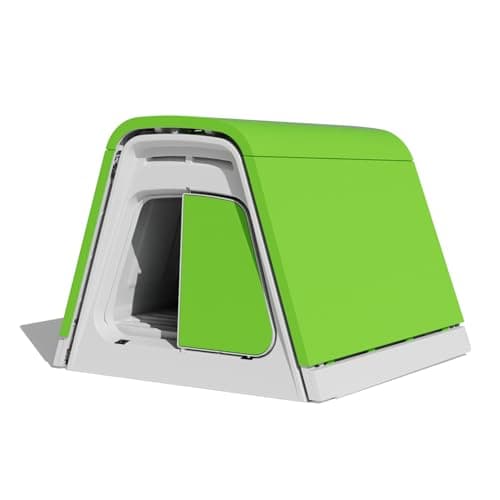
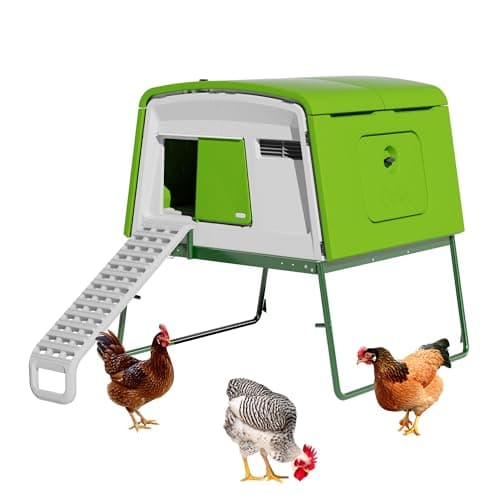
The Eglu Cube publishes 34 by 33 inches of interior, which is 7.79 square feet. Against a four-bird flock that is 1.95 square feet a hen — better than the six-bird figure of 1.30, and still around half the extension minimum. Under Omlet’s design assumption, with the run permanently attached and open, four birds in a Cube is comfortable. Under confinement it is not.

The Eglu Go publishes 25 by 25 inches, or 4.34 square feet, and states three large hens. At four birds that is 1.09 square feet each, which is the tightest figure in this whole comparison. Omlet does not claim four; the reason it appears here is that people routinely put four birds in a Go because it is the affordable one, and the arithmetic says do not.

The Producer’s Pride Sentinel publishes an external footprint of 11.70 square feet and states six chickens. For four birds the external number at least leaves room for the interior to be adequate — but since no interior area is published, that remains a hope rather than a check.

Why the run matters more at four than at six

This is counterintuitive and worth stating. At four birds you are far more likely to be within reach of the coop’s claimed capacity, which means you are more likely to treat the coop as sufficient on its own — and then the run gets built small or not at all. But the outdoor figure does not scale down: 10 square feet a bird is 40 square feet, and a four-by-ten run is a real structure.

Birds with too little outdoor space develop the behavioral problems people blame on breed: feather picking, bullying, and eventually egg eating. Space is the cheapest prevention available and it is mostly the run, not the coop.

Heads up: some links on this page are affiliate links. If you buy through one we may earn a commission at no extra cost to you. It never changes a ranking, and we take no payment for placement. The full version.

The short answer

The short list

Ranked on the published rubric. Every row jumps to that product's full write-up below; the button goes straight to Amazon.

#PickBest forKey specScorePrice
1
Score7.9

Our pick

Omlet

Eglu Cube

A plastic coop that hoses out, with published interior dimensions you can actually check — and once you check them, a six-hen claim that only works because the run is permanently attached.

Cleaning in ten minutes, not an hour7.8 sq ft interior7.9of 10
2
Score5.7

Producer's Pride

Sentinel Chicken Coop

A steel-framed wooden coop with three nest boxes and a published external footprint — and no published interior floor area or roost length, which is the pair of numbers the six-chicken claim rests on.

A first coop from a farm store shelf41.7 x 40.4 x 48.2 in5.7of 10
3
Score7.8

Omlet

Eglu Go

The small plastic coop, published at three large hens across 4.3 square feet of interior — the same 1.4 square feet a bird as the rest of the range, and the same caveat.

Three hens and a small yard4.3 sq ft interior7.8of 10

#ad No live price feed on this build yet, so every button reads “check price” rather than showing a figure we cannot stand behind. Scores are our own published rubric, not customer ratings.

Score7.9no photo yet

#1 · Cleaning in ten minutes, not an hour

Omlet Eglu Cube

A plastic coop that hoses out, with published interior dimensions you can actually check — and once you check them, a six-hen claim that only works because the run is permanently attached.

Who it is for. Somebody in a suburban yard with a permanently attached run, who values a coop that cleans in minutes and is prepared to read the six-hen figure as four.

Published specifications

Stated capacity
6 large hens or 10 small hens
Interior dimensions
H 1 ft 7 in x W 2 ft 10 in x D 2 ft 9 in
Interior floor area
7.79 sq ft, computed from the published 34 in x 33 in footprint
Floor area per hen at stated capacity
1.30 sq ft, computed from 7.79 sq ft divided by 6 hens
Nest box
Integrated; accommodates up to 3 hens laying at a time
Roosting bars
Integrated into the floor; bars measure 2.3 x 7.3 cm (about 1 in x 2.8 in)
Droppings tray
One removable slide-out tray
Runs
Detachable

Source: Omlet, Eglu chicken coop comparison table (omlet.us/misc/eglu_comparison), retrieved 2026-09-01. Floor-area figures computed from those published dimensions.

Rubric — 7.9 / 10

  • Capacity honesty5/10 · weight 26%
  • Documentation9/10 · weight 24%
  • Build and weather8/10 · weight 20%
  • Running cost9/10 · weight 15%
  • Daily use10/10 · weight 15%

What it gets right

  • Omlet publishes interior dimensions, which most coop makers do not, so the capacity claim can be checked rather than trusted
  • A wipe-clean plastic shell with a slide-out droppings tray, which changes coop cleaning from a weekend job to a ten-minute one
  • Integrated roosting bars and nest box, so there is nothing to build and nothing to buy separately
  • Detachable runs mean the coop is not locked to one footprint

What it costs you

  • 1.30 sq ft of interior floor per hen at the stated six-bird capacity, against the 3 to 4 sq ft per hen that poultry.extension.org publishes for laying hens indoors
  • That gap only closes if the attached run is genuinely always open — a Cube used as a lockable overnight coop in a snowbound week is badly overstocked
  • Omlet publishes no insulation value and no temperature rating, so cold-climate performance is a claim you cannot check

Skip it if. Your birds will be shut in for whole days in winter, or you cannot commit to leaving the run open. The interior arithmetic does not support six hens under confinement.

Check price on Amazon

#ad No live price feed yet, so no number is shown rather than a stale one. How this is funded.

Score5.7no photo yet

#2 · A first coop from a farm store shelf

Producer's Pride Sentinel Chicken Coop

A steel-framed wooden coop with three nest boxes and a published external footprint — and no published interior floor area or roost length, which is the pair of numbers the six-chicken claim rests on.

Who it is for. A first-time keeper who wants a conventional wooden coop from a store they can drive to, and who plans on three or four birds rather than six.

Published specifications

Stated capacity
Up to 6 chickens
External dimensions
41.74 in L x 40.35 in W x 48.23 in H
External footprint
11.70 sq ft, computed from the published 41.74 in x 40.35 in
Nest boxes
3 large nest boxes
Roost
Extended roosting bar; length not published
Interior henhouse floor area
Not published by the maker
Frame
Powder-coat steel frame with wooden panels
Roof
Asphalt
Door opening
12 in H x 12 in W
Weight
170 lb

Source: Producer's Pride Sentinel Chicken Coop product listing at Tractor Supply, retrieved 2026-09-01. Footprint computed from the published external dimensions.

Rubric — 5.7 / 10

  • Capacity honesty4/10 · weight 26%
  • Documentation4/10 · weight 24%
  • Build and weather7/10 · weight 20%
  • Running cost8/10 · weight 15%
  • Daily use7/10 · weight 15%

What it gets right

  • A steel frame rather than staples and thin ply, which is a genuine difference from the cheapest flat-pack coops
  • Three nest boxes is generous — University of Maryland Extension publishes one nest per four to five birds, so three covers twelve
  • Slide-out tray and a solid wood ramp are both published features
  • You can look at it in a store before buying, which is worth something on a 170 lb flat-pack

What it costs you

  • The maker publishes no interior floor area and no roost-bar length, so the six-chicken claim cannot be checked against the 6 to 10 inches of perch per bird that University of Maryland Extension publishes
  • 11.70 sq ft is the whole external footprint including the run underneath, not henhouse floor — treat it as an upper bound and nothing more
  • Asphalt roof and wooden panels need annual attention that plastic coops do not
  • 170 lb of flat pack, and assembly is required

Skip it if. You want to verify capacity before you buy. Nothing published here lets you. If that matters, buy a coop whose maker prints interior dimensions.

Check price on Amazon

#ad No live price feed yet, so no number is shown rather than a stale one. How this is funded.

Score7.8no photo yet

#3 · Three hens and a small yard

Omlet Eglu Go

The small plastic coop, published at three large hens across 4.3 square feet of interior — the same 1.4 square feet a bird as the rest of the range, and the same caveat.

Who it is for. A small urban yard, three hens, an always-open run, and an owner who genuinely will stop at three.

Published specifications

Stated capacity
3 large hens or 4 small hens
Interior dimensions
H 1 ft 5 in x W 2 ft 1 in x D 2 ft 1 in
Interior floor area
4.34 sq ft, computed from the published 25 in x 25 in footprint
Floor area per hen at stated capacity
1.45 sq ft, computed from 4.34 sq ft divided by 3 hens
Droppings tray
One removable
Runs
Available; not detachable in the way the Cube's are

Source: Omlet, Eglu chicken coop comparison table (omlet.us/misc/eglu_comparison), retrieved 2026-09-01. Floor-area figures computed from those published dimensions.

Rubric — 7.8 / 10

  • Capacity honesty5/10 · weight 26%
  • Documentation9/10 · weight 24%
  • Build and weather8/10 · weight 20%
  • Running cost9/10 · weight 15%
  • Daily use9/10 · weight 15%

What it gets right

  • The published interior dimensions again let you check the claim yourself
  • Small enough for a genuinely small yard, and light enough to move
  • Same hose-out plastic construction as the Cube

What it costs you

  • 1.45 sq ft per hen at the stated capacity, against 3 to 4 sq ft published for laying hens indoors
  • Three hens is the practical floor for a flock anyway, since chickens are social, so there is no headroom in the capacity at all
  • No published insulation or temperature data

Skip it if. You think you might want more than three birds. Almost everybody does, within a year, and this coop has no room to grow.

Check price on Amazon

#ad No live price feed yet, so no number is shown rather than a stale one. How this is funded.

FAQ

Questions people actually ask

How big should a coop be for 4 chickens?

12 to 16 square feet of coop floor, at the 3 to 4 square feet per hen published by poultry.extension.org, plus 40 square feet of run at 10 square feet a bird. Twelve square feet is a coop about three feet by four, which is smaller than most people picture and larger than many coops marketed at four birds.

How many nest boxes for 4 chickens?

One. University of Maryland Extension publishes one nest for every four to five birds, mounted 18 to 20 inches off the floor. Adding more rarely helps, because hens tend to decide collectively that one particular box is the correct one and queue for it regardless of how many you provide.

Can 4 chickens live in an Eglu Go?

Omlet states three large hens for the Go and publishes an interior of 25 by 25 inches, which is 4.34 square feet. Four birds works out at 1.09 square feet each, the tightest figure in this comparison and well under the published extension minimum. Three is the number the maker states and the arithmetic supports.

How much run space do 4 chickens need?

40 square feet, at the 10 square feet per hen that poultry.extension.org publishes for outdoor space. That is a run roughly four feet by ten. Under-building the run is the most common cause of the feather picking and bullying that people usually blame on breed or temperament.

Where the numbers came from

Sources

Every figure cited on this page came from one of these documents. If one of them has changed since we read it, the number here is out of date and we would like to know.

Keep reading